
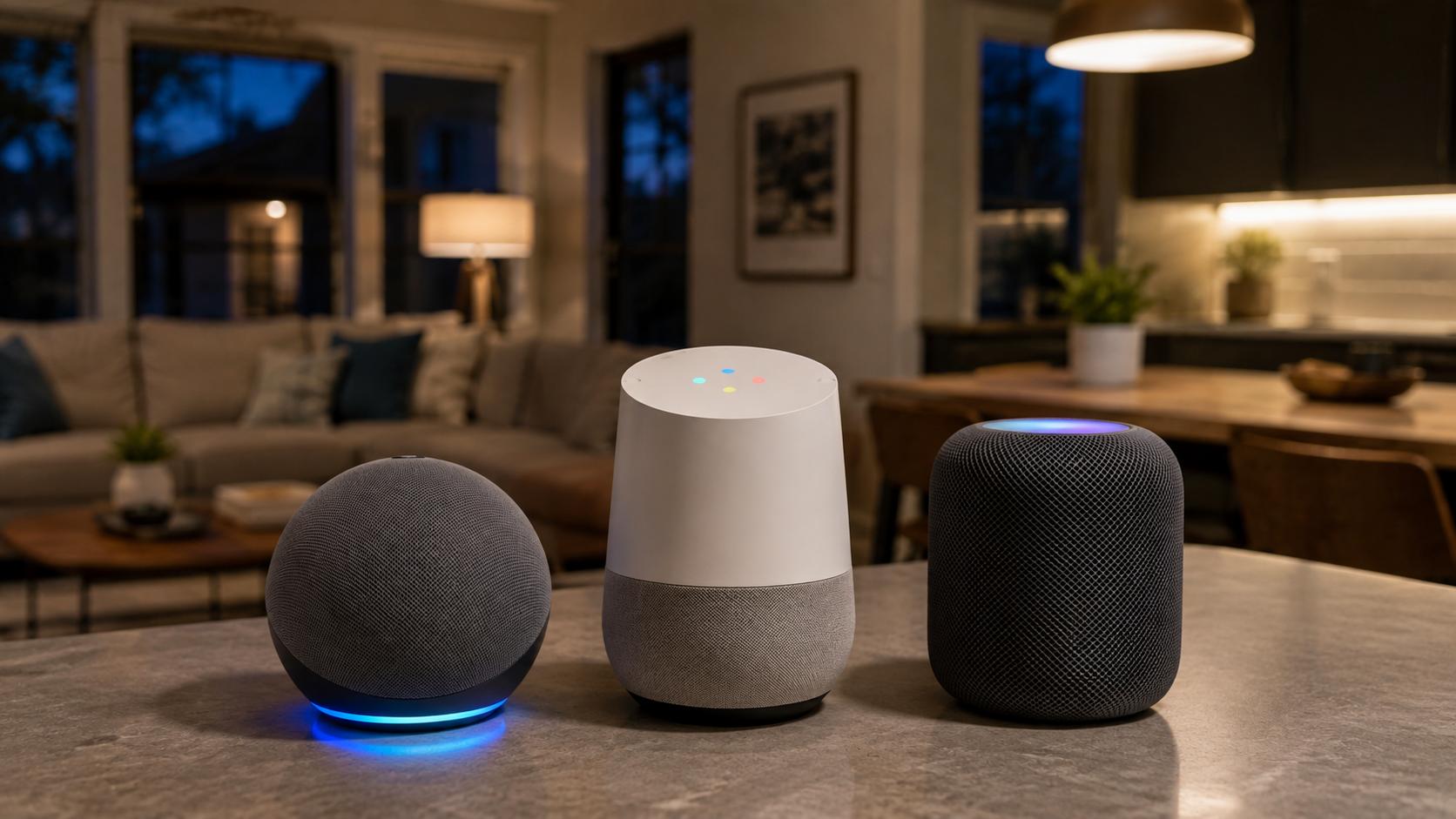
The smart speaker market has changed more in the past year than in the previous five. Both Amazon and Google have replaced their voice assistants with generative AI versions, and the differences between ecosystems now matter more than the hardware.
If you are buying a first smart speaker, or replacing one, the decision is less about sound quality than about which company you want running your home.
Here is where things currently stand.
Alexa+ replaced standard Alexa.
Amazon's AI assistant, Alexa+, spent close to a year in early access before rolling out generally. It is now available to everyone, including a free tier for people without a Prime subscription.
The pitch is more natural conversation, the ability to handle multi-step requests in a single instruction, and proactive suggestions rather than purely reactive responses.
Its strength is the breadth of the Amazon ecosystem behind it. Ring doorbells and cameras, Fire TV, Prime Video, Amazon Music and Amazon shopping all connect natively, and third-party manufacturers including Sonos, Bose and Denon have built Alexa into their own speakers.
Gemini has replaced Google Assistant.
Google has moved in the same direction, replacing Google Assistant with Gemini across its devices. Gemini for Home began an early access phase in late 2025 and has expanded since.
Google launched a new speaker built specifically for it, the Google Home Speaker, priced at around £100 and available in the UK in Porcelain and Hazel finishes, which reached shelves in late June 2026.
Gemini's advantages lie where Google is strongest: search, YouTube, Gmail and Android integration. For finding information or surfacing content, it is generally considered the stronger of the two.
One important caveat: getting the fullest Gemini experience requires a Google Home Premium subscription, quoted at around £8 a month, which is a running cost the hardware price does not reveal.
Google Assistant is being switched off.
This is the point that will catch people out, and it deserves attention.
Google Assistant is being fully retired during 2026, disappearing from Android phones and tablets, with the standalone iOS app also going away.
That matters because a great many older devices — soundbars, televisions, older smart plugs and lighting systems — rely on Google Assistant, and several require the Assistant app for initial setup.
Manufacturers of out-of-support devices are unlikely to update them for Gemini. If you own older kit that depends on Assistant, check whether it will continue to work, because the alternative may be replacing hardware that functions perfectly well.
Apple sits apart.
Apple's HomePod and HomePod mini run Siri, and Apple has introduced its own AI version of the assistant.
Apple's ecosystem is smaller in smart home terms and works best if your household is already substantially Apple-based. Its privacy positioning has historically been stronger than its competitors, with more processing performed on device.
Third-party smart home device support through Apple Home is narrower than Alexa or Google, though the Matter standard has narrowed that gap.
Matter reduces the lock-in slightly.
Matter is a cross-industry smart home standard designed so that devices work across ecosystems rather than being tied to one.
A Matter-certified bulb, plug or sensor should work with Alexa, Google Home and Apple Home alike. Support is not universal and implementation varies, but buying Matter-certified devices where possible gives you more freedom to change assistant later.
Thread, a related low-power networking standard, appears alongside Matter on many newer devices and requires a compatible hub or border router.
Privacy deserves genuine thought.
Neither Alexa+ nor Gemini is privacy-first in any meaningful sense. Both rely on personal data, contextual awareness and behavioural learning to deliver what they promise.
Amazon attracted specific criticism during the Alexa+ rollout for removing the option preventing voice recordings being sent to its servers, a setting some users had relied on.
Anyone uncomfortable with that should review the privacy settings available in whichever app they use, understand what is retained and for how long, and consider whether a smart speaker belongs in bedrooms or a home office where sensitive conversations happen.
Microphone mute buttons on the devices themselves are physical and worth using.
Practical advice before buying.
Start by auditing what you already own. If your household runs on Prime, Fire TV and Ring, Alexa+ is the path of least resistance. If it runs on Android, YouTube and Google accounts, Gemini makes more sense.
Check whether the features you actually want require a subscription, since both companies are moving in that direction.
Buy one speaker first and live with it for a month before expanding. Ecosystem decisions become expensive to reverse once you own a dozen bulbs and plugs.
Where to buy locally.
The major electrical retailers in Newcastle city centre and at the Metrocentre, Silverlink and Kingston Park all stock the main devices, and being able to hear a speaker before buying is genuinely useful given how much the audio quality varies.
Discount events including Amazon's Prime Day and Black Friday consistently produce the lowest prices on Echo devices in particular, so timing a purchase is worthwhile.
Refurbished and open-box units are widely available and generally carry a warranty, which makes them a reasonable option for a first speaker.
Share your thoughts.
Which assistant runs your house, and would you switch?
Tech News
Alexa+, Gemini or Siri: Choosing a Smart Home Assistant
Both Amazon and Google have replaced their voice assistants with AI versions, and the choice now locks you into an ecosystem more firmly than before.
Advertisement





Comments (0)
You must be logged in to post comments.
Don't have an account? Register here
No comments yet. Be the first to share your thoughts!