
Long before Newcastle existed, the Romans held this northern frontier of their empire, guarding it with forts and the great wall that bears the name of the Emperor Hadrian. At the mouth of the Tyne stood one of the most important of these forts, a great supply base that fed and equipped the garrison of the frontier. The fort known as Arbeia, at South Shields, is a remarkable survival from the age of Roman Britain, and its story takes us back nearly two thousand years.
The Roman Frontier.
In the second century, the Romans established their northern frontier across the neck of Britain, building the great wall that ran from coast to coast to mark the edge of their empire and to control movement across it. This frontier was garrisoned by soldiers drawn from across the Roman world, and it required a vast system of supply to keep the troops fed, equipped and provisioned. The forts of the frontier were not isolated outposts but part of an elaborate military system, connected by roads and supported by supply bases. At the eastern end of this frontier, where the Tyne met the sea, stood the fort that would play a vital role in supplying the garrison of the wall.
A Great Supply Base.
The fort at South Shields was developed as a major supply base, a depot through which provisions were gathered, stored and distributed to the troops of the frontier. Its position at the mouth of the Tyne made it ideally suited to this role, for supplies could be brought in by sea and then distributed along the frontier. The fort was filled with granaries, great storehouses in which grain and other provisions were kept, reflecting its importance as a supply depot. From here, the food and equipment needed to sustain the garrison of the frontier were gathered and sent out, making the fort a vital link in the military system of the Roman north. It was a place of great strategic importance.
Soldiers from Afar.
The garrison of the fort, like that of the frontier as a whole, was drawn from across the vast Roman empire. The Roman army recruited soldiers from many lands, and the troops stationed at the fort came from distant parts of the empire, bringing with them the diverse origins and cultures of the Roman world. Among those associated with the fort were soldiers and others from far-off regions, a reminder of the extraordinary reach of the Roman empire and the diversity of those who served on its frontiers. The presence of these people from distant lands, here on the northern edge of the Roman world, speaks to the cosmopolitan character of the empire and the long distances that its service could carry people.
The Life of the Fort.
The fort was not only a military installation but a community, home to soldiers and to the people who lived and worked alongside them. Within and around the fort there developed the life of a frontier community, with all the activities of supply, trade, craft and daily living that such a settlement involved. The soldiers went about their duties of guarding the frontier and managing the supplies, while around them grew the ordinary life of a community on the edge of the empire. The fort was a place of work and habitation as well as of military purpose, and the traces of this life, uncovered by excavation, give us a vivid picture of the frontier in the Roman age. It was a living community as well as a military base.
Rediscovering the Past.
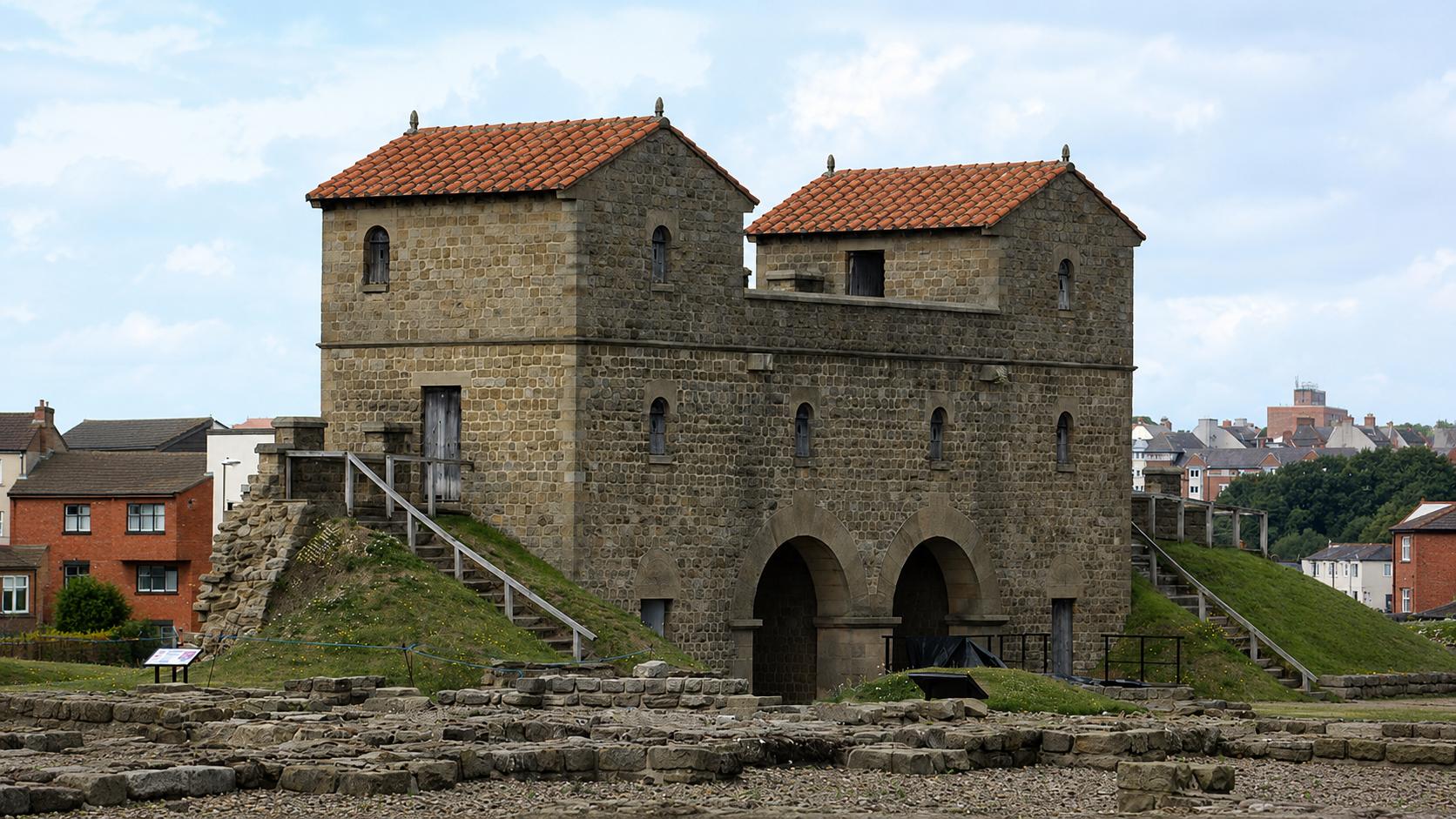
The fort at South Shields lay buried and largely forgotten for many centuries after the end of Roman Britain, until it was rediscovered and excavated, revealing its remarkable remains. The excavation of the site uncovered the foundations of the fort, its buildings and a wealth of objects that shed light on the life of the Roman frontier. Among the most striking results of this work was the reconstruction of parts of the fort, including a great gatehouse, built upon the original foundations to show how the fort would have appeared in the Roman age. These reconstructions, rising above the excavated remains, bring the Roman fort vividly to life and allow visitors to glimpse the appearance of this frontier stronghold.
A Window on Roman Britain.
The fort at South Shields is one of the most important and evocative Roman sites in the region, offering a remarkable window on the age of Roman Britain. The excavated remains, the reconstructed buildings and the objects recovered from the site combine to tell the story of this great frontier fort and the role it played in guarding and supplying the northern edge of the empire. To visit the site is to step back nearly two thousand years, to the age when the Romans held this frontier and when soldiers from across the empire served here at the mouth of the Tyne. The fort is a precious link to the deep history of the region, a reminder of the Roman age that shaped these lands.
An Ancient Heritage.
The Roman fort at South Shields is a treasure of the region's ancient heritage, a survival from the age of Roman Britain that connects us to a past of extraordinary depth. The great supply base that once fed the garrison of the frontier, garrisoned by soldiers from across the empire and humming with the life of a frontier community, has been rediscovered and brought to life through excavation and reconstruction. It stands today as one of the region's most important Roman sites, a window on a distant age and a reminder of the long and remarkable history of these lands. The fort connects us to the Roman world and to the ancient origins of the region, a heritage of which we can be truly proud.
The Edge of an Empire.
To stand at the site of the Roman fort at South Shields is to stand at what was once the very edge of one of the greatest empires the world has known, a frontier that marked the limit of Roman power. The Roman empire, at its height, stretched across a vast expanse of territory, encompassing many lands and peoples, and its northern frontier in Britain marked the furthest extent of its power in this part of the world.
The fort at the mouth of the Tyne stood at this frontier, guarding and supplying the troops who held the edge of the empire against the lands beyond. This position at the edge of the empire gave the fort a particular significance, for it stood at the meeting point of the Roman world and the lands that lay outside it. The frontier was not merely a military line but a zone of contact, trade and interaction between the Roman world and the peoples beyond, and the fort played a part in this frontier life.
The soldiers who served here, drawn from across the empire, guarded the frontier and maintained the Roman presence at the edge of the known world. The remains of the fort, and the objects recovered from it, bring this frontier world vividly to life, allowing us to glimpse the realities of life at the edge of the empire nearly two thousand years ago. To contemplate the fort and its position at the frontier is to appreciate the extraordinary reach of the Roman empire and the role that these northern lands played in its history.
The fort at South Shields connects us to this frontier world and to the age when the region stood at the edge of a great empire, a heritage of remarkable depth and significance that reminds us of the ancient origins of the region and its place in the wider history of the Roman world.
Share your thoughts.
The Roman fort at South Shields was a great supply base for the garrison of the northern frontier.
Have you visited the reconstructed Roman fort and stepped back into the age of Roman Britain?
Newcastle History
Gateway to the Wall: Arbeia Roman Fort
The story of Arbeia, the Roman fort at South Shields that served as a great supply base for the garrison of the northern frontier nearly two thousand years ago.
Advertisement

Comments (0)
You must be logged in to post comments.
Don't have an account? Register here
No comments yet. Be the first to share your thoughts!