
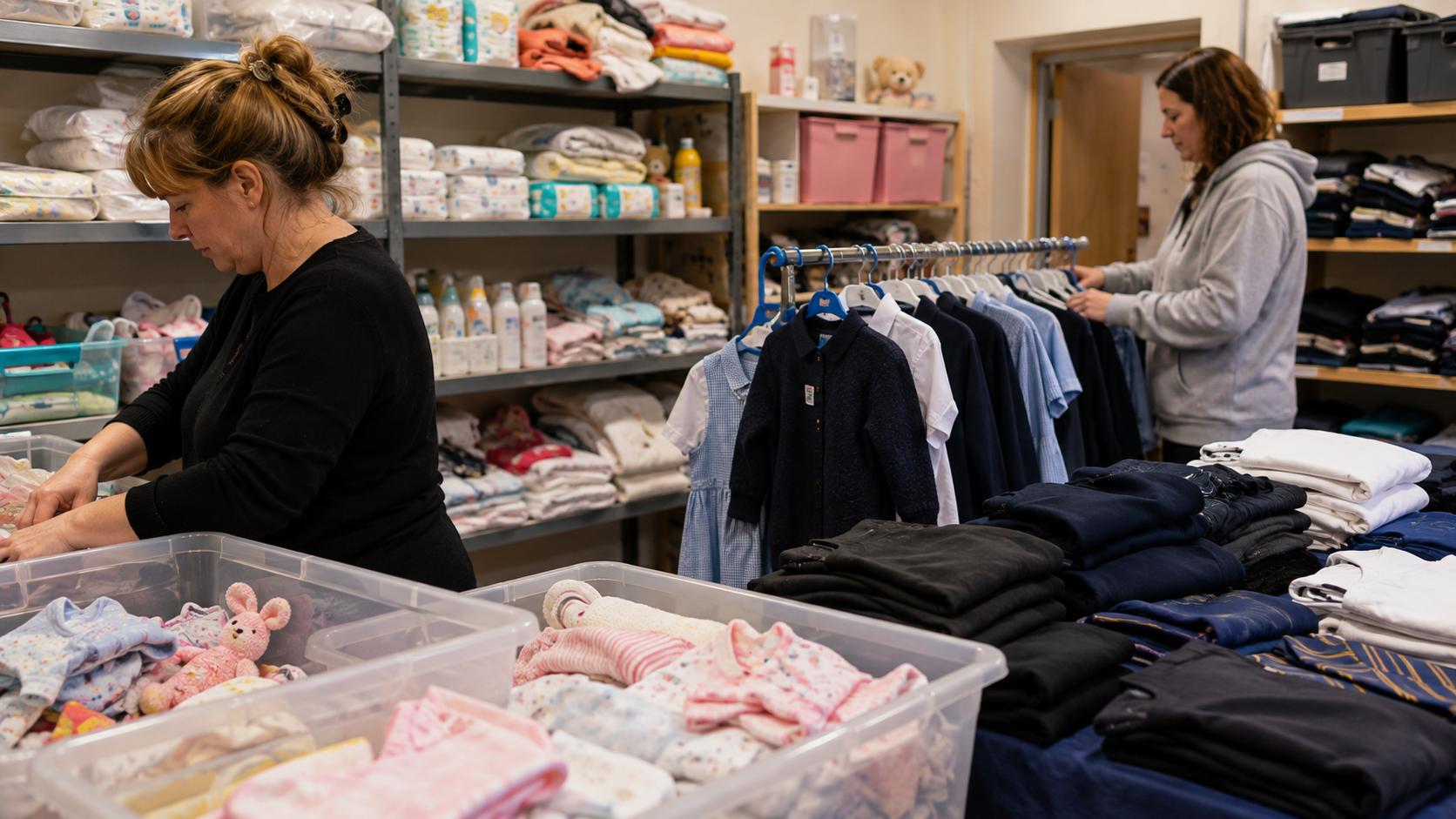
Alongside foodbanks, two other forms of practical support have expanded rapidly across Britain: baby banks providing equipment and clothing for young children, and uniform exchanges recycling school clothing.
Both address the same underlying problem. Children grow, essentials are expensive, and the costs arrive whether or not a household can meet them.
Here is how each works.
Baby banks provide equipment as well as clothes.
A baby bank collects, sorts and redistributes items for babies and young children, generally free of charge to families referred to them.
Typical provision includes clothing, cots, moses baskets, prams, high chairs, blankets, bedding, nappies, wipes, toiletries, bottles, sterilisers, toys and books.
Some operate as standalone charities, some through churches or community centres, and some alongside foodbanks. The national Little Village model operates in several areas, and independent baby banks are widespread.
Access is usually by referral.
Most baby banks work through referral from a professional already involved with the family: a midwife, health visitor, GP, social worker, family hub, school or support charity.
That approach allows the service to reach families most in need and to be linked to wider support, though some projects operate open access.
Referrals are generally straightforward and quick. Anyone struggling to afford essentials for a baby should raise it with their midwife or health visitor, who will know what is available locally.
Certain items are never accepted.
Baby banks operate safety rules that surprise donors, and they are not arbitrary.
Car seats are almost universally refused, because a seat involved in a collision may be structurally compromised in ways that cannot be seen, and history cannot be verified for a donated seat.
Mattresses are generally not accepted second-hand, following safer sleep guidance which recommends a firm, flat, clean and preferably new mattress for each baby.
Items subject to safety recalls, damaged equipment and anything missing parts or instructions are also declined. Projects publish their own lists, and checking before collecting a car boot of donations saves everyone time.
What is genuinely needed.
Clothing in good condition, washed and sorted by size, is always useful, with larger sizes for toddlers and older children frequently in shorter supply than newborn items.
Nappies, wipes and toiletries are consistently in demand and cannot generally be obtained through food provision.
Cash donations allow projects to buy items they cannot accept second-hand, particularly mattresses, and to cover storage, transport and insurance.
Uniform exchanges work differently.
School uniform exchanges collect outgrown uniform, sort and clean it, and make it available to other families, usually free or for a nominal sum.
Some are run by schools directly, some by parent-teacher associations, and some by independent community groups covering several schools.
Availability tends to peak in July and August as families clear out at the end of the school year, and demand peaks at the same time, so many exchanges run events immediately before the start of term.
Schools have obligations on cost.
Statutory guidance in England requires schools to keep the cost of uniform down and to ensure that branded items are kept to a minimum.
Schools are also expected to ensure second-hand uniform is available and that parents are made aware of how to access it.
That means asking the school about second-hand provision is entirely legitimate, and schools should have an answer. Where a school requires numerous branded items available only from a single supplier, that is worth raising.
Some local authorities and charities operate grant schemes towards uniform costs, and eligibility varies, so it is worth checking what applies locally.
Both models rely on volunteers.
Sorting, washing, checking, storing and distributing donated items is labour-intensive, and both baby banks and uniform exchanges depend almost entirely on volunteers.
Roles include sorting and quality-checking, laundry, packing, collections and deliveries, admin and organising events.
Storage is the other persistent constraint. Donated space from businesses, churches and community buildings is frequently what makes a project viable.
Why the demand exists.
Both movements have grown in response to sustained pressure on household budgets, with the cost of children's essentials rising alongside everything else.
Baby equipment in particular is expensive and used briefly, which makes reuse both economically sensible and environmentally preferable regardless of household income.
Several projects deliberately position themselves as open to any family rather than as poverty relief, on the basis that reuse benefits everyone and reduces stigma for those who need it most.
Finding one locally.
Health visitors, midwives, family hubs and children's centres will know what operates in a specific area.
Schools can advise on uniform exchanges, and many run their own. Local authority websites frequently list family support services.
For anyone with outgrown clothing or unused equipment, contacting a project before dropping items off is worthwhile, since needs and capacity change week to week.
Share your thoughts.
Does your school run a uniform exchange, and is it well used?
Community News
Baby Banks and School Uniform Exchanges
Two grassroots movements have grown quickly in response to the same problem: essentials for children costing more than families can manage.
Advertisement



Comments (0)
You must be logged in to post comments.
Don't have an account? Register here
No comments yet. Be the first to share your thoughts!