
Water is one of the few household costs people rarely examine. It arrives, it goes, and the bill is paid without much thought about where the usage actually comes from.
That is worth revisiting, both because reducing water use lowers bills for metered households and because it reduces the energy used to heat it, which is where much of the real cost sits.
Here is where household water actually goes and what genuinely makes a difference.
Know whether you are metered.
The single most important question is whether you pay by meter or by rateable value.
Unmetered customers pay a fixed amount based on the property's old rateable value, regardless of how much they use. In that case, reducing consumption saves energy for heating water but does not directly reduce the water bill.
Metered customers pay for what they use, so every reduction shows up. As a general rule, households with fewer occupants than bedrooms often benefit from a meter, while large families in small properties frequently do not.
Most suppliers, including Northumbrian Water in this region, allow customers to request a meter, and there is usually a trial period during which you can revert if the bill turns out higher. Check current terms before switching.
The bathroom uses most of it.
Across a typical household, the largest single share of water goes on toilets, showers and baths. Washing machines and outside use account for much of the rest.
That means bathroom habits are where the meaningful savings sit, and small changes there outweigh careful behaviour everywhere else.
Turning off the tap while brushing teeth is genuinely worthwhile, but it is not going to transform a bill on its own.
A leaking toilet is the hidden culprit.
This is the one most people have never checked, and it is the biggest single avoidable waste in many homes.
A toilet with a faulty flush valve can trickle water continuously into the pan, silently, day and night. Because it makes no sound and leaves no puddle, it can continue for years.
The test is simple. Wipe the back of the pan dry above the water line, then place a dry piece of toilet paper against it. Leave it for half an hour without flushing. If the paper is wet or has slipped down, water is running.
Repairs are usually inexpensive, involving a new flush valve or washer, and the saving on a metered supply can be considerable.
Showers are not automatically better than baths.
A short shower uses less water than a bath. A long shower under a powerful electric or power shower can easily use more.
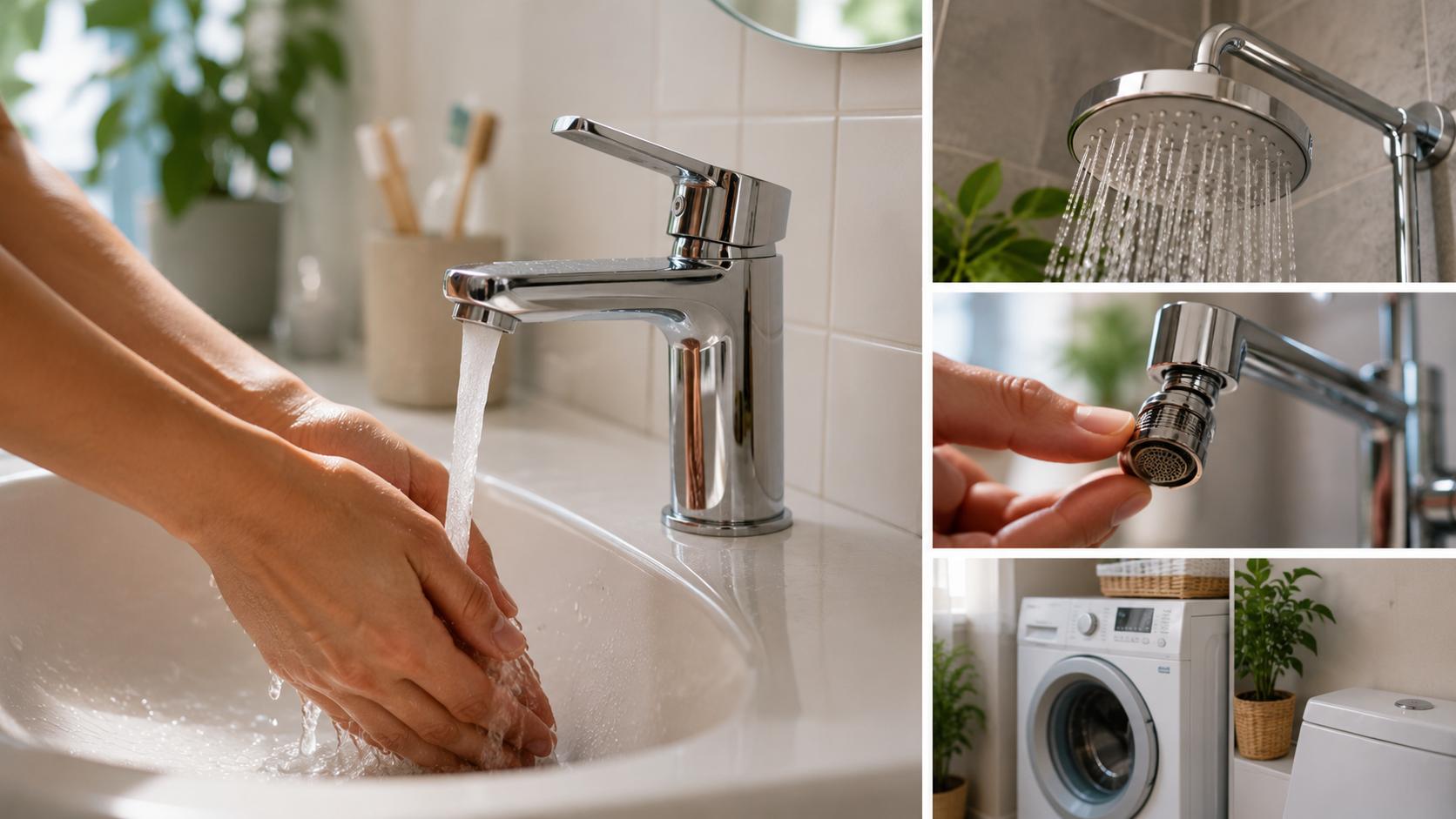
The variable is flow rate and duration rather than the fact of showering. A water-efficient shower head reduces flow while maintaining the feel of the spray, and many suppliers give these away free.
Reducing shower time by a couple of minutes is the simplest change and makes a measurable difference to both water and heating costs.
Free devices are widely available.
Water companies across the UK offer free water-saving devices to customers, typically including shower heads, tap aerators, cistern displacement bags and shower timers.
The cistern bag sits in the toilet cistern and displaces a small volume, so each flush uses slightly less. They are only suitable for older, larger cisterns, since modern low-volume ones may not flush properly with less water.
Check your supplier's website, as the range offered changes and registration is usually straightforward.
Appliances matter more than rinsing.
A modern dishwasher run full generally uses less water than washing the equivalent load by hand under a running tap.
Washing machines and dishwashers should be run with full loads wherever possible. Half-load settings rarely use half the water.
When replacing an appliance, water consumption per cycle is listed alongside energy efficiency and is worth comparing, particularly for a machine that will be in use for a decade.
Outside use spikes in summer.
Garden watering, paddling pools and pressure washers can cause a sharp increase in summer, which is precisely when supply is under most pressure.
A water butt collecting roof runoff costs little and provides free water that plants generally prefer to treated tap water. Suppliers sometimes offer them at discounted rates.
Watering in the early morning or evening reduces evaporation, and watering deeply but less often encourages roots to grow downwards, producing more resilient plants.
Established lawns do not need watering. Grass browns in dry weather and recovers when rain returns, which it reliably does in the North East.
Help is available if you are struggling.
Water companies operate schemes for customers who use more water for medical reasons or who have large families on certain benefits, capping bills at a set level. These are generally known as WaterSure or similar.
Social tariffs providing reduced bills for low-income households are also available, though eligibility criteria vary by company.
Leak allowances may be available where a hidden underground leak has caused an unexpectedly high bill. Contact your supplier rather than simply paying an unexplained increase.
Small changes accumulate.
Fixing a dripping tap, keeping a jug of water in the fridge rather than running the tap cold, and using a bowl for washing up rather than a running tap are all marginal individually.
Together with a shorter shower and a working toilet valve, they add up to a genuinely noticeable reduction.
For a region with a relatively secure supply, the argument is less about scarcity than about cost, energy and simply not wasting something that took considerable effort to deliver.
Share your thoughts.
Have you ever checked whether your toilet is leaking?
Lifestyle News
Cutting Your Water Use at Home
Most households could cut water use noticeably without any change they would actually notice day to day, starting with a leak nobody can hear.
Advertisement



Comments (0)
You must be logged in to post comments.
Don't have an account? Register here
No comments yet. Be the first to share your thoughts!