
How much exercise a dog needs is one of the most frequently asked and least usefully answered questions in pet ownership.
The honest answer is that it varies enormously with breed, age, health and individual temperament, and that quality matters at least as much as duration.
Here is a practical guide, including the hazards specific to walking dogs in this region.
Breed and age set the baseline.
Working breeds bred for endurance — collies, spaniels, pointers, huskies — generally need considerably more than companion breeds, and they need mental work as well as physical.
Flat-faced breeds including pugs, French bulldogs and English bulldogs have restricted airways and are far less tolerant of exertion and heat. They need shorter, gentler activity and require particular care in warm weather.
Giant breeds and heavier dogs are more prone to joint problems, and repeated high-impact activity can cause harm.
For puppies, a widely used guideline suggests around five minutes of formal exercise per month of age, twice daily, until fully grown. It is a rule of thumb rather than a scientific standard, but the principle behind it is sound: growth plates are still developing, and excessive or high-impact exercise in a young dog carries risk.
Older dogs still need activity, adapted to their capability. Shorter, more frequent walks generally suit stiff joints better than one long outing.
Mental exercise tires dogs efficiently.
A dog given demanding mental work is frequently more settled afterwards than one walked further.
Scent work is the most accessible option. Scattering food in grass, hiding treats around the house or letting a dog sniff at its own pace on a walk all engage the part of the brain dogs use most.
A sniffing walk at the dog's pace is genuinely more tiring than a brisk march covering more ground, and it suits dogs recovering from injury or with limited mobility.
Training sessions, puzzle feeders and chew items all contribute.
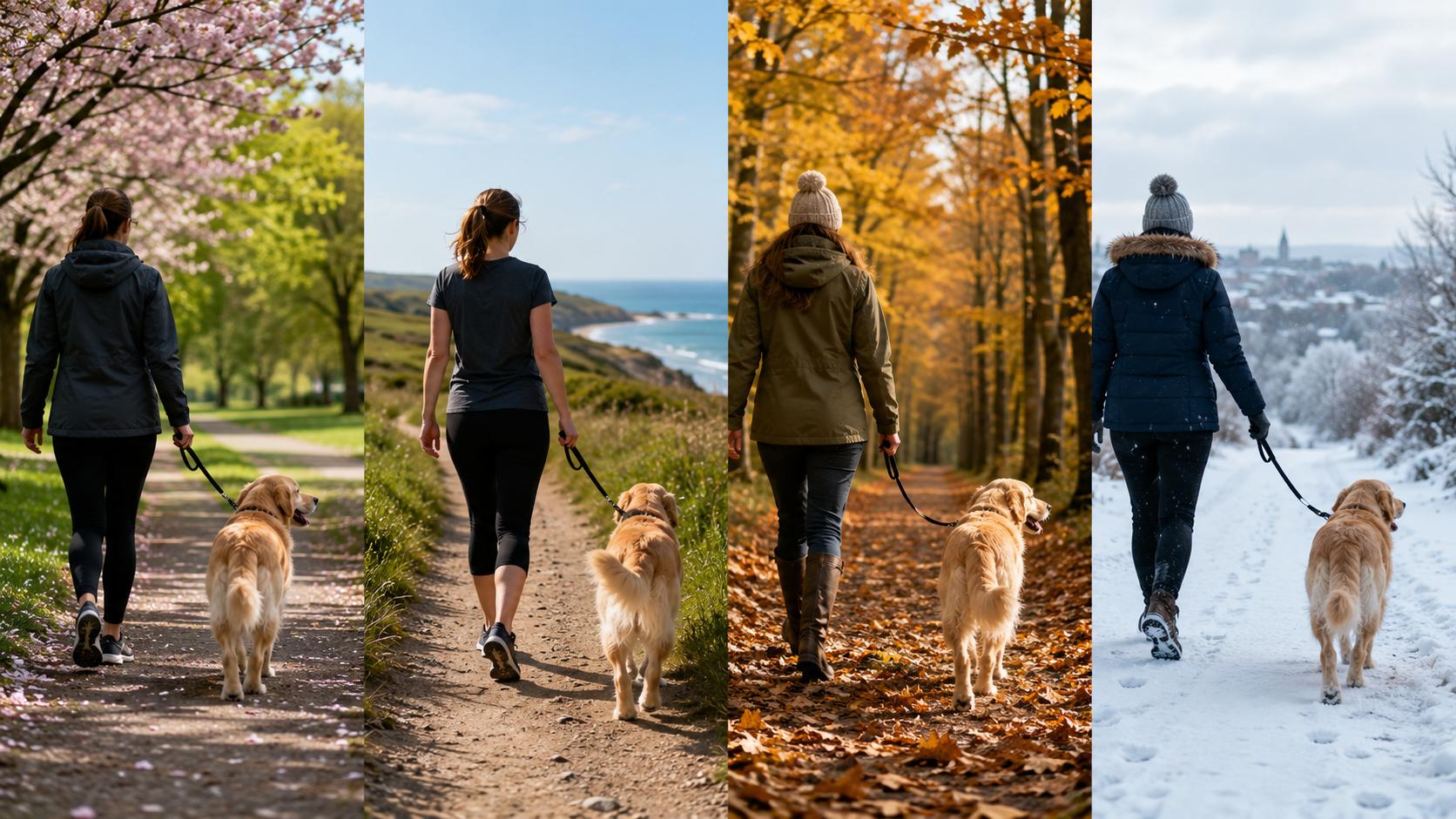
Heat is the most serious seasonal risk.
Dogs cool themselves primarily by panting, which is far less efficient than sweating, and heatstroke can be fatal.
Walk early morning or late evening in warm weather. Pavement and tarmac retain heat long after the air has cooled, and can burn paw pads. The back of your hand held against the surface is the standard test.
Never leave a dog in a car in warm weather, including in shade with windows open, as internal temperatures rise extremely quickly.
Signs of heatstroke include heavy panting, drooling, distress, unsteadiness, vomiting and collapse. Move the dog to shade, offer water and begin cooling with cool water, and contact a vet immediately.
Water carries its own hazards.
Blue-green algae, more accurately cyanobacteria, can form blooms on still and slow-moving fresh water in warm weather, and can be rapidly fatal to dogs that drink or swim in affected water.
It appears as a green or blue-green scum on the surface, and warnings are usually posted at affected sites. Reservoirs, ponds and slow rivers across the region can be affected during warm spells.
If in doubt, keep the dog out. There is no antidote, and dogs can become seriously unwell within minutes.
Coastal swimming brings other considerations, including currents, cold water shock and, on the North East coast, occasional strong rip currents. Rinse salt and sand off afterwards.
Livestock is a legal matter.
Sheep worrying is a serious offence, and dogs can lawfully be shot by farmers protecting livestock in certain circumstances. Legislation on livestock worrying has been strengthened, with substantial penalties available.
Across Northumberland and County Durham, dogs should be on a lead near livestock, and particular care is needed during lambing season in spring.
Newcastle's Town Moor is grazed by cattle, and dogs must be under control there. If cattle approach while you have a dog, the standard advice is to let the dog off the lead so it can escape, and to move away yourself rather than trying to protect the animal.
Countryside Code guidance applies across the region's access land, including restrictions on ground-nesting bird sites during the breeding season.
Local access rules vary.
Several North East beaches, including popular stretches at Tynemouth and Whitley Bay, operate seasonal dog restrictions, typically through the summer months, with dogs permitted outside those dates or on specified sections.
Check current signage and the relevant council's website, since restrictions and boundaries change.
Public spaces protection orders operated by local authorities set requirements on leads, exclusion areas and fouling, and breaching them can result in a fixed penalty.
Dogs travel free on the Tyne and Wear Metro, which makes coastal and country walks accessible without a car.
Other seasonal hazards.
In summer, grass seeds can penetrate paws, ears and eyes, particularly in long-coated dogs, and frequently require veterinary removal. Check between the toes after walks in long grass.
Adders are Britain's only venomous snake and are present in parts of Northumberland, particularly on heathland and moorland in spring and summer. Bites are a veterinary emergency.
In autumn, conkers and acorns are toxic if eaten. Some fungi are dangerous.
In winter, road salt and grit irritate paws and are harmful if licked off, so rinsing paws after walks is worthwhile. Antifreeze, discussed elsewhere, is a serious risk. Reduced daylight makes reflective gear and a lit collar genuinely useful on Newcastle's darker parks and paths.
Share your thoughts.
Where is your favourite dog walk in the North East?
Lifestyle News
Exercising Your Dog Safely Through the Seasons
How much exercise a dog needs varies enormously, and the North East throws up specific seasonal hazards worth knowing about.
Advertisement




Comments (0)
You must be logged in to post comments.
Don't have an account? Register here
No comments yet. Be the first to share your thoughts!