
Food aid in Britain has grown from a handful of church-run projects into a substantial network operating in almost every town and city.
The terms used are often interchangeable in conversation, but foodbanks and community pantries work in genuinely different ways, and knowing which is which matters both for people seeking help and for anyone wanting to support them.
Here is how each operates.
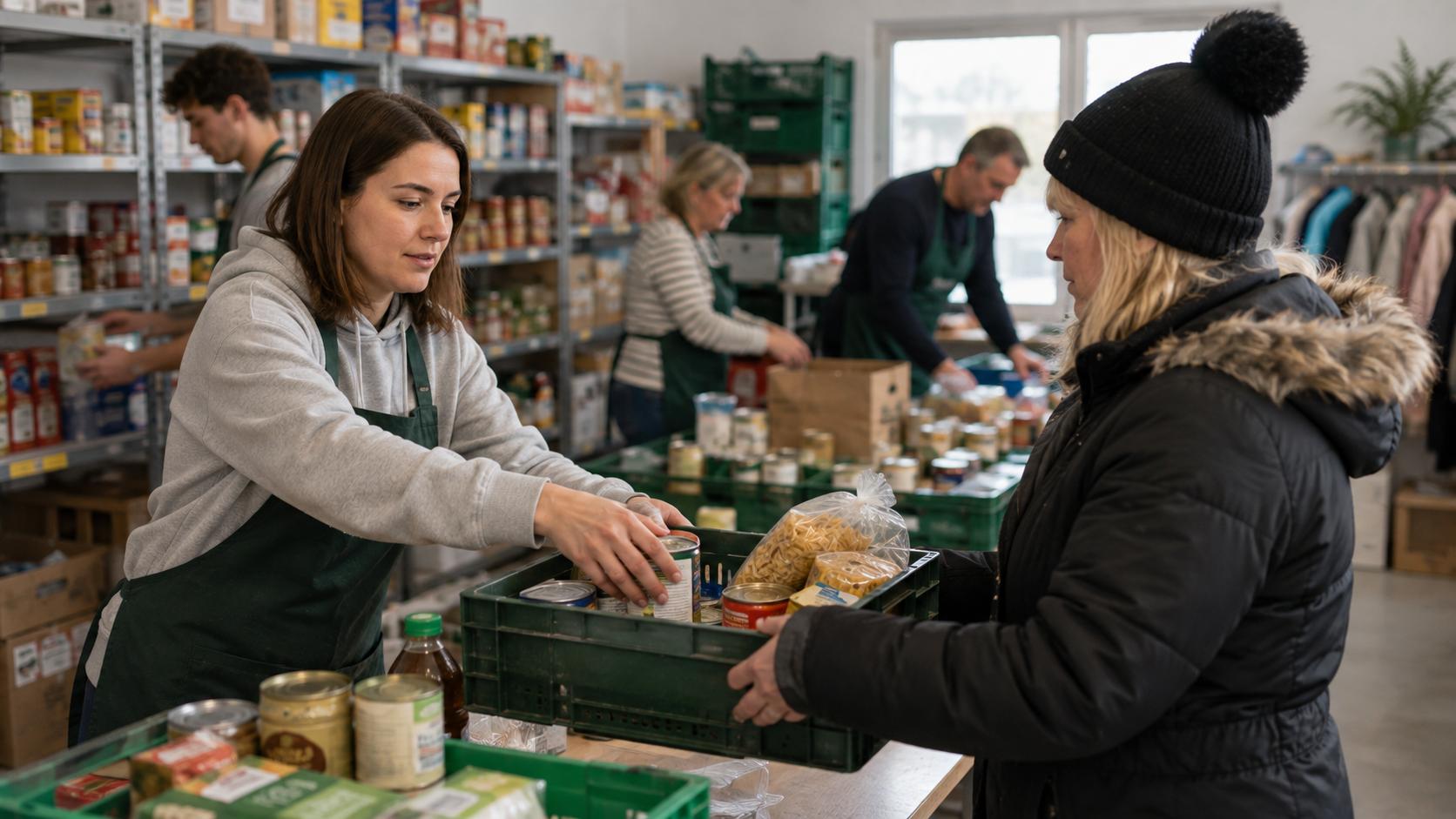
Foodbanks generally work by referral.
The best-known model provides emergency food parcels to people in crisis, usually accessed through a referral rather than by walking in.
Referrals come from agencies already working with the household: GPs, health visitors, schools, social workers, Citizens Advice, housing associations, and in some areas the local authority welfare team.
The referral produces a voucher or code that can be exchanged for a parcel. A standard parcel is designed to provide several days of food for the household size specified.
Not every foodbank uses referrals. Independent projects, many of them church or community-run, operate open-door models where anyone can attend.
There are two main networks, plus many independents.
Trussell, formerly the Trussell Trust, supports a large network of foodbanks operating a common referral model and publishes regular statistics on parcels distributed.
The Independent Food Aid Network represents independent foodbanks, which operate their own arrangements and are frequently smaller and locally rooted.
Beyond both, a substantial number of projects run through churches, mosques, community centres and mutual aid groups without formal affiliation to either.
Newcastle's West End Foodbank has been among the largest in the country by volume of provision, and the North East as a region has consistently recorded some of the highest rates of food parcel distribution.
Community pantries work on membership.
A pantry, sometimes called a social supermarket, operates on a different principle. Rather than emergency parcels, members pay a small weekly subscription and choose a set number of items from what is available.
Typical arrangements involve a few pounds a week for a basket worth considerably more, with members selecting their own items rather than receiving a pre-packed parcel.
The model is designed to be used regularly rather than in a crisis, to preserve dignity through choice, and to reduce the stigma some people report in accessing emergency provision.
Pantries frequently source surplus stock from retailers and redistribution organisations, which is why availability varies week to week.
The difference matters practically.
A foodbank parcel is short-term crisis support, usually limited in how often it can be accessed, and generally accompanied by an offer of advice on the underlying problem.
A pantry membership is ongoing and intended to reduce weekly shopping costs for households on tight budgets, without any assessment of crisis.
Many areas now have both, and projects increasingly refer between one another according to what a household needs.
Advice is often the more valuable part.
Most established food aid projects now offer or host advice services alongside food, because food need is generally a symptom rather than the underlying problem.
Common causes include benefit delays or changes, sanctions, low or irregular earnings, sudden costs such as a broken appliance, debt, and relationship breakdown.
Advisers can check benefit entitlement, challenge decisions, arrange fuel vouchers and negotiate with creditors. A significant proportion of people referred are found to be missing entitlements they qualify for.
Anyone using a foodbank should ask what advice provision is attached, since resolving the cause is what prevents repeat visits.
What to donate.
Projects publish their own shortage lists, and those lists change constantly. Checking before shopping is more useful than assuming.
Items consistently in demand include tinned meat and fish, tinned vegetables and fruit, long-life milk, rice, pasta sauce, tinned pulses, coffee, and food that requires little cooking for people without a working cooker or with limited fuel.
Non-food items are frequently the greatest gap: nappies, period products, toothpaste, washing powder, shampoo and toilet roll cannot be bought with most food vouchers and are always needed.
Check dates before donating, and avoid anything requiring extensive preparation, refrigeration or a great deal of energy to cook.
Money often goes further than tins.
Most projects will say, if asked, that financial donations are more useful than food.
Cash allows a project to buy exactly what is short that week, at wholesale prices, and covers costs that donated food does not: rent, transport, insurance, refrigeration and staff.
Regular monthly giving is particularly valuable because it allows planning, and Gift Aid adds to the value at no cost to the donor.
Volunteering is the other need.
Projects run on volunteers, and roles extend well beyond sorting tins: driving and collections, warehouse work, reception, advice, admin and fundraising.
Commitments are usually flexible, and training is provided for anything requiring it.
For anyone wanting to help locally, contacting a project directly is the quickest route, and most publish current volunteering needs on their websites and social media.
Where to find help.
Anyone struggling to afford food should speak to their GP surgery, school, health visitor or Citizens Advice, all of which can refer.
Local authorities also operate schemes providing emergency support for essentials such as food and fuel, and eligibility is not always as narrow as people assume.
Nobody should go without food while waiting to establish which service is technically correct. Contacting any one of them will generally lead to the right place.
Share your thoughts.
Does your area have a community pantry as well as a foodbank?
Community News
Foodbanks and Community Pantries: How They Work
Foodbanks and community pantries operate on quite different models, and understanding the difference matters for anyone seeking help or offering it.
Advertisement





Comments (0)
You must be logged in to post comments.
Don't have an account? Register here
No comments yet. Be the first to share your thoughts!