
Ask somebody in Newcastle where to go for a day out and they will point north to Northumberland or west to the Wall. Almost nobody points south past Durham, and the Tees valley and the Hartlepool coast remain among the least visited parts of the region by people who live an hour away.
That is a gap in local knowledge rather than a reflection of what is there. The area has one of the most remarkable historic ships in the country, a Victorian pier with a working cliff lift, an internationally important wetland reserve and an industrial landscape that is genuinely extraordinary to look at.
Getting there is straightforward.
Trains run south from Newcastle on the Durham Coast Line to Hartlepool, taking around an hour, and continue to Seaton Carew, Middlesbrough and beyond towards Saltburn.
By road, the A19 south is the direct route and takes a similar time outside peak periods.
The rail option has a particular advantage here, since the line runs close to the coast for much of the way and the stations are within walking distance of most of what you would want to see.
The National Museum of the Royal Navy at Hartlepool.
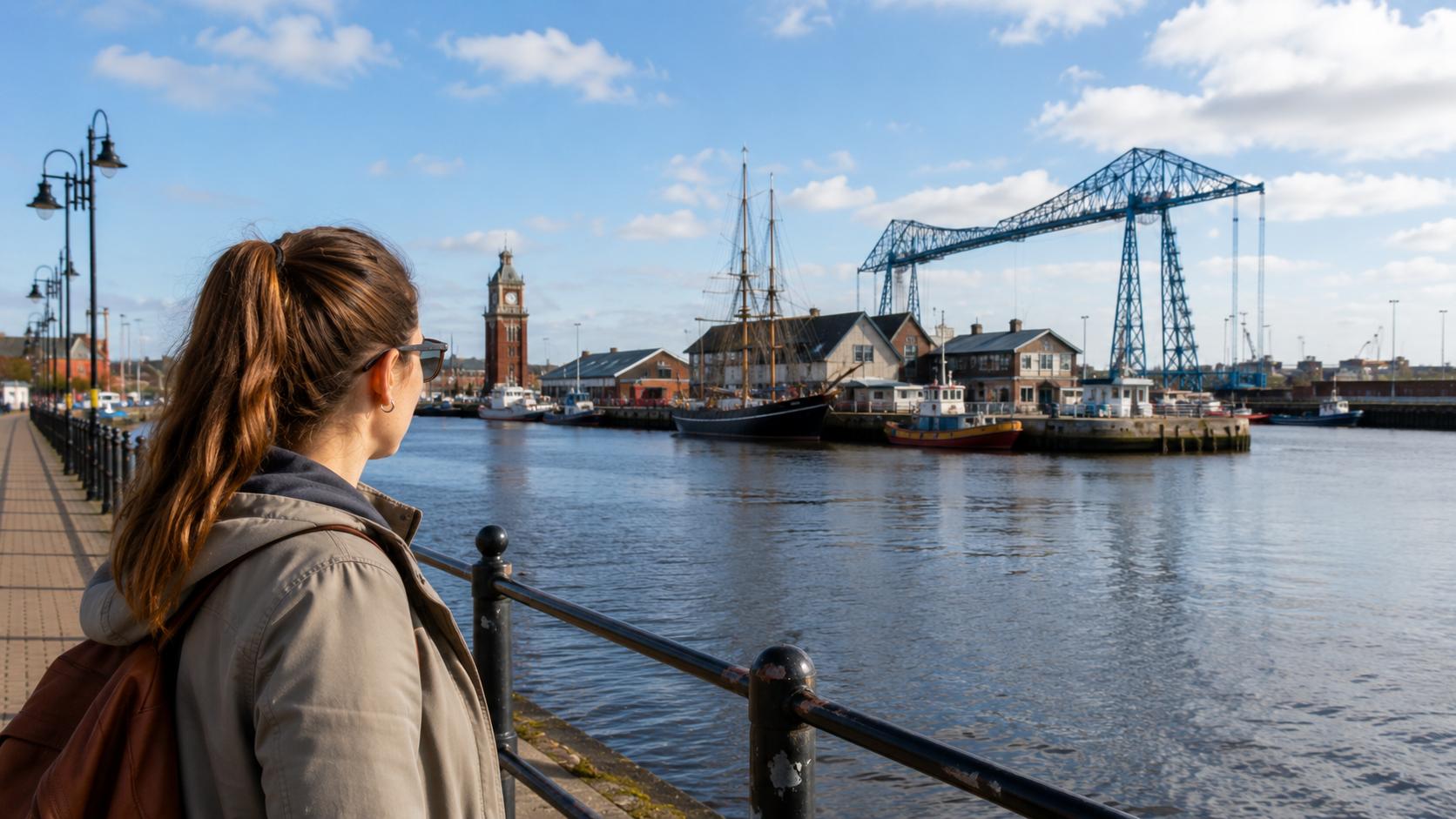
The centrepiece is HMS Trincomalee, a frigate launched in 1817 and the oldest British warship still afloat. She is genuinely old, genuinely a ship rather than a replica, and walking her decks gives a physical sense of naval life in the age of sail that no museum display achieves.
Around her sits a reconstructed Georgian quayside with shops, a naval outfitter and craftspeople, which sounds like a theme park and works considerably better than that description suggests, particularly for children.
The museum complex includes exhibitions on maritime history and the Royal Navy's connections with the North East, and it sits in the marina area with places to eat nearby.
The Headland is the older town.
Hartlepool's Headland is the medieval settlement, sitting out on its promontory and quite separate in character from the newer town.
St Hilda's Church dominates it, a substantial early English building on the site of the Anglo-Saxon monastery founded in the seventh century, which places Hartlepool in the same story as Whitby, Jarrow and Lindisfarne.
The town walls, the Heugh Battery and the seafront are all worth walking. The battery holds a specific historical distinction, having been involved when German warships bombarded Hartlepool, Whitby and Scarborough in December 1914, an attack that killed civilians and became a significant moment in the home front experience of the First World War.
The monkey story is genuine folklore rather than invention, and the town has embraced it with a certain amount of humour.
Seaton Carew and the coast.
Seaton Carew is a traditional seaside resort with a long sandy beach, a promenade and a bus station of considerable architectural interest to those who notice such things.
North of the town, the dunes and the coast towards the mouth of the Tees form a landscape unlike anywhere else, with beaches backed by industry and enormous skies.
Seals are frequently visible around the Tees mouth, and the area supports substantial populations.
Saltholme is one of the best wildlife sites in the region.
RSPB Saltholme sits in the middle of the industrial Tees, which is exactly why it is remarkable. Wetlands, pools and grassland surrounded by chemical works and wind turbines, supporting enormous numbers of birds including breeding avocets, terns and waders, with hides, trails and a visitor centre.
The juxtaposition is the point. Nature reserves are usually sold on remoteness, and Saltholme demonstrates something more useful: that habitat can be created and sustained in the middle of heavy industry, and that wildlife will use it.
It is excellent for families, with accessible paths, play areas and a good café.
The Tees industrial landscape.
Whether you find the Tees estuary beautiful or grim depends entirely on your eye, but nobody finds it boring. The chemical works, the steel heritage, the wind turbines and the sheer scale of the infrastructure make for a landscape with genuine drama, particularly at dusk.
Middlesbrough's Transporter Bridge is the region's most distinctive structure, and its status and operation have varied in recent years as major restoration has been required, so check the current position before travelling specifically to see it working.
MIMA, the Middlesbrough Institute of Modern Art, is a serious gallery with a strong collection, and it is free.
Further south, Saltburn has a Victorian pier, the oldest working water-balance cliff lift in Britain, a surfing beach and a well-preserved seaside townscape, and is easily added to a day if you are driving.
Why it is worth the trip.
There is a tendency in the North East to treat Tyneside, Wearside and Teesside as separate worlds, and a great many people on Tyneside have simply never been.
The area rewards curiosity, the attractions are cheaper and quieter than their Northumberland equivalents, and the history on offer is different from anything you get north of the Tyne.
Share your thoughts.
When did you last go south to Hartlepool or the Tees, and what did you make of it?
Travel News
Hartlepool and the Tees: An Overlooked Day Out
Advertisement



Comments (0)
You must be logged in to post comments.
Don't have an account? Register here
No comments yet. Be the first to share your thoughts!