
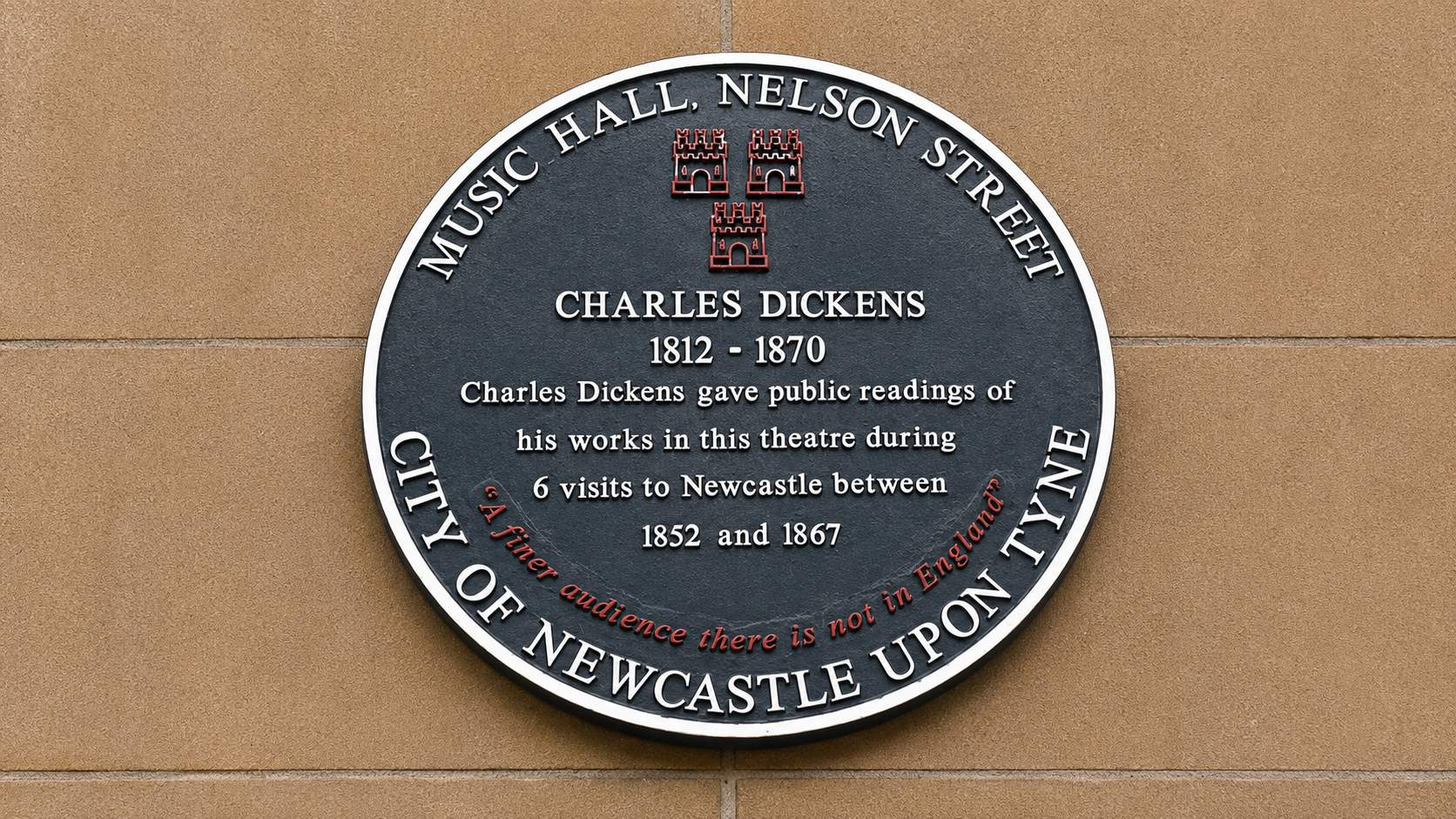
Thousands of people walk along Nelson Street in Newcastle city centre every week without realising they are passing one of the city's most fascinating literary landmarks. Mounted on the former Music Hall building is a blue plaque celebrating Charles Dickens, one of Britain's greatest novelists, whose relationship with Newcastle stretched far beyond a fleeting visit.
Rather than simply passing through, Dickens returned to Newcastle six times between 1852 and 1867. His visits attracted packed audiences, enthusiastic reviews and lasting admiration. More than 150 years later, the plaque continues to remind visitors that Victorian Newcastle was an important stop on one of the world's most famous literary tours.
Why does Charles Dickens have a blue plaque in Newcastle.
The plaque marks the site of the former Music Hall on Nelson Street, where Dickens gave several public readings from his own novels during the mid nineteenth century.
According to Newcastle City Council, Dickens appeared at the theatre during six visits to Newcastle between 1852 and 1867. The plaque also carries one of his most memorable quotes about the city.
"A finer audience there is not in England."
It was not empty praise. Contemporary newspaper reports described overflowing crowds and thunderous applause as Dickens read from classics including A Christmas Carol, David Copperfield, Nicholas Nickleby, The Pickwick Papers and Dr Marigold's Prescription.
A building with its own remarkable history.
Although many people focus on Dickens, the building itself has an equally interesting story.
The Music Hall opened in 1838 and quickly became one of Newcastle's leading entertainment venues. It hosted lectures, concerts, political meetings and performances before later becoming the New Tyne Concert Hall and eventually the Gaiety Music Hall. During the twentieth century it even operated as a cinema before much of the building was demolished in the 1950s. Thankfully, its historic frontage survived and remains Grade II listed today.
That surviving façade allows visitors to stand in almost exactly the same location where Victorian audiences queued to hear one of history's greatest storytellers.
Dickens formed a genuine connection with Tyneside.
While London dominates most discussions about Charles Dickens, Newcastle clearly left a lasting impression on him.
Writing after one of his performances, Dickens described local audiences as unusually warm, emotionally engaged and appreciative. He praised their ability to laugh loudly during comic passages while responding with equal feeling during emotional moments.
His admiration extended beyond Newcastle itself. During his 1867 visit he travelled to Tynemouth, where he wrote enthusiastically about the dramatic North Sea coastline and stormy conditions he witnessed.
The numbers behind Dickens' enduring popularity.
Charles Dickens remains one of the most widely read authors in history.
Some interesting figures include:
More than 200 million copies of Dickens' books are estimated to have been sold worldwide.
His novels have been translated into dozens of languages, ensuring his stories continue reaching new generations.
A Christmas Carol alone has inspired hundreds of film, television and stage adaptations, making it one of the most adapted stories ever written.
Newcastle City Council maintains dozens of commemorative plaques across the city, with Dickens among the best known literary figures recognised.
These figures help explain why a single plaque in Newcastle continues attracting interest from literature enthusiasts, historians and tourists alike.
An overlooked attraction in Newcastle city centre.
Unlike Newcastle's famous landmarks such as Grey Street, the Castle Keep or St Nicholas' Cathedral, the Dickens plaque is easy to miss.
Yet it forms part of a wider trail of historic plaques that tell the story of the city's industrial, cultural and literary heritage. Visitors exploring Grainger Town can discover plaques dedicated to architects, inventors, musicians, scientists and political figures, making the city centre something of an open-air history museum.
For literature lovers, standing outside the former Music Hall provides a rare opportunity to connect directly with one of the Victorian era's biggest cultural events.
Why the plaque still matters today.
Historic plaques do more than commemorate famous names. They connect modern cities with the people who helped shape them.
Charles Dickens could have remembered Newcastle simply as another stop on a busy speaking tour. Instead, he singled out its audiences for praise that has echoed through generations.
Today, the Nelson Street plaque preserves that relationship, reminding residents and visitors alike that Newcastle once played host to one of Britain's greatest literary figures at the height of his fame. It is a small marker with a remarkably big story, and one that deserves far more attention from anyone exploring the city's rich history.
Join the conversation.
Have you ever spotted the Charles Dickens blue plaque on Nelson Street
Newcastle History
Hidden In Plain Sight - Newcastle's Forgotten Charles Dickens Landmark
Advertisement



Comments (0)
You must be logged in to post comments.
Don't have an account? Register here
No comments yet. Be the first to share your thoughts!