
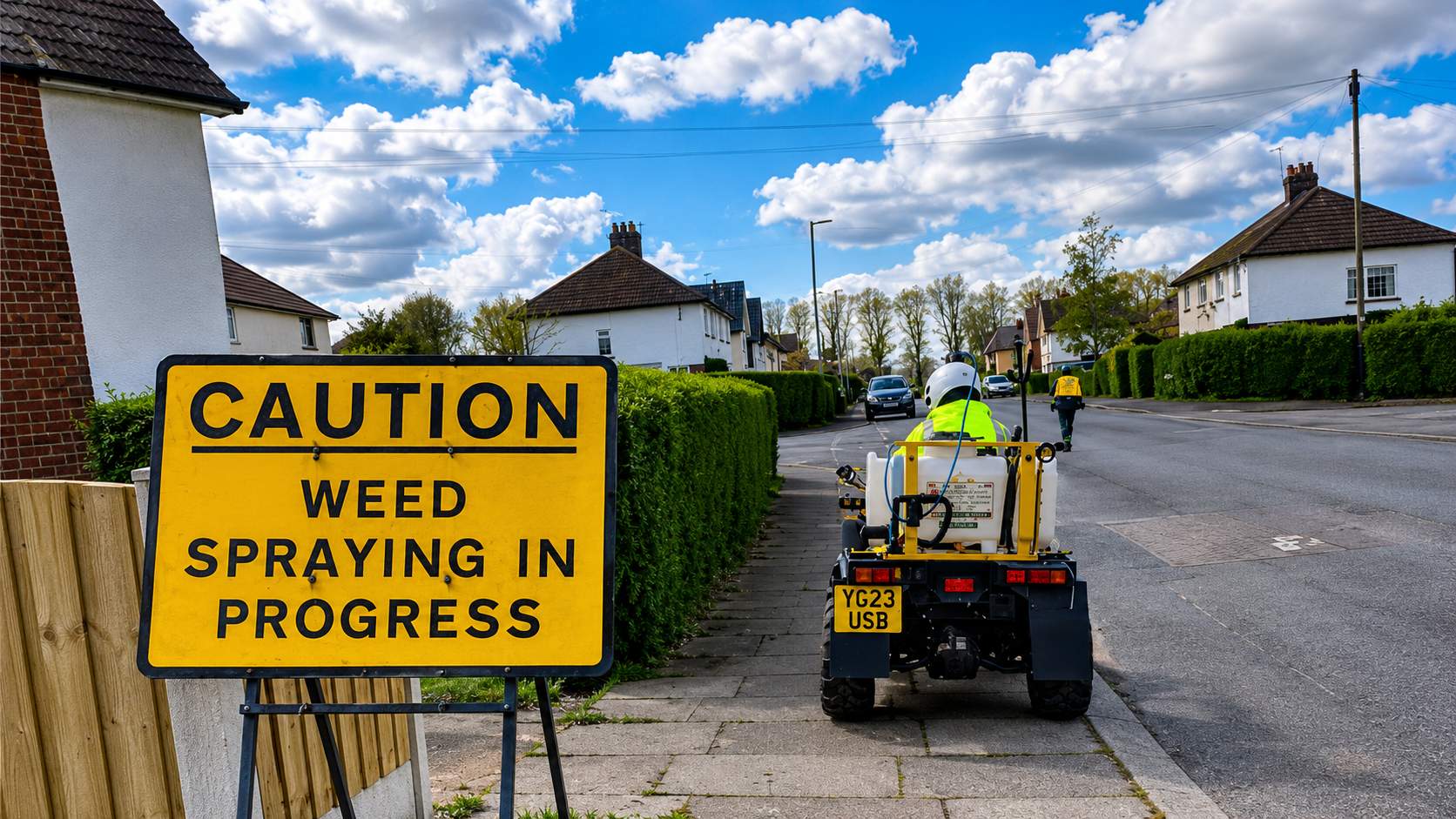
Every spring and summer, weeds begin appearing along pavements, kerbs and roadside channels across Newcastle. Many residents notice council spraying teams working through neighbourhoods and wonder exactly what is being used, whether it is safe and what the potential health risks are.
The short answer is yes. Newcastle City Council uses UK approved herbicides to control weeds on hard surfaces such as pavements and roads, with treatments typically taking place between April and September. The authority says the programme is designed to keep streets safe by reducing trip hazards, maintaining visibility for road users and preventing weeds from damaging hard surfaces. Weedkiller is not routinely used in parks, playing fields or other soft landscape areas as part of the council's standard weed management approach.
While the practice is common across the UK, glyphosate remains one of the most debated weed killers in the world.
Why councils continue using glyphosate.
Glyphosate has been used internationally for more than 50 years and remains one of the most widely used herbicides. Local authorities often argue it is currently the most effective and affordable option for controlling weeds on highways where manual removal would require significantly larger budgets and staffing.
Newcastle City Council says weed control helps reduce slip and trip hazards, improves access for wheelchair users and pushchairs, maintains visibility for drivers and ultimately reduces long term maintenance costs.
Across Britain, many councils have explored alternatives including hot foam, steam treatment, mechanical brushing and increased manual weeding. However, several authorities have concluded these methods can cost several times more while requiring more frequent treatment.
What are the health concerns?
Glyphosate has remained controversial because different organisations have reached different conclusions about its potential health risks.
In 2015, the International Agency for Research on Cancer classified glyphosate as "probably carcinogenic to humans", based largely on limited evidence from occupational exposure and animal studies.
However, regulators including the UK's Health and Safety Executive, the European Food Safety Authority and numerous international agencies have concluded that glyphosate is unlikely to pose a cancer risk when authorised products are used correctly according to label instructions. The UK continues to approve regulated glyphosate products following scientific risk assessments.
For residents walking past recently treated areas, experts generally state that exposure levels are significantly lower than those experienced by professional users.
That has not stopped campaigners calling for councils to reduce or eliminate its use wherever practical.
Environmental concerns remain under scrutiny.
Health is only part of the debate.
Environmental organisations have raised concerns about biodiversity, particularly where repeated herbicide use removes flowering plants that provide food sources for insects and pollinators.
There are also concerns over aquatic environments if herbicides are misused near watercourses, although strict regulations exist governing how approved products should be applied.
Increasingly, councils across Britain are trialling integrated weed management, combining manual removal, mechanical treatment and more targeted chemical application to reduce overall herbicide use rather than relying solely on spraying.
What happens in Newcastle?
According to Newcastle City Council, roadside weeds are treated between April and September, although weather conditions can delay scheduled work.
If weeds remain after around 20 working days, the council says affected areas may receive further treatment. The authority also states that Japanese knotweed on council-owned land is treated through an ongoing spraying programme because it is considered one of the UK's most invasive plant species. Government guidance identifies glyphosate as one of the most effective methods for controlling established Japanese knotweed.
In 2026, Newcastle also announced that weed treatment had been brought back in-house, allowing the council greater control over response times and targeting of priority locations.
The numbers behind the debate.
Several statistics help explain why glyphosate continues attracting attention.
Glyphosate has been used commercially for more than 50 years, making it one of the world's most extensively researched herbicides.
The International Agency for Research on Cancer classified glyphosate as "probably carcinogenic" in 2015, while UK regulators continue approving authorised products following ongoing safety reviews.
In the UK, thousands of miles of roads, pavements and public footpaths require routine vegetation management every year, with local authorities balancing public safety, budgets and environmental concerns.
Several councils elsewhere in England have reported reductions in glyphosate use through improved spraying technology and alternative treatment trials, although complete removal has often proved challenging because of higher costs and increased labour requirements.
Will Newcastle eventually stop using glyphosate?
It is difficult to predict.
Across the UK, councils continue reviewing weed management strategies as new technologies become available and public concern grows.
Some authorities have introduced pilot schemes using steam, foam and manual removal in selected locations, while others continue using carefully targeted herbicide applications until practical alternatives become affordable at scale.
For Newcastle residents, the discussion is unlikely to disappear anytime soon. Keeping streets safe while addressing environmental and public health concerns remains a balancing act that many councils across the North East and the wider UK are still trying to solve.
Share your experience.
Have you noticed weed spraying where you live in Newcastle?
Community News
Is Newcastle City Council's Selected Weed Killer Safe Around Children and Pets?
Advertisement




Comments (0)
You must be logged in to post comments.
Don't have an account? Register here
No comments yet. Be the first to share your thoughts!