
It is one of the most ordinary objects imaginable, found in kitchens and pockets the world over, yet the match was a genuine revolution in everyday life. Before it existed, making fire was a slow and awkward business of flint, steel and tinderboxes. The man who changed all that was a modest chemist from Stockton-on-Tees, and his story is one of accidental genius and remarkable generosity that deserves to be far better known across the North East and beyond.
A Chemist of Stockton.
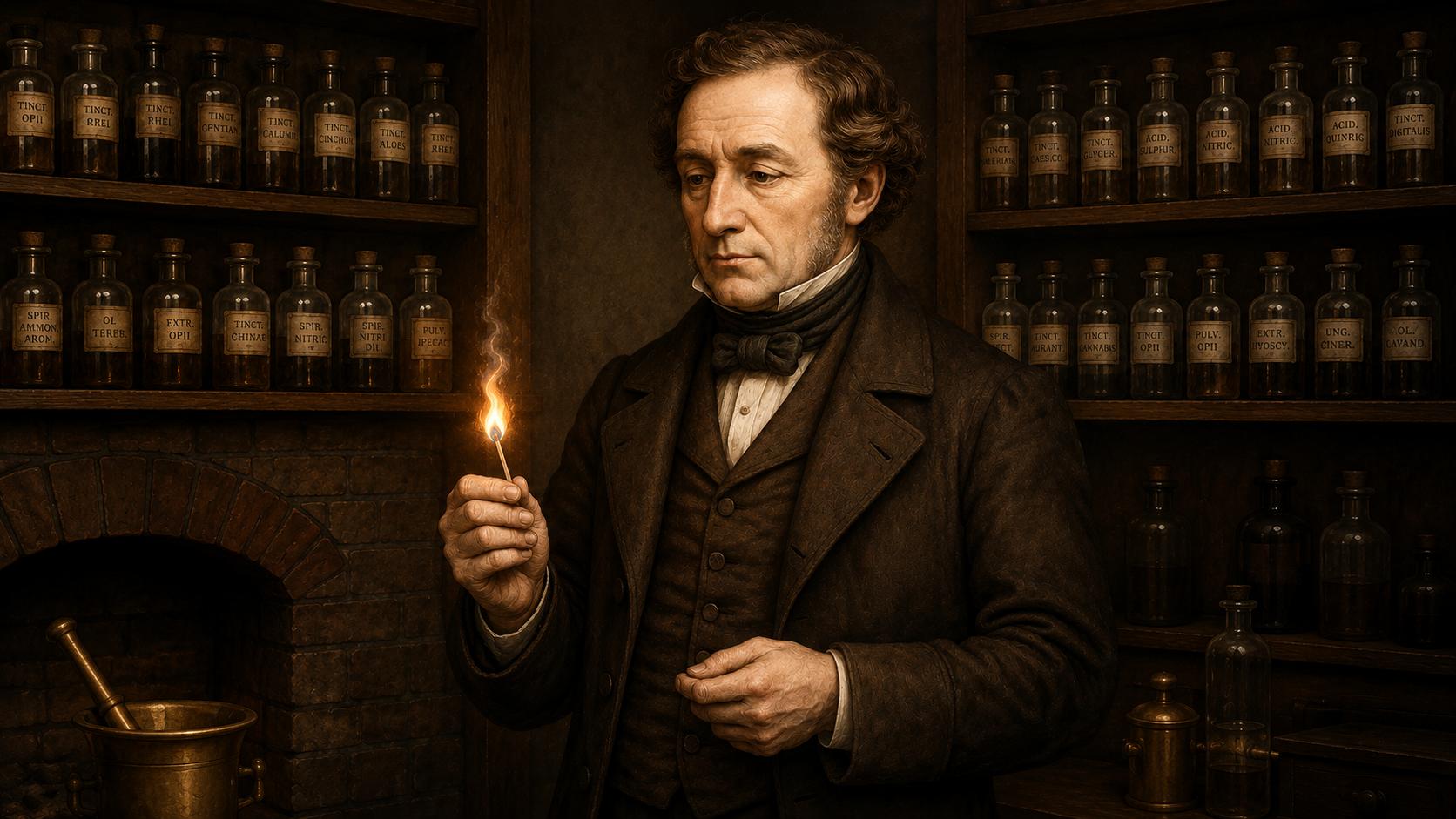
John Walker was born in Stockton-on-Tees in 1781, the son of a local tradesman, and after his schooling he trained in medicine before turning to chemistry. He set up his own business as a chemist and druggist on Stockton High Street, where he dispensed medicines to the townspeople and built a reputation as a knowledgeable and well-respected man. So wide-ranging was his learning that he became known locally as a kind of walking encyclopaedia. In his shop he experimented freely with chemicals, including various explosive and combustible mixtures, searching for a reliable way to create fire easily and on demand.
A Happy Accident.
The great discovery came in 1826, and it came by chance. Walker had been stirring a mixture of chemicals with a wooden stick, and a lump of the paste had dried on the end of it. When he scraped the stick against the stone of his hearth to clean it off, it suddenly burst into flame. In that instant, Walker had stumbled upon something that countless others had sought without success: a way to produce a controlled flame by friction alone, simply by striking a coated stick against a rough surface. He immediately grasped the importance of what he had found.
Friction Lights.
Walker perfected his chemical formula and began selling his invention from his shop, with the first recorded sale taking place in 1827. He called his creation Friction Lights, and he sold them in boxes complete with a strip of rough paper for striking. The matches were coated with a paste of chemicals that, when scraped, produced enough heat to ignite the wooden splint. They were an immediate novelty, and Walker soon recognised their enormous practical potential, stepping up production to meet the curiosity and demand of his customers. The age of easy fire had begun.
The Decision Not to Patent.
Here the story takes its most remarkable turn. Walker was urged to take out a patent on his invention, which would have protected it and could have made him a wealthy man. By some accounts the great scientist Michael Faraday himself encouraged him to do so. Yet Walker refused. He took the view that his invention would be a benefit to all, and that the public should simply be allowed to have it. He considered the matter unimportant for his own enrichment and preferred to devote his attention to his scientific interests rather than to commerce and legal protection.
Others Take the Credit.
The consequence of Walker's generosity was that others were free to copy and improve upon his idea. Within a few years, manufacturers elsewhere were producing their own friction matches, refining the formula and selling them widely under names of their own. The publicity given to the invention through scientific lectures helped to spread the concept rapidly. Walker, meanwhile, made little from the world-changing thing he had created, and he ceased producing his own matches as competition grew. He died in Stockton in 1859, never having sought reward for his contribution to everyday life.
A Quiet Hero.
There is something deeply admirable about John Walker's refusal to profit from his discovery. In an age that often celebrates the pursuit of wealth, here was a man who gave a genuinely transformative invention to the world freely, asking nothing in return. His matches lit fires in homes, factories and far-off places, making a small but profound difference to the daily lives of millions. That such a contribution should have come from a modest Stockton chemist, working alone in his shop, is a wonderful reminder that great things can come from unassuming people in ordinary places.
Remembering the Inventor.
For a long time Walker received little recognition for his achievement, and his role was at risk of being forgotten. In time, however, efforts were made to honour him, and a sculpture was eventually erected in Stockton to mark the anniversary of his invention. The town has continued to celebrate its connection to the man who gave the world the match, and his story remains a point of local pride. The next time anyone strikes a match without a second thought, they might pause to remember that this everyday miracle began with a chance discovery on a chemist's hearth in the North East of England.
A World Transformed by a Small Thing.
It is easy to underestimate just how much the friction match changed everyday life, precisely because it became so utterly commonplace.
Before Walker's invention, lighting a fire was a slow and uncertain business, requiring flint, steel and tinder and no small amount of patience and skill. The ability to produce a flame instantly, simply by striking a small stick, was a genuine revolution in convenience that touched almost every household and workplace. It made the lighting of fires, lamps, candles and stoves quick and easy, saving time and effort countless times every day in homes across the world.
The match also had wider effects, supporting the spread of gas and oil lighting and contributing in countless small ways to the rhythms of industrial and domestic life. That such a profound change in everyday convenience should spring from a chance discovery in a Stockton chemist's shop is a striking illustration of how the smallest inventions can have the largest effects.
John Walker's friction match is a perfect example of a technology so successful that it became invisible, taken for granted by the billions who have used it, while its humble North East origins were all too often forgotten. It deserves to be remembered.
Share your thoughts.
A modest Stockton chemist gave the world the match and refused to make a penny from it.
Did you know that the humble match was invented right here in the North East?
Tech News
The Stockton Chemist Who Gave the World the Match
How John Walker, a chemist from Stockton-on-Tees, invented the friction match in 1826 by accident and generously refused to patent his world-changing discovery.
Advertisement





Comments (0)
You must be logged in to post comments.
Don't have an account? Register here
No comments yet. Be the first to share your thoughts!