
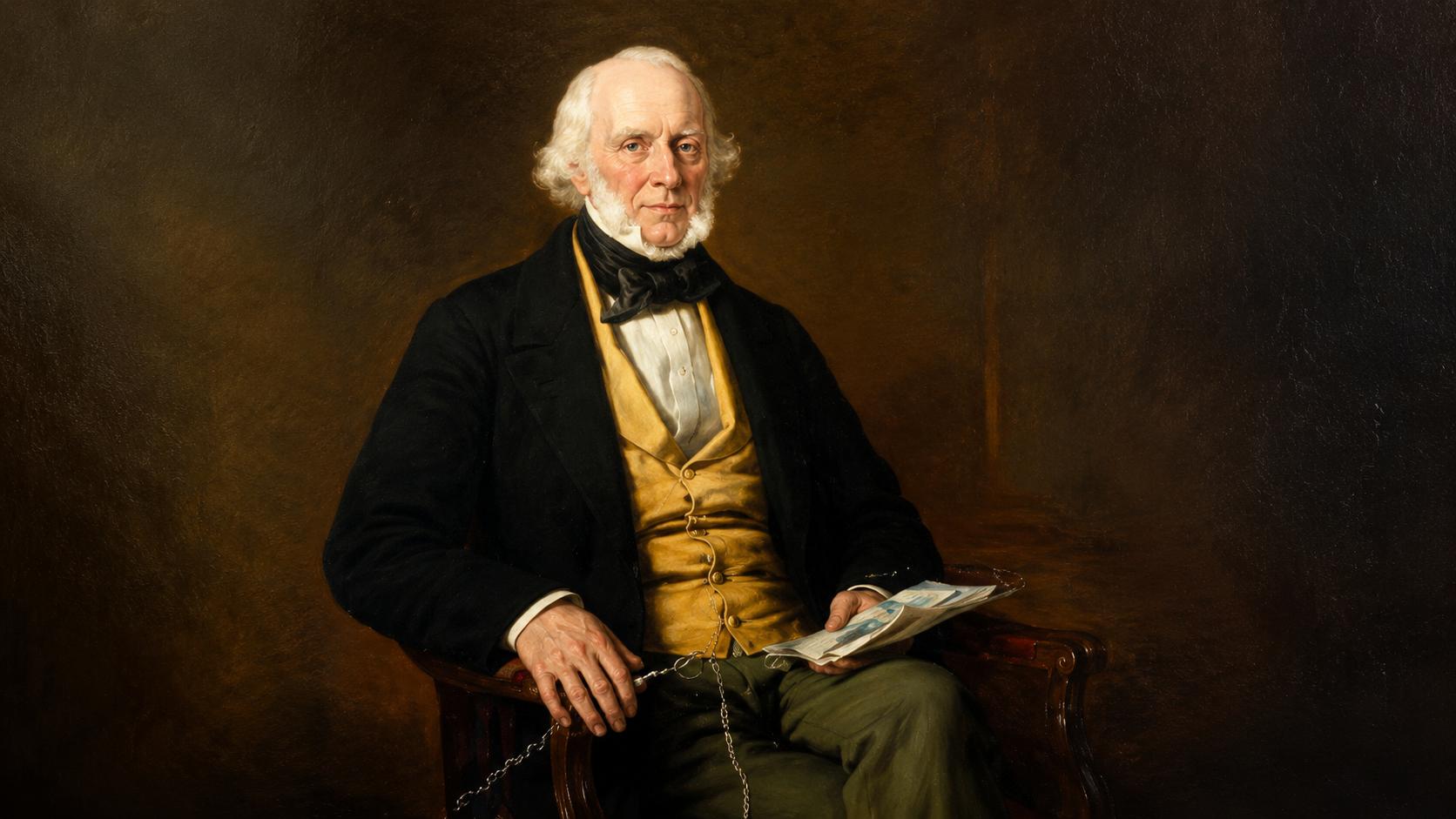
Joseph Cowen was born on 9 July 1829 at Stella Hall near Blaydon, the son of a prominent local businessman and future Newcastle MP also named Joseph Cowen. Educated privately before attending Edinburgh University, the younger Cowen developed a deep fascination with European revolutionary movements while still a student, an interest that would come to define much of his extraordinary later life on Tyneside.
Cowen joined his father's brick manufacturing business at Blaydon, but his real influence came through the written word. In 1859 he bought the Newcastle Daily Chronicle, transforming it into one of the most influential radical newspapers in the country and using its pages relentlessly to campaign for better housing, workers' rights and social reform across Tyneside for the remainder of the century.
What set Cowen apart from other newspaper proprietors of his era was his extraordinary personal network of European revolutionaries. He counted the Italian nationalist Giuseppe Garibaldi, French socialist Louis Blanc, Russian anarchist Mikhail Bakunin and Russian revolutionary Alexander Herzen among his close friends, several of whom visited him personally at his Blaydon home, smuggling documents through his family's brick consignments to support revolutionary movements across the continent.
In 1873 Cowen succeeded his father as Liberal MP for Newcastle upon Tyne, a seat he held until 1886. In Parliament he became known for a distinctive personal touch that shocked more conventional colleagues, regularly appearing in the House of Commons dressed in the clothing of a Northumbrian miner, a deliberate statement of solidarity with the working-class constituents he represented and spoke for so passionately.
Cowen used both his newspaper and his parliamentary platform to campaign relentlessly against the death penalty, decades before its eventual abolition in Britain, and to champion Irish nationalism, Jewish emancipation and improved conditions for miners and ironworkers across the North East. He founded the Northern Reform Union in 1858 alongside fellow campaigners, sending activists into towns and villages around Newcastle to organise ordinary workers politically.
Beyond politics and journalism, Cowen left a lasting cultural mark on Newcastle too. Frustrated by what he saw as an unfair monopoly held by the city's Theatre Royal, he successfully campaigned for permission to build a rival venue, resulting in the opening of the Tyne Theatre and Opera House on Westgate Road in 1867, a building that survives today as the Journal Tyne Theatre.
Cowen's independence from strict party discipline occasionally brought him into conflict with the wider Liberal establishment, both nationally and within Newcastle itself, yet his personal popularity and formidable skills as a public speaker consistently carried him through, including a notable re-election victory in 1885 despite these internal party tensions. He finally retired from Parliament and public life entirely in 1886.
Cowen's international connections extended well beyond Garibaldi and Bakunin too, and he numbered the Hungarian revolutionary Lajos Kossuth and the Italian nationalist conspirator Felice Orsini among the visitors who travelled to see him personally at Blaydon, reflecting his genuinely unusual standing as a provincial English newspaper proprietor with direct personal ties to some of Europe's most significant nineteenth-century revolutionary figures.
His father, also named Joseph Cowen, had himself served as Newcastle's MP from 1865 to 1873 before the younger Cowen succeeded him, and the family's combined newspaper and brick manufacturing interests gave them a genuinely rare platform from which to campaign for reform. Cowen also served as president of the first day of the 1873 Co-operative Congress, further cementing his standing within the wider working-class self-improvement movement of the era.
Joseph Cowen died on 18 February 1900, having spent nearly half a century as the dominant political and journalistic voice of what became known as Newcastle's "radical citadel".
A bronze statue of Cowen still stands at the foot of Westgate Road today, positioned deliberately near the Tyne Theatre he fought to build, a permanent reminder of the newspaper baron who turned Victorian Newcastle into a genuine centre of European radical thought.
The Newcastle Weekly Chronicle, a sister title Cowen also owned and edited, extended his reach considerably further across the wider North East region beyond the city itself. That combined newspaper reach helped cement Cowen's status as the single most influential press figure across the entire Victorian-era North East. Few provincial newspaper proprietors of the era managed to combine journalism, industry and elected office quite so effectively across a single career.
Join the conversation below.
Did you know Joseph Cowen sheltered European revolutionaries?
Political News
Joseph Cowen: The Newcastle Press Baron Who Sheltered Europe's Revolutionaries
Joseph Cowen used his Newcastle newspaper empire to champion working-class causes and shelter some of nineteenth-century Europe's most wanted revolutionaries, becoming the region's most influential radical voice.
Advertisement


Comments (0)
You must be logged in to post comments.
Don't have an account? Register here
No comments yet. Be the first to share your thoughts!