
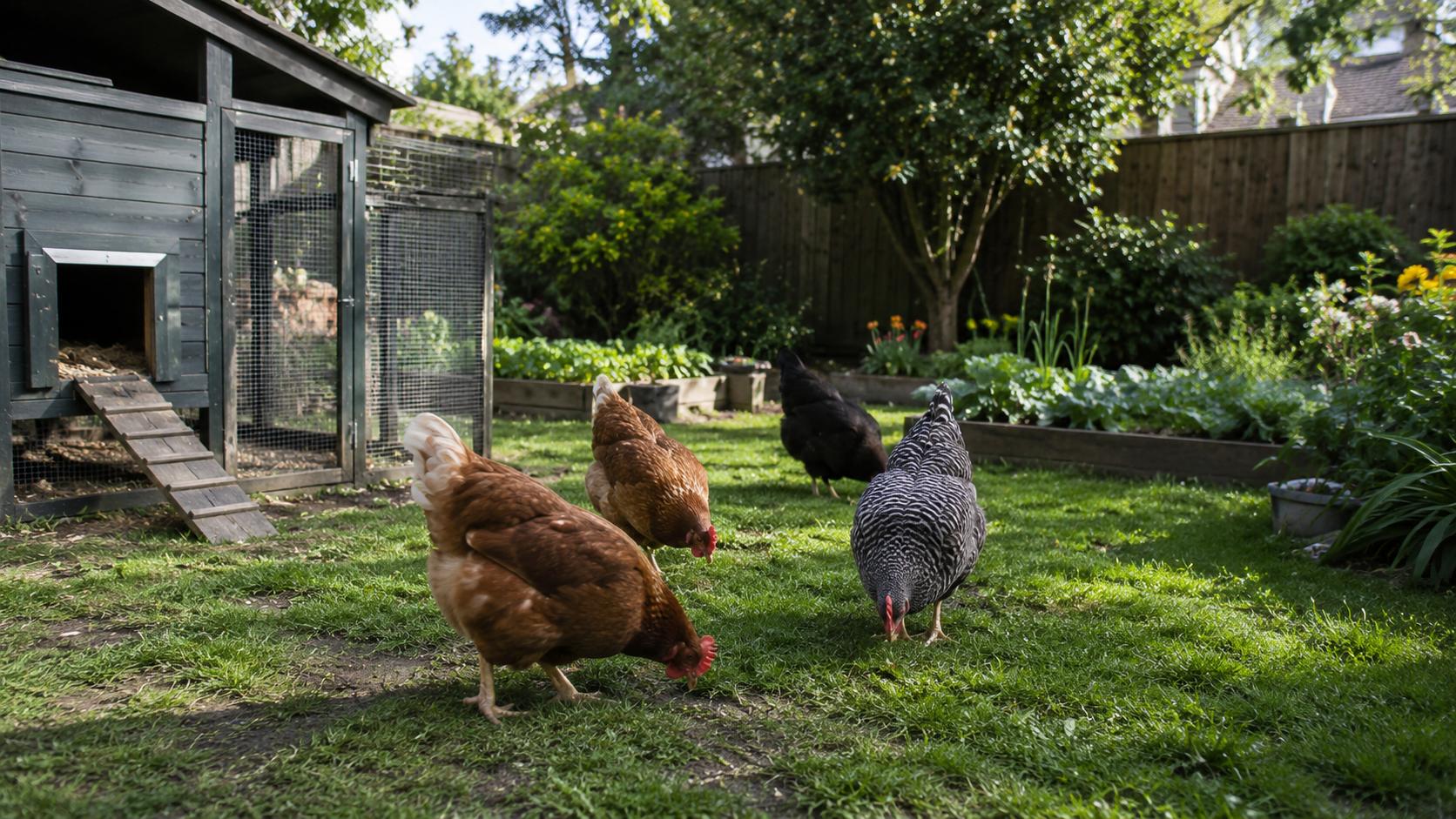
Keeping a few hens in a suburban garden has moved from eccentric to fairly ordinary, and Newcastle has a good number of back gardens with a coop in the corner. The appeal is obvious: eggs, an interest, something for children to be involved with, and a use for garden waste.
It is also a genuine commitment involving daily care, legal obligations that have tightened in recent years, and a set of practical realities that nobody mentions in the glossy photographs.
You now have to register, even with one bird.
This is the rule most people do not know about, and it changed relatively recently.
All bird keepers in England must register their birds with the Animal and Plant Health Agency, and the requirement now applies to everyone, including those keeping a single hen in a garden. It was previously limited to keepers with fifty or more birds.
Registration is free, done online, and exists so that keepers can be contacted rapidly during a disease outbreak. It is a legal requirement rather than a suggestion.
Avian influenza has become a recurring seasonal problem in Britain, and during outbreaks the government can impose housing orders requiring all poultry, including garden flocks, to be kept indoors. Anyone considering keeping hens should plan for the possibility of having to house them under cover for weeks or months.
Check whether you are allowed before you buy.
Property deeds sometimes contain covenants prohibiting the keeping of livestock or poultry, and these are enforceable regardless of what the neighbours think.
Tenants need their landlord's permission, and social housing and leasehold agreements frequently prohibit it.
There is no general licence required to keep hens for your own use, but a council can act under statutory nuisance provisions if the birds cause a genuine nuisance through smell, noise or attracting vermin.
Cockerels are the usual flashpoint. Hens lay perfectly well without one, a cockerel crows from before dawn, and in a terraced or semi-detached setting it will cause a complaint. The overwhelming advice is not to keep one in a garden.
Space, housing and predators.
Hens need a secure coop for night-time and a run for daytime, and both need to be genuinely fox-proof rather than approximately so.
Foxes are present throughout urban Newcastle and are considerably more capable than people expect. Wire mesh rather than chicken wire, buried or skirted around the perimeter to prevent digging, secure latches that a fox cannot work loose, and a routine of shutting the coop every single evening.
The most common cause of a wiped-out flock is a coop that was not closed one night.
Allow generous space. Cramped birds develop behavioural problems including feather pecking, and a run that is too small becomes a mud bath within weeks. Moveable runs, or a run with a hard-standing area, help enormously.
Provide perches, a dust bath area, shade and nest boxes, and expect to clean the coop weekly and to replace bedding regularly.
Feeding, and the rule people break.
Hens need a proper commercial layers feed to lay well and stay healthy, supplemented with grit and access to fresh water at all times. Water freezing in winter is a daily job.
It is illegal in the UK to feed catering waste or kitchen scraps to poultry, including material from a domestic kitchen. This surprises almost everybody, because feeding hens on scraps is the traditional image.
The rule exists to prevent disease transmission, and it applies even to a household flock. Garden greens and permitted supplementary feeds are fine; anything that has been in a kitchen where meat is handled is not.
Health and the reality of keeping animals.
Hens get red mite, worms, scaly leg mite and respiratory infections, and all of these need managing. Red mite in particular is a persistent problem that lives in the coop rather than on the bird and requires thorough treatment.
Find a vet who treats poultry before you need one, since not all small animal practices do.
Hens live for years but their laying declines substantially after the first couple of seasons, and a keeper needs to decide in advance what they will do with birds that have stopped laying. Most garden keepers keep them as pets, which is a longer commitment than the egg supply suggests.
Birds die, sometimes suddenly and without obvious cause, and children need preparing for that.
Rescue hens are worth considering.
Charities rehome commercial laying hens at the end of their productive life, birds that would otherwise be slaughtered at around eighteen months old.
They typically arrive in poor feather and looking startled, recover remarkably quickly, and lay well for a good while yet. It is a genuinely satisfying way into keeping hens and costs very little.
Eggs and the rules on selling.
Eggs from your own hens for your own household are entirely unregulated.
Selling them is a different matter, and there are rules about grading, marking and labelling that apply depending on how and where you sell. Giving surplus eggs to neighbours is generally fine; setting up a stall is not.
Whether it saves money.
It does not. Between the coop, the run, the feed, the bedding, the treatments and the veterinary costs, garden eggs are considerably more expensive than shop eggs.
People keep hens because they enjoy it, because the eggs are better, and because the birds are more entertaining than anybody expects. Those are good reasons. Economy is not one of them.
Share your thoughts.
Would you (or do you) keep hens in your garden?
Lifestyle News
Keeping Chickens in a Newcastle Garden
Advertisement





Comments (0)
You must be logged in to post comments.
Don't have an account? Register here
No comments yet. Be the first to share your thoughts!