
Learning to drive has become considerably more expensive and considerably slower than it was a decade ago. Lesson prices have risen sharply, test waiting lists have been under sustained pressure since the pandemic disrupted the system, and the combination means that a learner who assumed they would be on the road within six months is frequently still waiting a year later.
None of that is a reason not to do it, but it is a reason to plan the process properly rather than drifting into it. The learners who get through fastest and cheapest are almost always the ones who understood the sequence before they started.
Start with the provisional licence.
You can apply for a provisional licence from the age of fifteen years and nine months, and you can drive a car from your seventeenth birthday. Applying early costs nothing in lost time and means the document is in your hand when you want it.
The application is made online through the DVLA, requires proof of identity and address, and takes a matter of days in most cases. You need to meet the eyesight standard, which is the ability to read a number plate from twenty metres, and you must declare any medical conditions that affect driving.
The theory test comes next, and it expires.
The theory test has two parts taken in one sitting. A multiple-choice section requires a high pass mark from fifty questions, and a hazard perception section uses video clips in which you click when you spot a developing hazard.
The pass certificate is valid for two years. If you have not passed the practical test within that window, the theory test must be taken again, and a substantial number of learners lose their certificate to expiry while waiting for a practical slot.
That makes the sequencing important. Taking the theory very early, before you have had many lessons, risks burning the two years while you are still learning. Taking it too late delays your ability to book a practical test, because you cannot book one without it.
The practical test waiting list is the real bottleneck.
Booking is done through the DVSA, and slots can be booked up to a set period ahead. Demand has consistently outstripped supply at many centres, with waits that have at times run to several months.
The practical consequences are worth understanding. Book the test as soon as you are eligible and reasonably confident of being ready by then, because you can move a booking more easily than you can create one from nothing.
Cancellations do appear, particularly early in the morning and at short notice, and checking the booking system regularly is how many learners bring their date forward.
Test centres serving Newcastle and the surrounding area have different waiting times and different pass rates, and the DVSA publishes pass rate data by centre. It is worth being realistic about why those rates differ, since a centre with quiet residential routes will produce different figures from one with heavy urban traffic, and your instructor's knowledge of local routes matters more than the statistic.
How many lessons you will actually need.
The official guidance, based on DVSA research, is that the average learner needs somewhere in the region of forty-five hours of professional instruction plus around twenty-two hours of private practice.
Those are averages and individuals vary enormously, but they are a considerably better planning basis than the optimism most learners begin with. At current lesson prices, forty-five hours represents a serious sum of money, and it is worth budgeting for it honestly at the outset.
Private practice is the cheapest way to reduce the total. A supervising driver must be over twenty-one and have held a full licence for the relevant category for at least three years, and the car needs learner insurance and L plates. Short, frequent sessions between lessons consolidate skills far better than occasional long drives.
Intensive courses compress everything into a week or two and suit some people, but they are expensive, demanding and less effective for anyone who needs time for skills to embed.
Choosing an instructor.
Look for a fully qualified approved driving instructor with a green badge rather than a trainee with a pink one, though good trainees exist and charge less.
Ask about their pass rate, whether they know the routes used by your test centre, and whether lessons are structured to a plan rather than driving around aimlessly.
The relationship matters. An instructor who makes you anxious is costing you money, and changing instructors is entirely normal rather than a failure.
What the test actually involves.
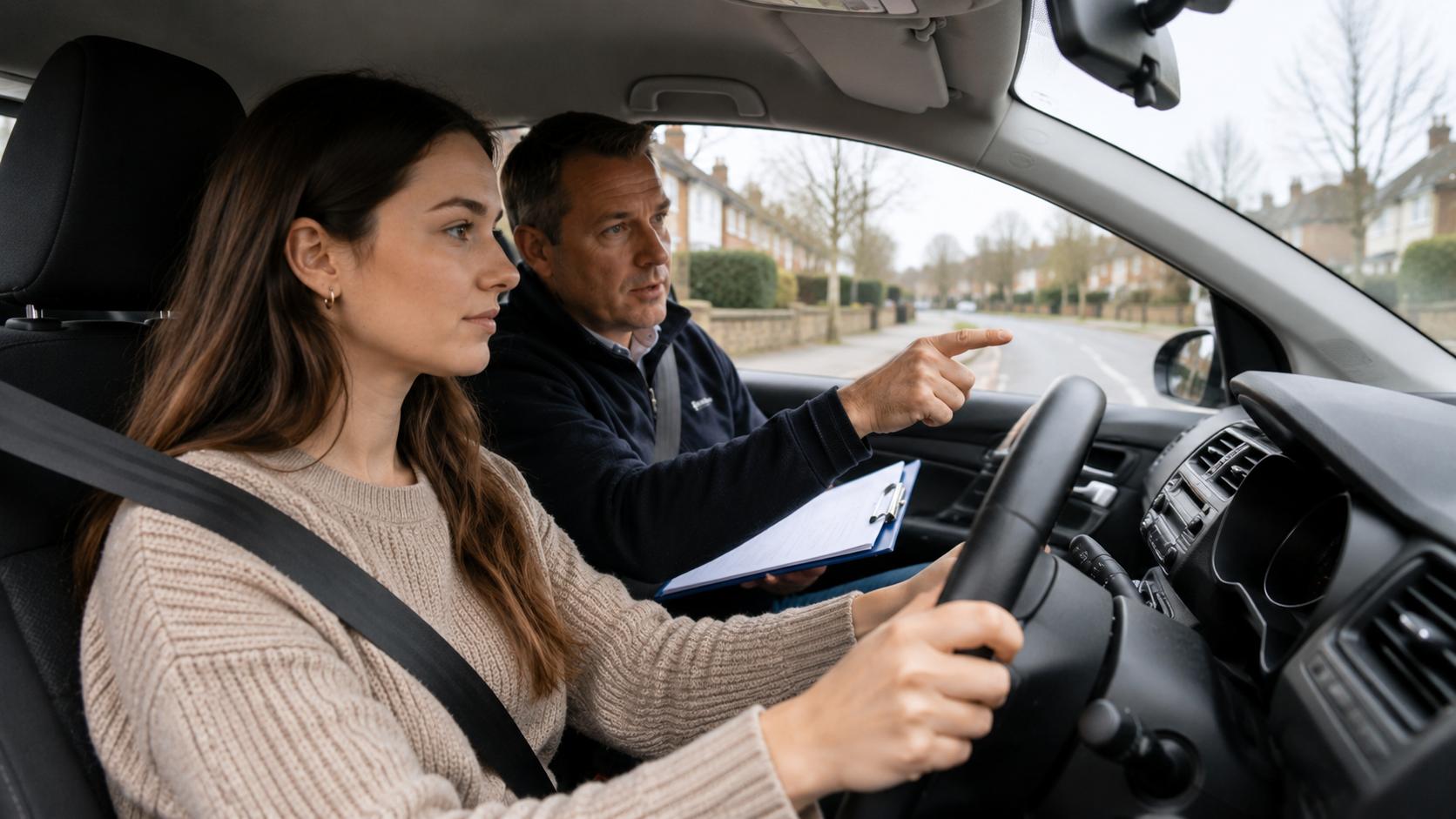
The practical test lasts around forty minutes and includes an eyesight check, two vehicle safety questions covering basic checks and controls, general driving, one reversing manoeuvre, and possibly an emergency stop.
Around twenty minutes is spent on independent driving, following either a satnav or road signs, which is designed to assess whether you can drive without step-by-step instruction.
Faults are recorded as driving faults, serious faults or dangerous faults. Accumulating more than fifteen driving faults fails the test, and a single serious or dangerous fault fails it outright.
The most common reasons for failure are consistent year after year: observation at junctions, use of mirrors when changing direction, steering control, response to traffic lights, and poor positioning during turns.
After you pass.
New drivers are subject to a specific rule for the first two years. Accumulating six or more penalty points during that period means the licence is revoked, and you return to a provisional licence and must pass both tests again.
Insurance in the first year is the largest cost most new drivers face, and it dwarfs the price of the lessons. Telematics policies, adding an experienced named driver honestly, choosing a low-insurance-group car and taking additional training such as Pass Plus can all reduce it.
Do not be tempted by fronting, where a parent is listed as the main driver of a car actually used by the new driver. It is insurance fraud, it invalidates the policy, and it has consequences well beyond the refused claim.
Share your thoughts.
How long did it take you to pass, and what caught you out on the day?
Lifestyle News
Learning to Drive in Newcastle: Waits, Costs and Passing First Time
Advertisement




Comments (0)
You must be logged in to post comments.
Don't have an account? Register here
No comments yet. Be the first to share your thoughts!