
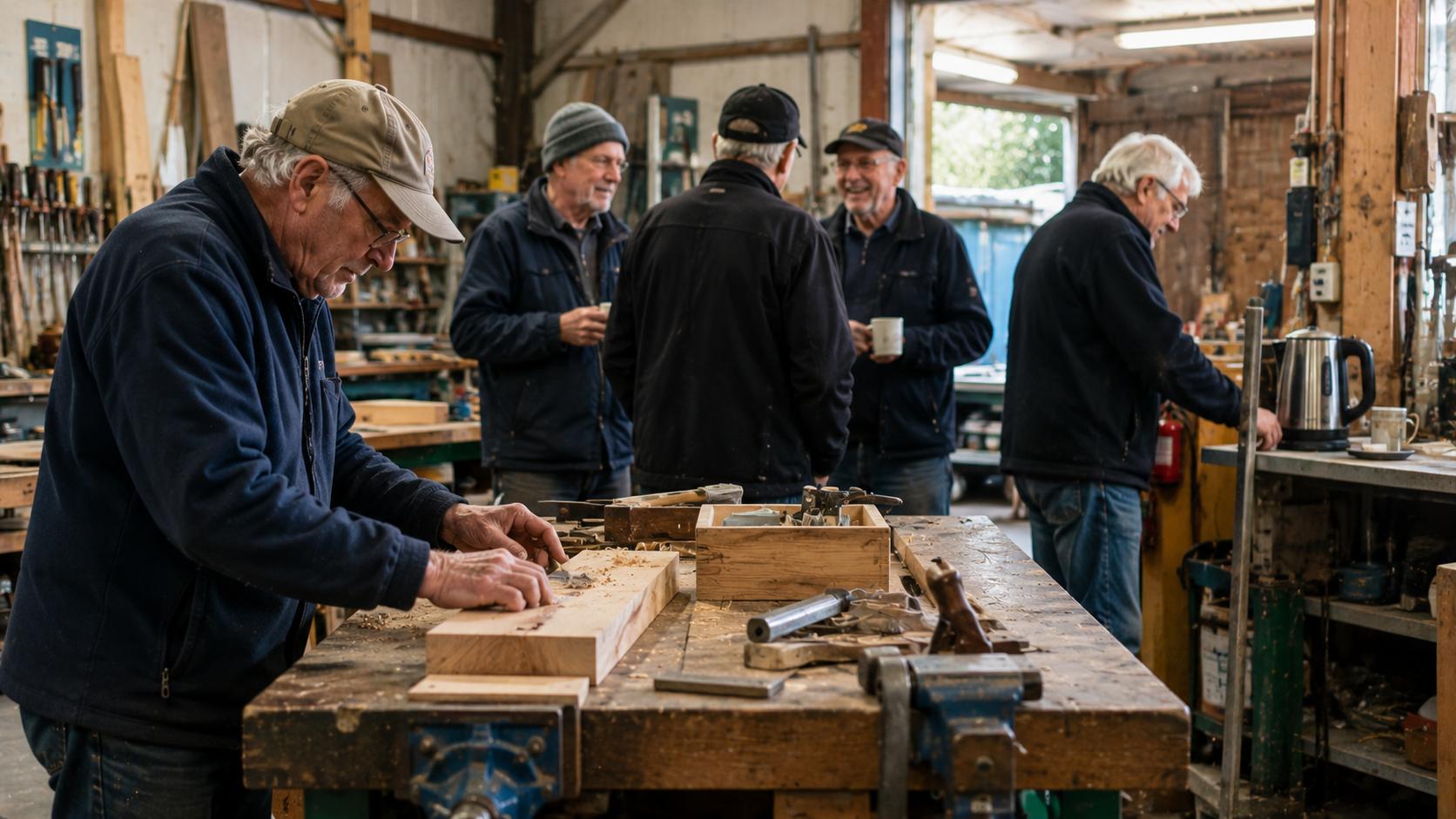
The concept is almost comically simple. A workshop, some tools, a kettle, and a group of people who turn up regularly to make things together.
From that starting point, Men's Sheds have spread from Australia across the world, and there are now hundreds across the United Kingdom, including a substantial number across the North East.
Here is what they are and why they have worked so well.
The idea came from Australia.
The Men's Shed movement emerged in Australia during the 1990s, developing from community projects aimed at older men who had become isolated after retirement, redundancy or bereavement.
The observation behind it was straightforward: services designed around sitting in a circle and talking about feelings attracted very few men, while activities built around a shared practical task attracted plenty.
The movement grew rapidly in Australia and Ireland before reaching Britain, where the UK Men's Sheds Association was established to support new and existing groups.
Shoulder to shoulder, not face to face.
The phrase most associated with the movement is that men talk shoulder to shoulder rather than face to face.
The observation is that conversation about difficult subjects happens more readily alongside a shared activity than across a table. A workshop provides exactly that: a reason to be there, something to do with your hands, and long stretches of time.
Sheds do not present themselves as mental health services, and most deliberately avoid that framing. The wellbeing benefit is a consequence of the activity rather than its stated purpose.
What actually happens at one.
Most Sheds are workshops of some kind, commonly focused on woodwork, with benches, hand tools and machinery.
Projects vary enormously. Members repair furniture, build planters and benches for local groups, restore bicycles, make toys, and take on commissions for schools, churches and community organisations.
Not every Shed is a woodwork shop. Some focus on metalwork, model engineering, electronics, gardening, bike repair or computing, and many combine several.
Every Shed has a kettle, and most have a routine built around tea breaks that members will tell you are the actual point.
They are not exclusively for men.
Despite the name, a substantial proportion of Sheds welcome women, and some operate explicitly as mixed groups or run separate sessions.
The movement's origins lie in a specific gap in provision for older men, and many Sheds retain that focus. Others have broadened.
Age varies too. While the typical membership skews older, plenty of Sheds include younger members, and some run intergenerational projects with schools and youth groups.
The evidence base has grown.
Research into Sheds has consistently found benefits including reduced isolation, improved wellbeing, a restored sense of purpose after retirement and the maintenance of practical skills.
For men who have recently retired, lost a partner or experienced ill health, the structure of a regular commitment matters as much as the activity.
Health services in some areas now refer to Sheds through social prescribing, alongside walking groups, gardening projects and community choirs.
Skills pass in both directions.
A common feature is that members arrive with widely varying experience, and much of the value comes from that mix.
Retired joiners, engineers, electricians and shipyard workers pass on skills that would otherwise disappear, and the North East's industrial history means many Sheds contain considerable expertise.
Equally, members with no practical background at all are welcome, and most Sheds are explicit that no skills are required to join.
Safety is taken seriously.
Sheds using machinery operate proper safety arrangements, including induction for new members, supervision on power tools, risk assessments and insurance.
Most are constituted organisations with a committee, a bank account and formal governance, which is necessary both for insurance and for applying to funders.
Anyone concerned about their own capability should say so on arrival. Sheds are used to accommodating members with limited mobility, reduced dexterity, poor eyesight or health conditions.
Finding one locally.
The UK Men's Shed Association maintains a directory of registered Sheds searchable by location, and most Sheds have a website or social media presence.
Sessions typically run on set days each week, and visitors are generally welcome to turn up and look round before deciding.
Membership fees are usually modest, covering materials and running costs, and many Sheds waive them where cost would be a barrier.
Starting one is possible.
Where no Shed exists, the association provides guidance on establishing one, covering premises, insurance, governance and funding.
The hardest element is almost always premises. Successful Sheds have been established in disused garages, church halls, scout huts, allotment buildings, industrial units and space donated by local businesses.
Funding is available from a range of sources including the National Lottery Community Fund, local authority community grants and charitable trusts, and several national funders have supported Shed development specifically.
Share your thoughts.
Is there a Men's Shed near you, and have you ever been in?
Community News
Men's Sheds and Why They Spread So Quickly
A workshop with a kettle turned out to be one of the most effective responses to isolation among older men that anyone has devised.
Advertisement




Comments (0)
You must be logged in to post comments.
Don't have an account? Register here
No comments yet. Be the first to share your thoughts!