
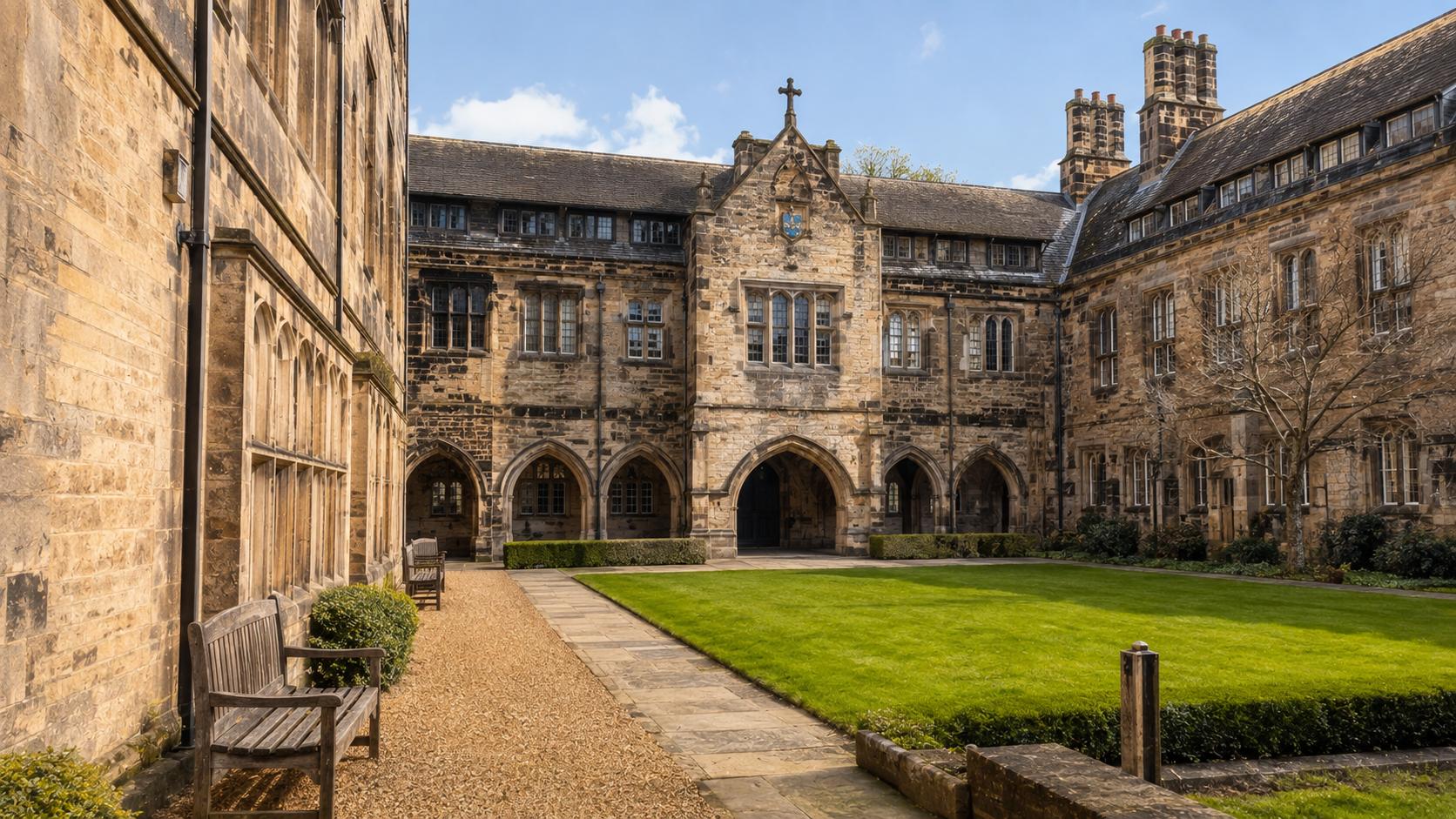
Newcastle has had formal schooling since long before the state took responsibility for it, and some of the institutions founded in the sixteenth and eighteenth centuries are still operating today.
The city's educational history runs from chantry schools through merchant endowments and charity foundations to the Victorian board schools whose buildings still dominate many inner-city streets.
Here is how it developed.
Education began with the church.
Before the Reformation, such schooling as existed in Newcastle was connected to the church, with chantry priests providing instruction alongside their religious duties.
The dissolution of the chantries in the 1540s removed much of that provision, and the response in Newcastle, as in many English towns, was the establishment of an endowed grammar school under civic rather than religious control.
That transition marks the beginning of continuous formal education in the town.
The Royal Grammar School dates from 1525.
Newcastle's Royal Grammar School traces its foundation to a bequest by Thomas Horsley, a merchant and mayor of Newcastle, whose will provided for the establishment of a free grammar school in the town.
The school was subsequently reconstituted under royal charter, which is the origin of the Royal prefix, and it has occupied several sites across the city over five centuries.
Its curriculum, like all grammar schools of the period, was built on Latin, with pupils drawn initially from the sons of freemen and merchants. It moved to its present site in Jesmond in the early twentieth century.
Dame Allan's was founded for the poor.
Dame Allan's Schools trace their origin to 1705 and a bequest by Eleanor Allan, the widow of a Newcastle merchant.
Her endowment provided for the free education of a specified number of poor children of the town, initially boys and girls in separate provision, which was itself notable for the period.
The schools have moved and been reorganised repeatedly since, and now operate on a site at Fenham. The original charitable purpose, providing education to children whose families could not otherwise afford it, remains part of the institution's account of itself.
Charity and Sunday schools filled gaps.
Through the eighteenth and early nineteenth centuries, provision for the majority of Newcastle's children depended on charity schools, Sunday schools and the small private establishments known as dame schools.
Quality varied enormously. Sunday schools taught reading, frequently for the purpose of scripture study, and for many working children they represented the only schooling available.
Ragged schools, aimed at the poorest children, operated in Newcastle from the mid-nineteenth century, and industrial schools combined basic education with training intended to produce employable workers.
The 1870 Act changed everything.
The Elementary Education Act 1870 allowed the creation of school boards empowered to build and run schools funded from the rates where existing provision was inadequate.
Newcastle's school board built extensively, and the resulting board schools are among the most recognisable Victorian buildings in the city: tall, red brick, with separate entrances carved for Boys, Girls and Infants, and large windows set high to prevent distraction.
Many still function as schools. Others have been converted to housing, offices or community use, and the carved entrance lettering usually survives.
Subsequent legislation made attendance compulsory and then free, and raised the leaving age progressively through the twentieth century.
Technical and further education followed.
Industrial Tyneside needed technically trained workers, and provision developed to meet that need.
Rutherford College, founded through the efforts of John Hunter Rutherford, a minister and educationalist, provided technical and scientific education to working people in Newcastle from the later nineteenth century.
The Durham College of Science, established in Newcastle in 1871, became Armstrong College and eventually King's College, which separated from Durham to become Newcastle University in 1963.
Northumbria University's origins lie in Rutherford College and other technical institutions, which merged to form Newcastle Polytechnic and gained university status in 1992.
Girls' education developed later.
Formal secondary education for girls in Newcastle developed principally in the later nineteenth century, when Central Newcastle High School and Newcastle Church High School were founded within a few years of one another.
Both operated for well over a century before merging in 2014 to form Newcastle High School for Girls.
Dame Allan's had provided for girls from its foundation, which was unusual, though the provision was separate and the curriculum differed considerably from that offered to boys.
Researching a school's history.
Tyne and Wear Archives holds school records including admission registers, log books and managers' minutes for a great many Newcastle schools, and these are among the most useful sources for family history.
Log books in particular can be extraordinary reading, recording epidemics, weather, absences for harvest or work, and the daily business of a Victorian classroom.
Newcastle City Library's local studies collection holds photographs, directories and published histories, and several individual schools maintain their own archives and alumni associations.
Share your thoughts.
Is your old school building still standing, and what is it used for now?
Newcastle History
Newcastle's Oldest Schools and Their Histories
Newcastle has been educating children in formal institutions for five centuries, and several of the schools founded in that time are still teaching.
Advertisement



Comments (0)
You must be logged in to post comments.
Don't have an account? Register here
No comments yet. Be the first to share your thoughts!