
For fifty years, Newcastle's streets carried a dense network of electric trams reaching from the city centre out to Gosforth, Benton, Byker, Walker, Denton and beyond.
By 1950 it had gone entirely, dismantled within a few years in favour of buses and trolleybuses. Traces survive in the street layout, in occasional surviving rails and in the Metro network that eventually followed.
Here is the story of the system Newcastle built and then removed.
Horse trams came first.
Newcastle's first trams ran from 1878, drawn by horses along rails laid in the street.
Horse traction had obvious limits. Gradients were a serious problem in a city built on the sides of a river valley, teams needed frequent changing, and the animals required stabling, feed and veterinary care on a substantial scale.
Steam traction was tried on some routes, but the noise, smoke and weight made it unpopular in urban streets.
Electrification transformed the system.
Newcastle Corporation took over the tramways and electrified the network, with electric services beginning in 1901.
Electric trams were faster, cleaner, quieter and capable of far greater capacity than horse trams, and they could handle gradients that horses could not.
The Corporation expanded aggressively, building new routes into developing suburbs and running a fleet that eventually numbered several hundred cars.
The network shaped where people lived.
This is the point most easily missed. Trams did not simply serve existing suburbs; they created them.
Housing development followed the tram routes outward from the centre, and speculative builders promoted new estates on the basis of tram access to city centre employment.
Gosforth, Heaton, Walker, Benwell and Denton all grew substantially in the tram era, and the pattern of terraced and semi-detached housing along the main radial roads reflects that.
The system was among the largest in Britain outside London, and it carried enormous numbers of passengers, particularly during the peak years between the wars.
Gateshead ran its own.
Gateshead operated a separate tramway system, run by a company rather than the corporation, with services running across the Tyne via the High Level and later the Tyne Bridge.
Through running between the two systems allowed journeys across the river, though the arrangements between operators were not always straightforward.
Gateshead's trams outlasted Newcastle's, running until 1951.
Decline set in after the war.
Several factors combined to end the system, and they were not unique to Newcastle. Tramways closed across Britain in the same period.
Track and vehicles had been worn hard through the Second World War with limited maintenance and no replacement, leaving substantial renewal costs at exactly the point when public finances were most constrained.
Motor buses had improved considerably and offered flexibility that fixed track could not: routes could be altered, extended or diverted without civil engineering.
Trams were also increasingly seen as obstructing motor traffic, since passengers boarded from the carriageway and trams could not pull to the kerb. In an era of rapidly rising car ownership, that was decisive.
The last tram ran in 1950.
Newcastle's system closed progressively through the late 1940s, with the final service operating in 1950.
Trolleybuses, drawing power from overhead wires but running on rubber tyres, replaced trams on many routes and continued until the 1960s, when they too were withdrawn in favour of motor buses.
Track was lifted or tarmacked over, overhead removed, and the depots repurposed. A small number of Newcastle and Gateshead cars survive in preservation.
The Metro was a partial return.
Newcastle eventually rebuilt urban rail, though in a different form. The Tyne and Wear Metro opened from 1980, using converted heavy rail alignments alongside new tunnelling under the city centre.
It was among the first modern light rail systems in Britain and became the model that later systems in Manchester, Sheffield, Croydon and elsewhere followed.
The Metro serves several corridors that trams once served, though on separate alignments rather than street running, and the Gateshead and Sunderland extensions came later.
The tram workers had their own world.
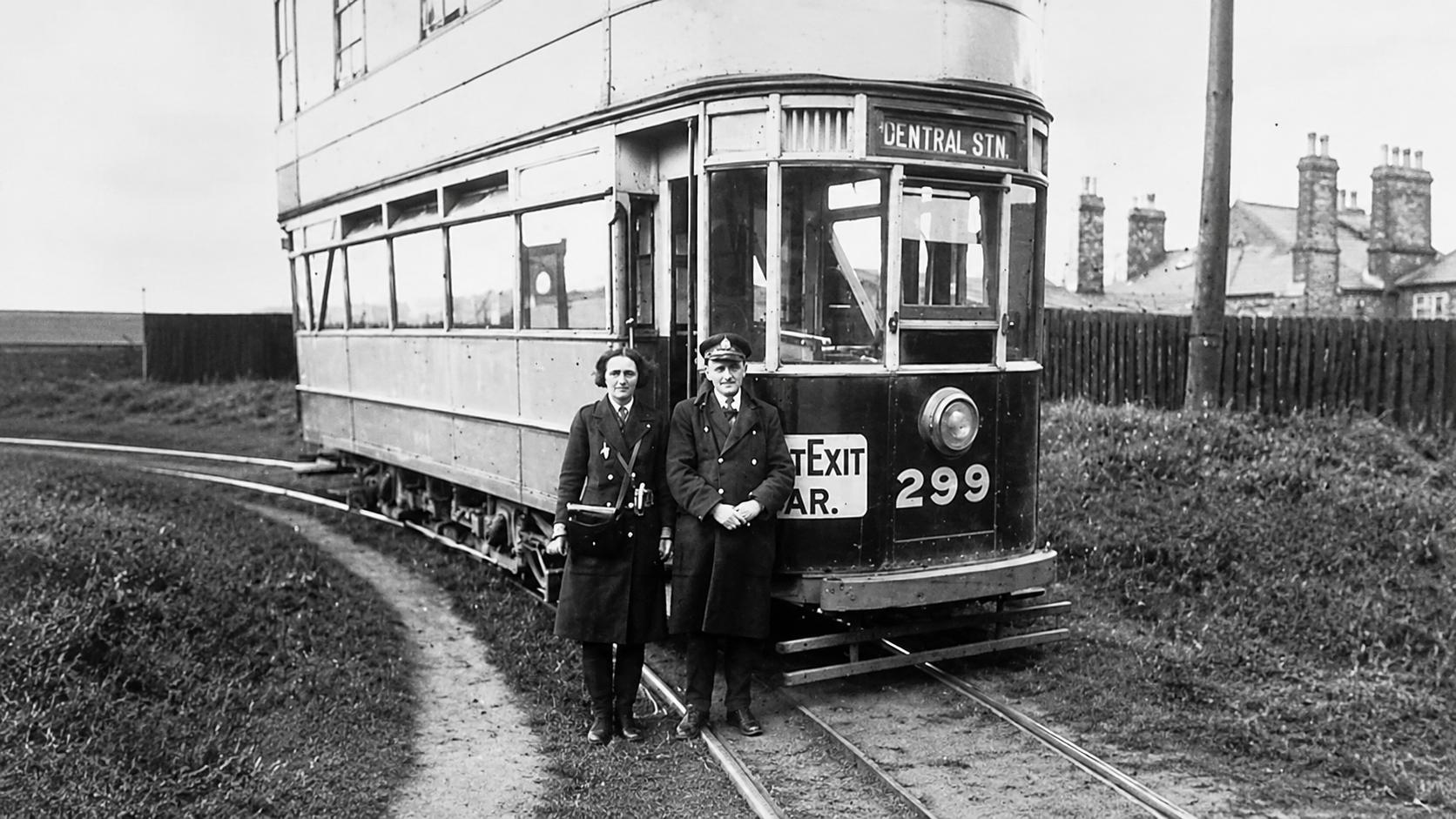
The Corporation employed large numbers of drivers, conductors, inspectors, fitters and permanent way staff, and tramway work was regarded as secure employment with a uniform and a pension.
Women were employed as conductors during both world wars, taking roles previously closed to them, and in Newcastle as elsewhere the question of whether they would be retained afterwards was contested.
Depot communities developed around the sheds at Byker, Wingrove and elsewhere, and the closure of the system removed a substantial body of skilled employment along with the trams themselves.
Traces remain if you look.
Setts and occasional rails survive in a few locations where resurfacing has worn through, particularly on quieter side streets and depot approaches.
Rosette fixings for overhead wires remain on some older buildings on main radial roads, drilled into the brickwork at first-floor level.
Former tram depots survive in altered use in several parts of the city, and the wide central reservations on some approach roads mark where reserved track once ran.
Tyne and Wear Archives holds Corporation tramway records including minutes, plans and photographs, and Newcastle City Library's local studies collection holds extensive photographic material of the system in operation.
Share your thoughts.
Do you have family who remember Newcastle's trams running?
Newcastle History
Newcastle's Trams: The Network the City Lost
For half a century, Newcastle ran one of the largest tram networks outside London, then dismantled it entirely within a few years.
Advertisement


Comments (0)
You must be logged in to post comments.
Don't have an account? Register here
No comments yet. Be the first to share your thoughts!