
When the shipyards and collieries that had defined the North East for generations fell silent, the region faced a profound economic challenge. The arrival of Nissan in Sunderland in the 1980s offered a powerful answer, bringing world-class car manufacturing and thousands of jobs to an area that had been hit hard by the decline of its traditional industries. Decades on, the plant has become one of Europe's most productive car factories and a symbol of the North East's capacity to reinvent itself.
A Bold Decision.
Nissan decided to build a plant in the United Kingdom in the early 1980s, and chose a site on the former Sunderland Airfield, close to the River Wear and a short distance from the Port of Tyne. There was something symbolic about the location, for an area scarred by the closure of shipyards and pits was to become home to a vital new source of employment and skilled work. Construction began in the mid-1980s, and car production started in 1986, with the first vehicle, a white Nissan Bluebird, rolling off the line that year and later finding a home in the local museum.
Building a Reputation for Excellence.
From its earliest days, the Sunderland plant set out to achieve the highest standards of quality and efficiency. It became renowned as one of the most productive car factories in Europe, a benchmark for manufacturing excellence that earned admiration across the industry. The workforce developed a reputation for skill, dedication and reliability, and the plant repeatedly demonstrated what could be achieved when modern manufacturing methods were combined with a committed and capable team. The North East had shown it could compete with the best in the world.
A Roll Call of Famous Models.
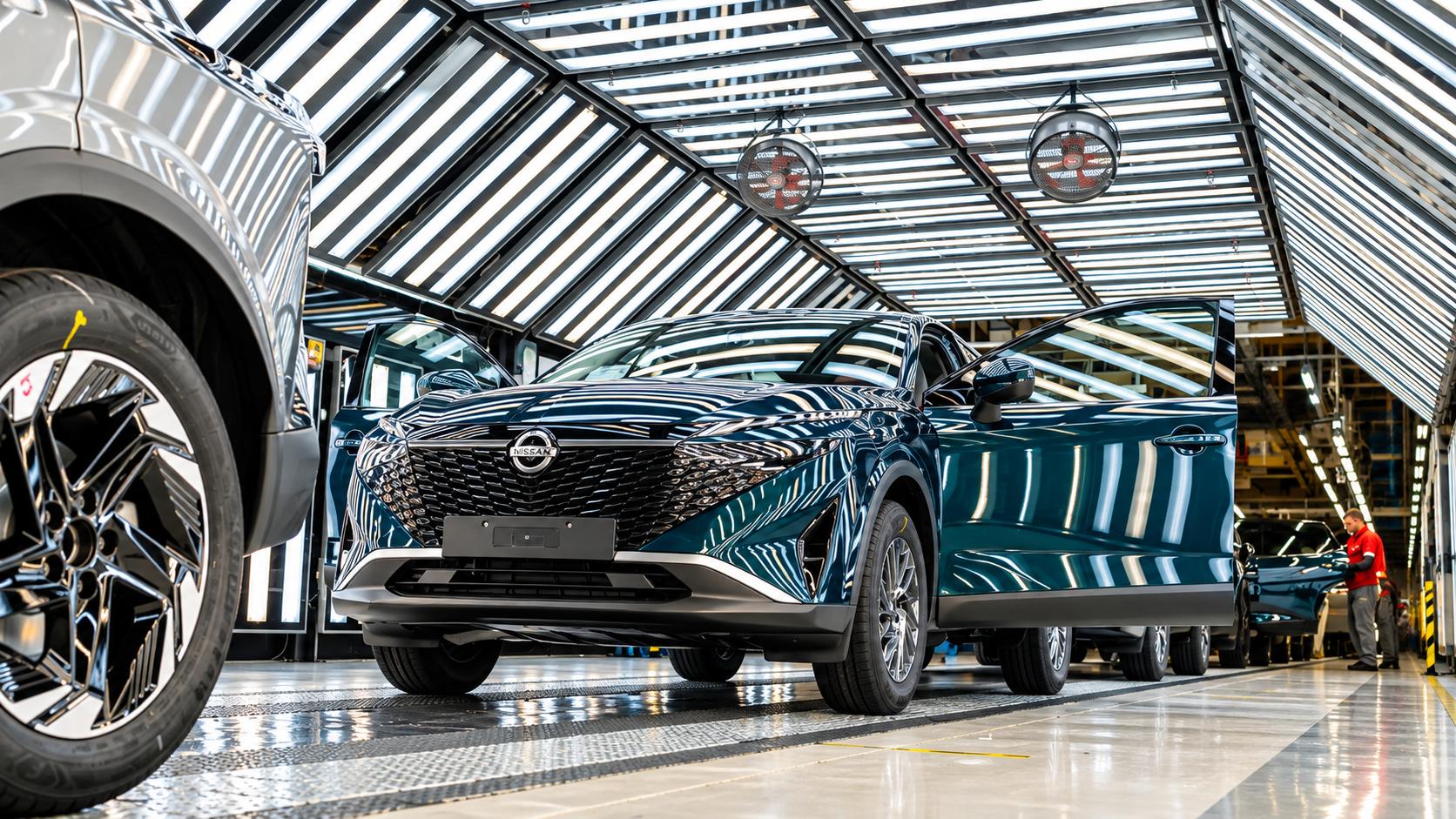
Over the decades the plant has produced a long line of well-known models, from the early Bluebird and Primera to the Micra, the Note, the Juke and, most importantly, the Qashqai. When the Qashqai was launched it helped to define an entirely new segment of the market, the crossover, and it became one of the most successful models in the history of the British car industry. The plant has built millions of vehicles over the years, with a new car rolling off the production line at an extraordinary rate around the clock, a testament to the scale and efficiency of the operation.
Driving Into the Electric Age.
Nissan Sunderland has also been at the forefront of the move towards electric vehicles. The plant became home to the production of the all-electric Nissan Leaf, one of the pioneering mass-market electric cars, along with battery manufacturing to support it. As the automotive industry undergoes its greatest transformation in a century, the Sunderland plant has continued to attract investment in electrification and new technology, positioning itself at the cutting edge of the transition to cleaner transport and securing its role in the future of the industry.
An Economic Powerhouse.
The importance of the plant to the North East economy is difficult to overstate. It directly employs thousands of people and supports many thousands more jobs in the wider supply chain, with a vast logistics operation delivering enormous quantities of parts to the site every day. As the United Kingdom's largest car factory and a major exporter, it contributes substantial sums to the national economy each year. For the region, it has been a source of stable, skilled employment and a powerful engine of economic regeneration over several decades.
More Than a Factory.
Nissan's presence has had an impact that goes beyond the production line. The plant has helped to build a skilled workforce, supported training and education initiatives, and encouraged the growth of a wider automotive supply industry in the region. It has demonstrated that the North East can be a competitive location for advanced manufacturing, attracting international investment and proving that the area's industrial traditions could be carried forward into new fields. The plant has become a source of pride and a symbol of renewal for Sunderland and the wider region.
A Symbol of Reinvention.
The story of Nissan in Sunderland is, at its heart, a story of reinvention. On land once associated with the decline of older industries, a new industry took root and flourished, giving the region renewed confidence and purpose. The plant stands as proof that the North East's manufacturing heritage did not end with the shipyards and the pits but found new expression in the most modern of industries. As it drives into the electric future, Nissan Sunderland continues to carry forward the region's proud tradition of making things, and making them well.
A Skilled and Loyal Workforce.
At the heart of the Sunderland plant's success has always been its people. From the very first days, when a small team built the first cars, the workforce developed a reputation for skill, commitment and pride in their work that became central to the plant's identity.
Many of those who joined in the early years stayed for the whole of their careers, and the plant became known for the loyalty and dedication of its employees. This human factor, as much as the advanced technology and efficient processes, explains why the Sunderland operation became a benchmark for quality and productivity admired across the industry.
The plant invested heavily in training and skills, creating opportunities for local people to build rewarding careers in advanced manufacturing and helping to develop a pool of expertise that benefits the wider regional economy. Initiatives to engage with schools and promote careers in engineering have helped to inspire the next generation.
The story of Nissan in Sunderland is therefore not only a tale of cars and investment but of the people who build them, whose skill and pride have made the plant one of the great manufacturing success stories of modern Britain.
We want to hear from you.
The Sunderland plant turned the decline of older industries into a story of manufacturing renewal.
How important do you think manufacturing like Nissan was to the future of the North East?
Business News
Nissan in Sunderland: The Plant That Rebuilt a Region's Pride
How the Nissan plant in Sunderland, opened in 1986, became one of Europe's most productive car factories and a symbol of North East manufacturing renewal.

Advertisement



Comments (0)
You must be logged in to post comments.
Don't have an account? Register here
No comments yet. Be the first to share your thoughts!