
For years, road safety campaigns have delivered the same clear message to motorists: keep your eyes on the road. Drivers have been warned repeatedly about the dangers of using mobile phones, adjusting sat navs, eating behind the wheel or becoming distracted by passengers. The consequences of taking your attention away from the road, even for a moment, can be devastating.
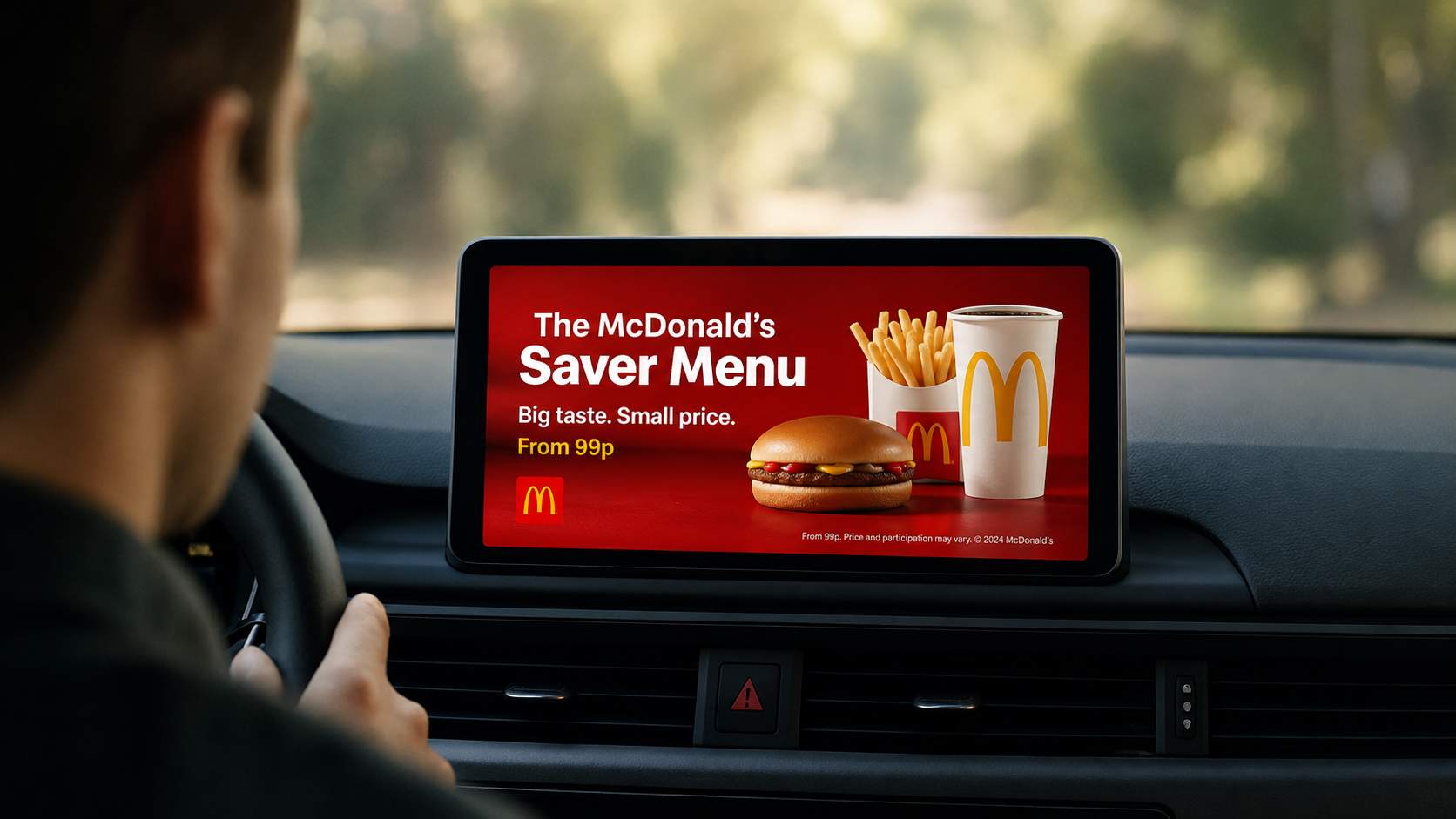
Yet while the Government continues to crack down on driver distraction, a new and unexpected threat is quietly appearing inside modern vehicles. Advertising is beginning to find its way onto dashboard infotainment systems, raising serious questions about whether cars are becoming the next frontier for digital marketing.
It sounds like something from a science fiction film, but it is already happening. Modern connected vehicles are capable of receiving over-the-air software updates, allowing manufacturers to add new features, improve navigation, fix faults and even install entirely new applications without the owner visiting a dealership. Increasingly, however, the same technology is also being used to deliver promotional content directly to drivers.
BMW recently launched a global promotional campaign across more than 70 countries, displaying adverts through its infotainment systems. While these messages generally appear before a journey begins rather than while the vehicle is moving, the move has sparked concern among consumer groups and road safety campaigners who fear it could mark the beginning of a much wider trend.
The concern is not necessarily today's advert. It is what could happen tomorrow.
Once manufacturers establish the technology and discover that dashboard advertising can generate additional revenue, the temptation to expand it could become difficult to resist. Promotional messages, subscription offers, sponsored recommendations and commercial notifications could all become part of the ownership experience. What begins as a harmless-looking advert before starting the engine could gradually evolve into a far more commercial driving environment.
This raises an uncomfortable question. If governments have spent years introducing tougher penalties for using mobile phones because they distract drivers, why is there seemingly so little discussion about advertising appearing on the very screens drivers rely on every day?
The Department for Transport has repeatedly identified driver distraction as one of the leading causes of preventable collisions on Britain's roads. Official figures show that in 2022 alone, 85 people lost their lives and more than 4,100 were injured in crashes where distraction inside the vehicle was recorded as a contributory factor. Those statistics only include incidents where police were able to identify distraction as a factor, meaning the real number is likely to be considerably higher.
Here in the North East, the issue is equally significant. Previous regional road safety analysis found that more than 1,400 casualties over a five-year period involved a distracted driver, representing around five per cent of all recorded casualties. On busy roads such as the A1, A19, Coast Road and Newcastle's Central Motorway, drivers have little margin for error. A momentary lapse in concentration can be all it takes for lives to change forever.
Road safety experts have long warned that drivers do not need to be distracted for very long before the risks increase dramatically. A motorist travelling at 30mph who looks away from the road for just two seconds will travel around 27 metres without properly observing what lies ahead. At motorway speeds, that distance rises to more than 60 metres – enough to miss stationary traffic, a pedestrian crossing or a cyclist emerging from a junction.
Successive governments have recognised these dangers. Handheld mobile phone use while driving carries six penalty points and a substantial fine because lawmakers accept that visual and cognitive distractions dramatically increase crash risk. Drivers can also be prosecuted for losing control of their vehicle while using hands-free technology if police believe they were not paying sufficient attention.
Against that backdrop, many motorists are asking whether it makes sense for manufacturers to begin placing commercial content on dashboard screens at all. Even if today's adverts only appear before a journey starts, the technology has now been proven. The infrastructure already exists. The commercial opportunity is obvious.
Perhaps the more important question is why regulators appear to be waiting for the technology to become widespread before deciding whether it is appropriate.
At present there is no specific UK law that expressly prohibits manufacturers from displaying advertising on infotainment systems before a journey begins, provided vehicles continue to comply with existing safety and construction regulations. However, there are also no dedicated rules governing how commercial content may be presented inside connected vehicles or how that technology might evolve in future.
That has left many questioning whether legislation has simply failed to keep pace with advances in vehicle technology. Cars are rapidly becoming internet-connected digital platforms, capable of downloading software, streaming entertainment, selling subscriptions and interacting with drivers in ways that would have been unimaginable a decade ago. Yet the regulatory framework surrounding driver distraction remains largely focused on mobile phones and traditional in-car behaviour.
The issue is no longer whether manufacturers can display adverts. They clearly can.
The question is whether they should.
Cars have traditionally been one of the few environments where people could escape the constant stream of online advertising that fills their phones, televisions and computers. If dashboard screens become another space for targeted marketing, many drivers will wonder whether safety is being placed behind commercial opportunity.
Road safety has always relied on removing distractions wherever possible. Introducing new ones—even with the best commercial intentions—appears to move in the opposite direction.
As connected vehicles become increasingly sophisticated, lawmakers may soon face an important decision. Do they act now, before in-car advertising becomes commonplace, or wait until commercial dashboards have become the new normal?
For many motorists, the answer is already clear.
Share your thoughts.
Should advertising on vehicle dashboard screens be banned in the UK?
Tech News
North East Drivers Face Dangerous Dashboard Concern
Advertisement




Comments (0)
You must be logged in to post comments.
Don't have an account? Register here
No comments yet. Be the first to share your thoughts!