
Smart heating controls are among the most heavily marketed home technology products, and the savings claims attached to them are among the least reliable.
They can genuinely reduce bills. Whether they will reduce yours depends almost entirely on what you are doing now.
Here is how they work and when they are worth it.
The savings depend on your starting point.
If your heating currently runs on a timer you never adjust, and you heat the whole house whether or not anyone is in it, a smart control can save a meaningful amount.
If you already have a well-programmed thermostat, adjust it seasonally and turn the heating down when out, the additional saving may be small.
Manufacturer savings figures are generally derived from comparison against poorly controlled heating, which is why they look impressive and why individual results vary so widely.
Smart thermostats replace the room stat.
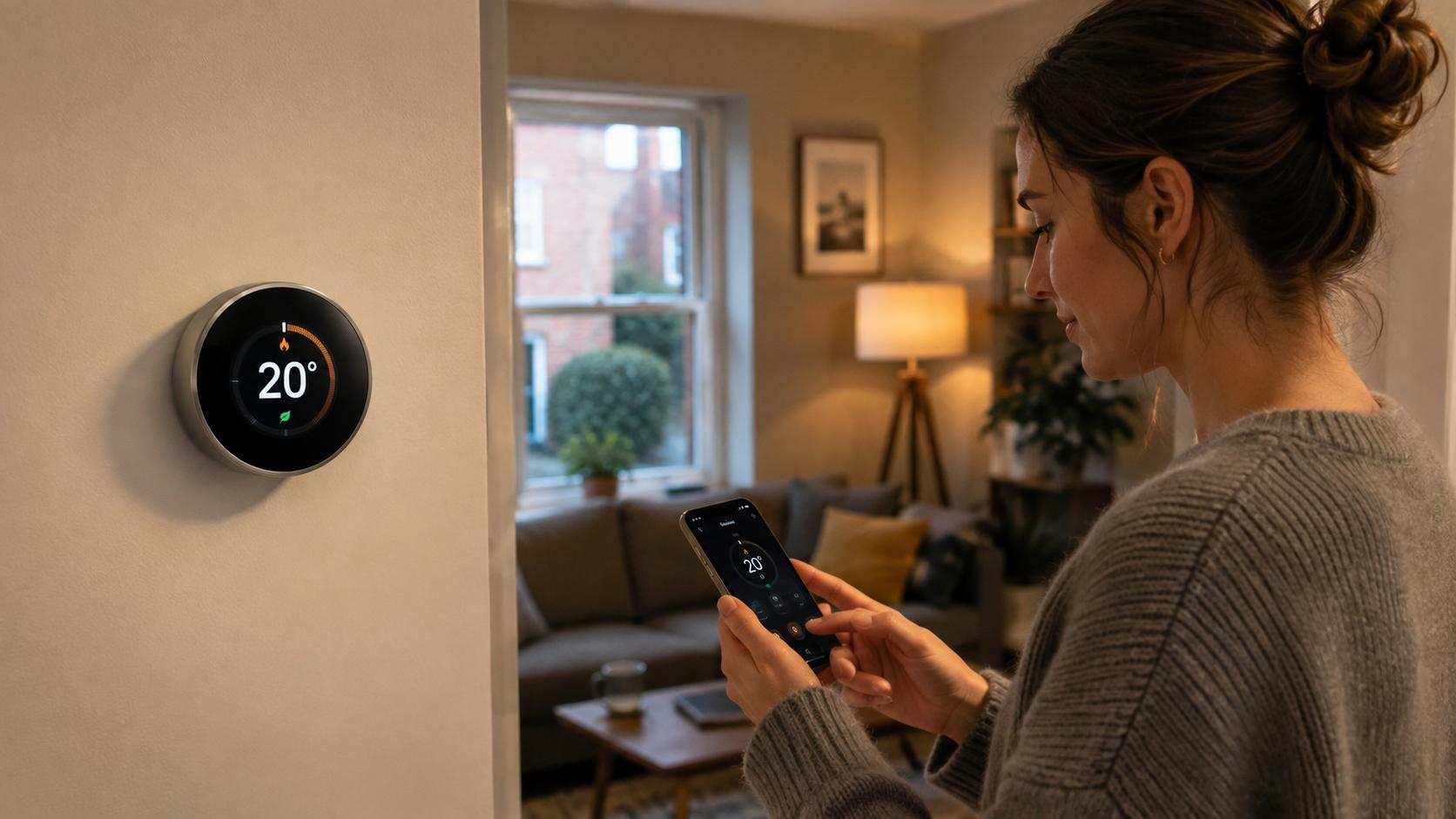
A smart thermostat controls the boiler based on a target temperature, like a conventional room thermostat, with the addition of remote control from a phone, scheduling and various automatic features.
The genuinely useful features are geofencing, which uses your phone's location to turn heating down when the house empties, and learning behaviour that adjusts the schedule to how you actually live.
Weather compensation, where the system adjusts flow temperature based on outdoor conditions, delivers real efficiency gains on compatible boilers.
Remote control is convenient rather than money-saving in itself, though the ability to turn heating off from elsewhere when plans change does add up.
Radiator valves enable zoning.
Smart thermostatic radiator valves replace the manual valve on individual radiators and allow each room to be controlled separately.
This is where genuine savings often sit, because it allows you to stop heating rooms nobody uses. Heating a spare bedroom to the same temperature as the living room, all winter, is a straightforward waste.
The catch is cost. Valves are expensive per radiator, and a whole-house set can cost several hundred pounds, which lengthens the payback period considerably.
Fitting is usually straightforward and does not require draining the system, though old valves can seize and occasionally require a plumber.
Compatibility must be checked first.
Not every system suits every control, and this is the most common cause of disappointment.
Combi boilers, system boilers with hot water cylinders, and heat pumps all have different requirements, and controls that work with one may not suit another.
If you have separate hot water control, you need a control supporting that. If you have underfloor heating, or a heat pump, check specifically for support, since heat pumps run very differently from gas boilers and require controls designed for low flow temperatures and continuous operation.
Older systems with no room thermostat at all may need additional wiring, and some installations require an electrician.
Placement affects everything.
A thermostat in a draughty hallway near the front door will read colder than the rest of the house and overheat everywhere else.
One above a radiator will read warm and shut the heating off prematurely. One in direct sunlight will do the same.
Ideal placement is an internal wall in a regularly used room, around 1.5 metres from the floor, away from draughts, radiators, direct sun and heat-producing appliances.
Smart meters are a different thing.
Smart meters measure and report consumption automatically. They do not control anything and do not save energy by themselves.
The in-home display is where the value sits, because seeing consumption in real time changes behaviour. Finding out what an electric shower or a tumble dryer actually costs to run tends to be memorable.
Smart meters also enable time-of-use tariffs, which charge different rates at different times. For households able to shift consumption — running appliances overnight, charging an electric vehicle off-peak — these can produce substantial savings.
The basics still matter more.
No control system compensates for an uninsulated loft.
Loft insulation, cavity wall insulation where suitable, draught-proofing around doors, floors and letterboxes, and thick curtains all deliver reliable savings for modest outlay, and they work whether or not anyone remembers to use an app.
Bleeding radiators, balancing the system so distant radiators heat properly, and having the boiler serviced all improve efficiency for very little cost.
Reducing boiler flow temperature on a condensing gas boiler, typically to around 60 degrees for radiators, allows it to condense properly and can improve efficiency noticeably without affecting comfort.
Grants and support in the North East.
Energy efficiency grant schemes operate periodically, with eligibility generally based on income, benefits, property energy rating and heating type.
Newcastle City Council and neighbouring authorities publish current schemes, and the Energy Saving Trust maintains national guidance on what is available.
Local energy advice services can carry out assessments and identify which measures suit a specific property, which is more useful than generic advice, particularly for the region's substantial stock of solid-walled Victorian housing where standard cavity insulation does not apply.
Practical advice.
Start with a single smart thermostat rather than a whole-house valve system, and see whether the behaviour change alone helps.
Check compatibility with your boiler before ordering, and check whether professional installation is included in the price.
Consider whether the system requires a subscription or a proprietary hub, and what happens to functionality if the manufacturer discontinues support.
Share your thoughts.
Has a smart thermostat actually cut your bills, or just made control easier?
Tech News
Smart Heating: What Actually Saves Money
Smart thermostats are sold on savings claims that depend almost entirely on how badly your heating was controlled beforehand.
Advertisement





Comments (0)
You must be logged in to post comments.
Don't have an account? Register here
No comments yet. Be the first to share your thoughts!