
Along the rugged coast of the North East, with its hidden coves, lonely beaches and quiet harbours, there once flourished a trade conducted by moonlight and shrouded in secrecy. Smuggling, the illicit trade in contraband goods that evaded the duties imposed by the government, was rife along the coast for many years, a shadowy world of free traders, revenue men and hidden cargoes. The story of smuggling is a colourful and dramatic part of the region's coastal heritage.
The Lure of Free Trade.
Smuggling arose because of the high duties that the government imposed on a range of goods, from spirits and tobacco to tea and other luxuries. These taxes made such goods expensive, and they created a powerful incentive to bring them into the country illicitly, avoiding the duties and selling them at a profit. The smugglers, who often saw themselves as free traders rather than criminals, supplied goods that ordinary people wanted at prices they could afford, and their trade enjoyed a good deal of sympathy and support among the coastal communities. The economics of high taxation made smuggling an attractive and widespread activity along the coast.
A Coast Made for Smuggling.
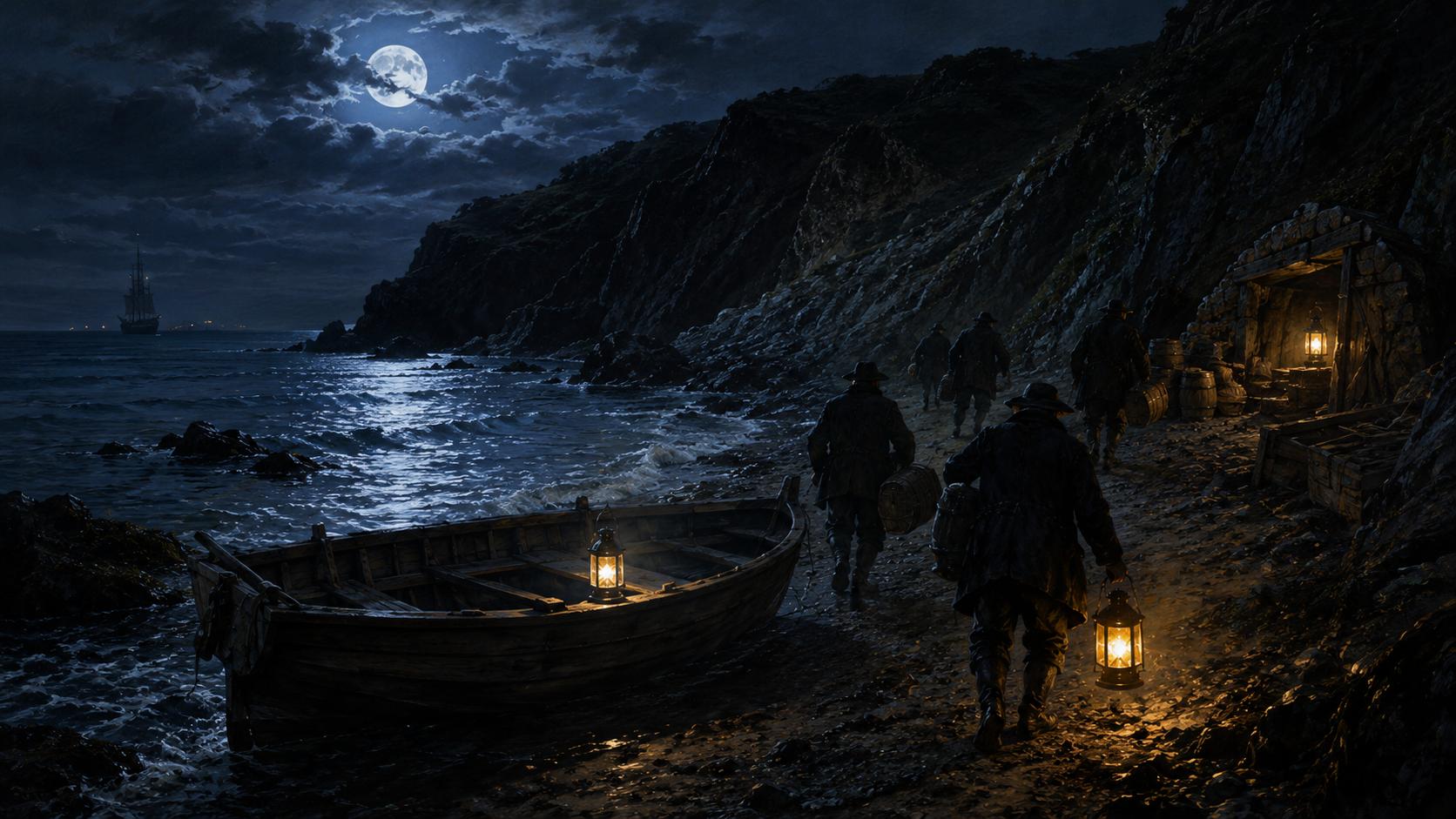
The coast of the North East was well suited to the smuggling trade. Its rugged shoreline, with numerous coves, inlets and quiet beaches, offered countless places where contraband could be landed away from prying eyes, while the fishing communities provided both the boats and the local knowledge needed for the trade. The smugglers knew the coast intimately, and they could land their cargoes under cover of darkness in remote spots, spiriting the goods away before the authorities were any the wiser. The geography of the coast, combined with the seafaring skills of the local people, made the region a natural home for smuggling.
The Methods of the Trade.
Smuggling required cunning, organisation and nerve. Contraband was brought across the sea and landed at night, often in carefully chosen spots where the goods could be quickly unloaded and concealed. The smugglers developed an array of ingenious methods to hide their cargoes and to move them inland, using hidden cellars, secret compartments and a network of trusted helpers. Signals were used to warn of danger or to indicate that the coast was clear, and the whole operation depended on secrecy and the cooperation of the local community. The smugglers were resourceful and daring, and they developed their illicit trade into a sophisticated operation.
The Revenue Men.
Ranged against the smugglers were the revenue men, the customs officers whose job it was to prevent smuggling and to collect the duties owed to the government. These officials patrolled the coast, watched for suspicious activity and sought to intercept the smugglers and their cargoes, supported by the revenue cutters that patrolled the seas. The contest between the smugglers and the revenue men was a constant one, a game of cat and mouse played out along the coast, with each side using cunning and local knowledge to outwit the other. The revenue men faced a difficult task, often outnumbered and hampered by the sympathy that many local people felt for the smugglers.
A Community Affair.
One of the most striking features of smuggling was the extent to which it involved and was supported by the coastal communities. Far from being the work of a few isolated criminals, smuggling was often a community affair, with many local people involved in or sympathetic to the trade. The goods it supplied were welcomed, the profits it brought were valued, and the smugglers were frequently regarded as local heroes rather than criminals. This community support made smuggling extremely difficult to suppress, for the authorities faced not just the smugglers themselves but the silent complicity of whole communities. The trade was woven into the life of the coast.
Danger and Adventure.
Smuggling was a dangerous business, carried out under cover of darkness and in defiance of the law, with the constant risk of capture, conflict and worse. Encounters between smugglers and revenue men could turn violent, and the penalties for those who were caught could be severe. Yet the dangers were part of the appeal, and the smuggling trade has acquired an air of romance and adventure that endures to this day. The image of the smuggler, landing his cargo by moonlight and outwitting the revenue men, has become a staple of coastal legend, lending the trade a glamour that perhaps obscures its harder realities.
A Coastal Legend.
Smuggling is a colourful and dramatic part of the heritage of the North East coast, a shadowy trade that flourished along the shoreline for many years. The hidden coves where contraband was landed, the cunning of the smugglers, the contest with the revenue men and the complicity of the coastal communities all combine to create a fascinating chapter in the region's history. Though the smuggling age has long passed, its memory lingers along the coast, in the tales and legends that recall the days of moonlight and contraband. It is a heritage of adventure and intrigue that continues to capture the imagination.
The Economics of Smuggling.
The persistence and scale of smuggling can only be understood in the light of the economics that drove it, for the trade was, at bottom, a response to the high duties imposed on popular goods. When the taxes on commodities such as spirits, tobacco and tea made them expensive, a powerful incentive was created to bring them into the country illicitly and to sell them more cheaply, and as long as this gap between the taxed and untaxed price persisted, smuggling remained profitable and widespread.
The smugglers were, in effect, responding to a demand created by the tax system, supplying goods that people wanted at prices they could afford. This economic logic explains both the scale of the trade and the sympathy it enjoyed among the coastal communities, for many ordinary people benefited from the cheaper goods that the smugglers supplied and saw no harm in evading taxes they regarded as excessive.
The contest between the smugglers and the authorities was thus, in part, a contest over taxation, and the trade flourished as long as the duties remained high enough to make it worthwhile. Only when the duties were eventually reduced did the incentive for smuggling diminish, and the trade gradually declined. The economics of smuggling reveal it as a phenomenon driven by the realities of taxation and demand, a response to the gap between the price of taxed and untaxed goods that made the illicit trade so attractive and so difficult to suppress along the coast.
Share your stories.
Do you know of any local smuggling tales?
Newcastle History
Moonlight and Contraband: Smuggling on the North East Coast
A look at smuggling on the North East coast, the shadowy trade of moonlit landings, hidden contraband, free traders and the revenue men who chased them.
Advertisement


Comments (0)
You must be logged in to post comments.
Don't have an account? Register here
No comments yet. Be the first to share your thoughts!