
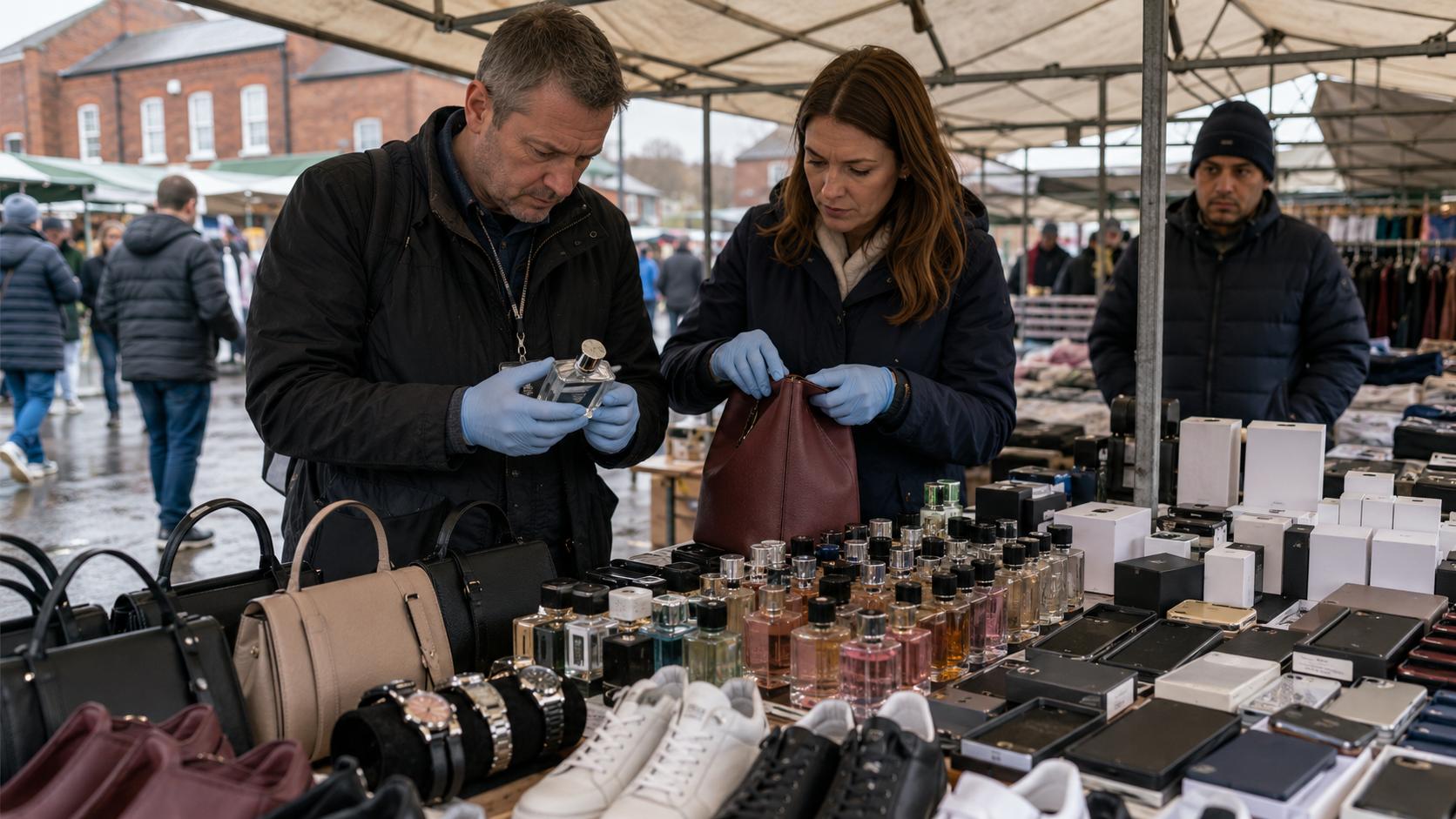
The market stall selling perfume at a fifth of the shop price, the social media account offering designer trainers with no returns policy, the phone charger that costs three pounds and arrives without any recognisable branding. Counterfeiting has moved a long way from the tourist markets and dodgy pub sales of thirty years ago, and the North East sees the full range of it.
Most people treat fakes as a victimless indulgence, a bit of harmless bargain hunting at the expense of companies who charge too much anyway. That view is comfortable and, in a significant number of cases, badly wrong. The trade is a criminal enterprise, the goods are frequently dangerous, and the money goes somewhere.
The law is criminal, not just civil.
Trade mark infringement is often assumed to be a matter for lawyers and injunctions. It is that, but selling counterfeit goods with an identical or nearly identical mark to a registered trade mark, in the course of business and without the owner's consent, is also a criminal offence carrying a substantial maximum sentence.
Enforcement falls largely to local authority trading standards teams, working alongside police, the Intellectual Property Office, Border Force and brand protection investigators employed by the rights holders themselves. Trading standards officers have powers of entry, inspection and seizure, and prosecutions in the region are brought regularly.
Proceeds of crime legislation applies as well, which means a successful prosecution can be followed by confiscation proceedings targeting the profits. That is frequently a more effective deterrent than the sentence itself.
The dangerous categories are not the obvious ones.
A counterfeit handbag is a commercial problem. A counterfeit electrical item is a safety problem, and the difference matters enormously.
Fake chargers, power banks, extension leads and other electrical goods are consistently found to fail basic safety testing. Common defects include inadequate insulation between mains and low-voltage sides, undersized components, absent fuses and casings that will not contain a fire. These are not marginal failures; they are the specific defects that cause fires and electrocutions.
Cosmetics and skincare are another recurring category, with counterfeit products found to contain substances that would never be permitted in a legitimate formulation. Fake vapes and their liquids have been a significant enforcement focus, with seized products found to exceed permitted nicotine strengths and tank sizes and to contain undeclared substances.
Vehicle parts are perhaps the most alarming. Counterfeit brake pads, airbags, filters and safety-critical components are found in circulation, and a part that fails at speed does not fail in a small way.
Fake toys and children's products fail on choking hazards, unsafe materials and inadequate flammability performance, and fake alcohol has caused serious illness where industrial alcohols have been substituted.
Where the money goes.
The comfortable assumption is that counterfeiting is small-scale entrepreneurial activity. In reality the supply chains are organised and international, and law enforcement across Europe has repeatedly established links between counterfeit trading and other organised crime including drug trafficking, money laundering and human trafficking.
Manufacturing frequently takes place in conditions with no labour protection whatsoever, and modern slavery has been identified in the production and distribution of counterfeit goods in the UK itself, including in nail bars, car washes and small manufacturing units.
There is also a straightforward economic effect closer to home. Legitimate retailers in Newcastle pay rent, business rates, staff wages and tax, and compete against sellers who pay none of those things.
Selling has moved online and into private messaging.
Enforcement was considerably easier when counterfeiting happened in physical markets. The trade has since moved substantially onto social media platforms, online marketplaces and encrypted messaging groups, where sellers operate under disposable accounts and take payment through methods that offer buyers no protection.
The pattern is consistent and recognisable. Goods advertised at a fraction of retail price, communication moved quickly to direct messages, payment requested by bank transfer or friends-and-family payment rather than a method with buyer protection, no business address, no returns policy and an account that disappears if challenged.
Live selling and group buying formats have added a sense of urgency that discourages the buyer from thinking too hard about any of that.
How to tell, and what to do.
Price is the strongest signal. A genuine premium product at eighty per cent below retail is not a bargain that somebody has stumbled into; it is an explanation waiting to be given.
Check for a proper business address and company details, a returns policy, and a payment method offering protection. Card payments carry chargeback rights, and credit card purchases over a certain value carry additional statutory protection that bank transfers do not.
For electrical goods, look for proper safety markings, a manufacturer's name and address, and packaging with correct spelling and print quality. Counterfeit packaging has improved enormously but rarely survives close inspection of the small print.
Report suspected counterfeit sellers to trading standards through the Citizens Advice consumer service, which passes information on, and to the platform hosting the sale. Reports build the intelligence picture even when no single report triggers action on its own.
If you have bought something dangerous, stop using it. A fake charger that has worked fine for six months is not safe; it is untested.
Share your thoughts.
Have you ever knowingly bought a counterfeit product, and would you again knowing where the money goes?
Crime News
The Counterfeit Goods Trade Across the North East
Advertisement




Comments (0)
You must be logged in to post comments.
Don't have an account? Register here
No comments yet. Be the first to share your thoughts!