
Every household eventually needs a shelf putting up, a radiator bleeding or a washer changing. Paying someone for a ten-minute job is dispiriting, and a small collection of decent tools pays for itself quickly.
Equally, some jobs should never be attempted by an untrained person, and a few of those are governed by law rather than preference.
Here is what to own, what to attempt and where the line sits.
Start with a dozen tools.
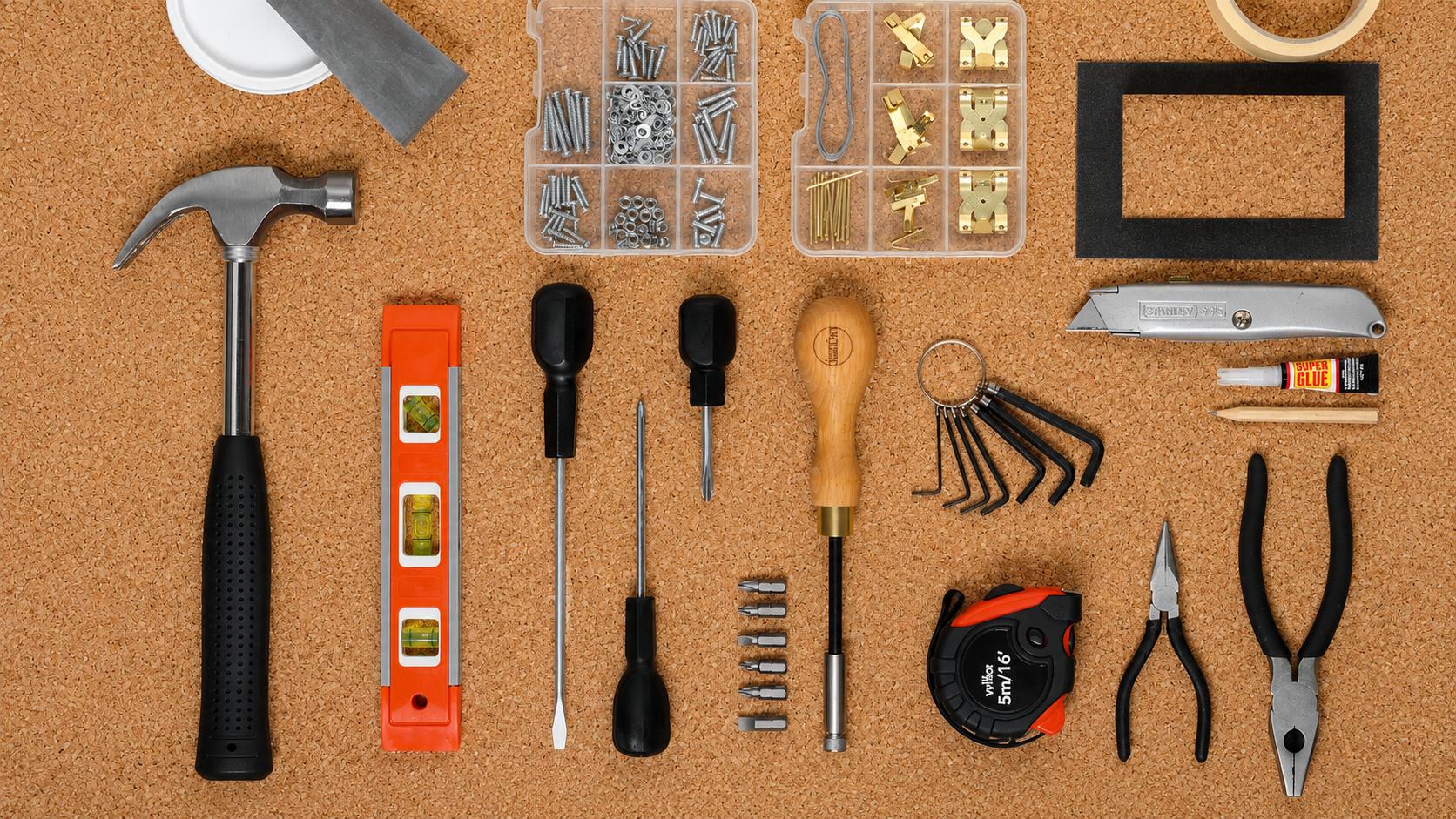
A claw hammer, a set of screwdrivers including both flat and cross-head in several sizes, and an adjustable spanner cover a surprising amount.
Add a retractable tape measure, a spirit level of reasonable length, a utility knife with replaceable blades, combination pliers and a pair of long-nose pliers.
A cordless drill with a driver function is the single most useful purchase. It does not need to be expensive, but a spare battery is worth having.
Finish with an assortment of screws and wall plugs, a small hacksaw, and a torch. Keep everything in one box, because tools scattered across three drawers effectively do not exist.
A detector belongs on that list.
A combined stud, pipe and cable detector costs relatively little and prevents the single most expensive DIY mistake.
Drilling into a buried cable or a water pipe turns a five-minute job into a substantial repair bill, and in the case of a cable it can be dangerous.
As a general rule, cables run vertically and horizontally from sockets and switches rather than diagonally, so avoid drilling directly above or beside them. A detector confirms it.
Fixing to a wall depends on the wall.
The most common DIY failure is a fixing pulling out, and the cause is almost always using the wrong type for the wall.
Solid masonry walls need a masonry drill bit and a standard wall plug matched to the screw size. Drill to the depth of the plug, not deeper, and tap the plug flush before driving the screw.
Plasterboard, hollow and common in modern homes and stud partitions, needs a specific fixing. Self-drive plasterboard fixings work for light loads, while heavier items need toggle or spring fixings that open out behind the board.
For anything genuinely heavy, such as a wall-mounted television or a shelf carrying books, fix into the timber studs behind the board rather than the board itself.
Learn the jobs that save call-outs.
Bleeding radiators is straightforward and worth doing at the start of each heating season. With the system off, use a radiator key on the valve at the top corner, release trapped air until water appears, then close it and check system pressure.
Changing a tap washer or a whole tap cartridge stops a drip and requires only isolating the water and a spanner. Know where your stopcock is before you need it, and check it turns.
Replacing a toilet flush valve, resealing a bath with silicone, changing a door handle, adjusting a hinge and replacing a light switch faceplate are all within reach of a careful beginner working from a reputable guide.
Resetting a tripped circuit breaker is fine. Investigating why it tripped repeatedly is not.
Some work legally requires a professional.
This is the part that matters most. Any work on gas appliances or gas pipework must be carried out by a Gas Safe registered engineer. It is a legal requirement, not a recommendation, and carbon monoxide risk makes it a genuinely serious matter.
Most fixed electrical work in England and Wales is notifiable under Part P of the Building Regulations, particularly anything in kitchens, bathrooms and outdoors, and new circuits anywhere. It must be carried out by a registered competent person or notified to building control.
Replacing a like-for-like light fitting or socket faceplate is generally permitted, but consumer unit work, new circuits and anything in a bathroom is not.
Structural work, including removing or altering any wall that may be load-bearing, needs professional assessment. If you are unsure whether a wall is structural, assume it is until told otherwise.
Asbestos deserves particular caution.
Homes built or refurbished before the late 1990s may contain asbestos, commonly in artex textured coatings, floor tiles, insulation board, garage roofs and around old boilers.
Undisturbed asbestos is generally not a risk. Drilling, sanding or breaking it releases fibres, which is where the danger lies.
If you suspect asbestos, stop and seek advice rather than continuing. Testing is available, and licensed removal is required for higher-risk materials.
Safety equipment costs very little.
Safety glasses, work gloves and a dust mask are inexpensive and should be used as a matter of routine rather than for big jobs only.
Drilling overhead sends debris directly towards your eyes, and old plaster dust is genuinely unpleasant to breathe.
A stepladder in good condition, used on level ground and not overreached from, prevents the single most common household DIY injury. Standing on a chair is how people end up in A and E.
Know when hiring is better than buying.
Tools used once a decade are rarely worth owning. Tool hire is widely available and covers everything from SDS drills and floor sanders to wallpaper steamers and carpet cleaners.
Some libraries now operate library of things schemes lending household tools and equipment, and several operate in the North East.
Borrowing from a neighbour remains the oldest and best system, provided you return things promptly and in the condition they arrived.
Know your limits without apology.
There is no shame in deciding a job is beyond you. Tradespeople generally prefer being called before an attempt rather than afterwards, and half-finished DIY costs more to put right than the original job.
Check that anyone you hire is appropriately registered for the work involved, ask for references and get more than one quotation for anything substantial.
Knowing which jobs to attempt is a skill in itself, and one that develops faster than any amount of tool buying.
Share your thoughts.
Do you have a home toolkit in case of emergencies?
Lifestyle News
The Home Toolkit: What to Own and What to Leave Alone
A dozen tools will handle most household jobs, and knowing which jobs to hand over is just as valuable as knowing which to attempt.
Advertisement




Comments (0)
You must be logged in to post comments.
Don't have an account? Register here
No comments yet. Be the first to share your thoughts!