
The rainbow flag has become one of the most instantly recognisable symbols in the world, yet relatively few people know the specific story behind its design or exactly what each of its colours was originally intended to represent. Understanding that history adds genuine depth to a symbol now seen flying above town halls, businesses and homes across Newcastle and far beyond every Pride season.
The flag was created in 1978 by Gilbert Baker, an artist and activist based in San Francisco, at the direct request of Harvey Milk, one of the first openly gay elected officials in the United States. Baker wanted a symbol that could unify the LGBTQ+ community in a way existing symbols of the time, including the pink triangle, could not, given the pink triangle's origins as a mark used to identify gay men in Nazi concentration camps.
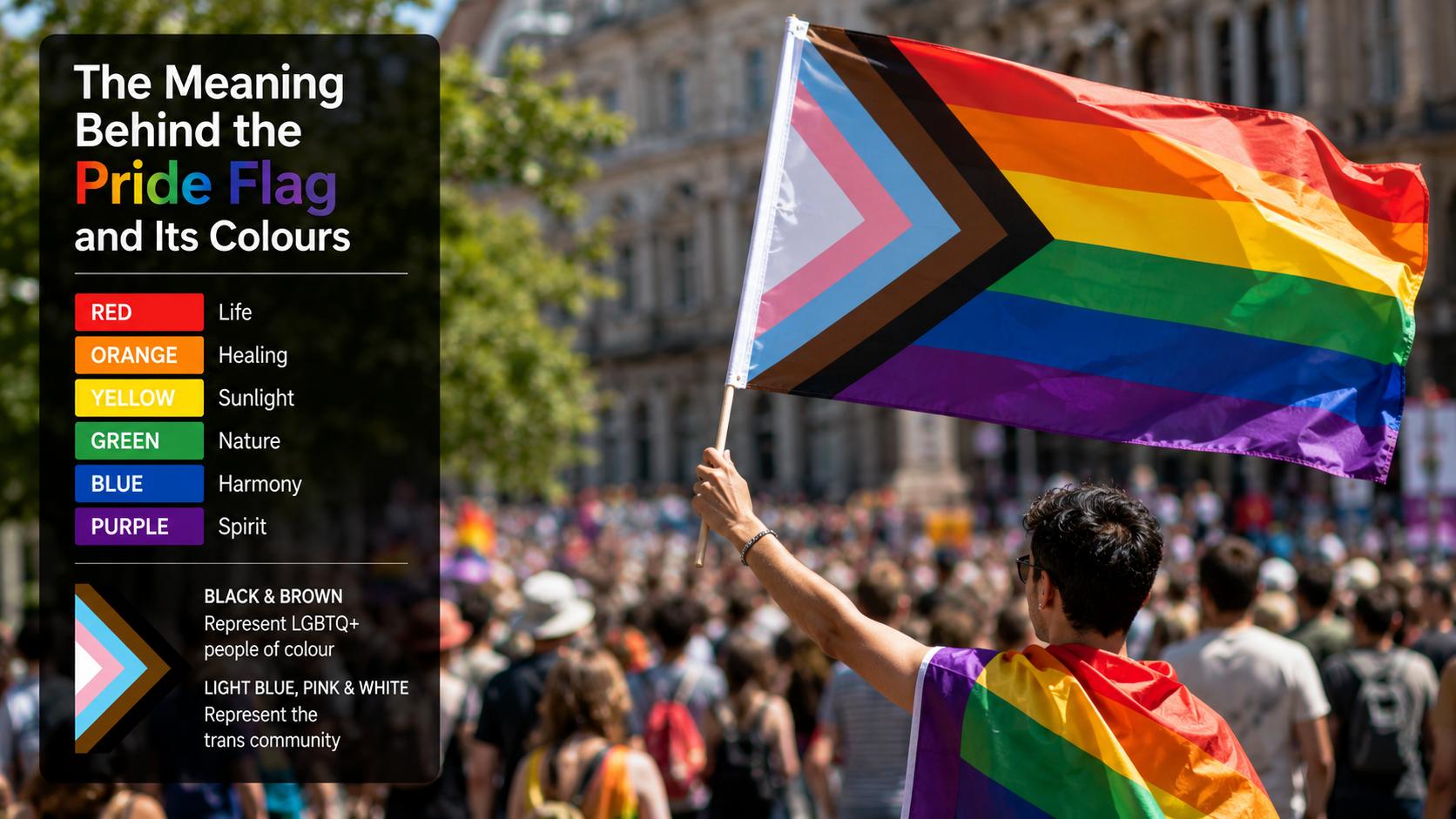
Baker's original design featured eight distinct colours, each carrying its own deliberate meaning: hot pink for sexuality, red for life, orange for healing, yellow for sunlight, green for nature, turquoise for magic and art, indigo for serenity, and violet for spirit. Each stripe was intended to represent a specific aspect of the diverse, multifaceted community the flag was designed to represent as a whole.
Practical constraints soon reshaped the design. Hot pink fabric proved difficult and expensive to source in the necessary quantities, leading to its removal from the flag shortly after its debut. Turquoise was later dropped too, largely so the remaining stripes could be divided evenly for manufacturing purposes, leaving the six-colour version, red, orange, yellow, green, blue and violet, that most people recognise as the standard Pride flag today.
The flag's meaning has continued evolving well beyond Baker's original design too. In 2017, Philadelphia introduced an additional black and brown stripe specifically to highlight the experiences of LGBTQ+ people of colour, whose contributions to the movement have sometimes been overlooked within its wider history. This variation helped inspire the creation of the Progress Pride flag in 2018.
The Progress Pride flag, designed by Daniel Quasar, incorporates a chevron of white, pink, light blue, brown and black stripes alongside the traditional six-colour rainbow, specifically representing transgender and non-binary people alongside LGBTQ+ people of colour, deliberately placing these additional stripes at the flag's leading edge as a visual statement about progress still needing to be made.
Numerous other flags have emerged over the decades to represent specific identities within the wider LGBTQ+ community too, including distinct designs for the bisexual, transgender, non-binary, asexual and pansexual communities, each carrying its own specific colour symbolism, reflecting the genuinely diverse range of identities the broader Pride movement has always sought to represent under one collective banner.
Gilbert Baker himself sewed the very first flags entirely by hand ahead of their debut at San Francisco's 1978 Gay Freedom Day Parade, and he later remarked that he wanted the flag to genuinely belong to everyone, refusing to trademark or copyright the design specifically so it could be freely reproduced and flown by anyone, anywhere, without restriction.
Newcastle's own Pride celebrations regularly incorporate several of these different flag variants across the festival's satellite events and community stalls, reflecting the wider LGBTQ+ movement's ongoing effort to ensure every part of its genuinely diverse community feels properly represented within the celebrations, rather than relying purely on the original six-colour design alone.
Flags are often displayed alongside one another during Pride season specifically to acknowledge this diversity of identity within a single visual display, and learning to recognise a handful of the more common variants can genuinely deepen anyone's appreciation of just how many distinct communities the wider Pride movement actually represents under one collective banner each year.
Whatever specific version is flown, the rainbow flag's core purpose has remained remarkably consistent since Gilbert Baker first raised it in 1978, offering a simple, immediately recognisable symbol of unity, visibility and pride for LGBTQ+ people everywhere. Seeing it displayed across Newcastle each Pride season connects the city directly to a design history stretching back nearly five decades.
Have your say.
Did you know the Pride flag once had eight colours?
Community News
The Meaning Behind the Pride Flag and Its Colours
Every colour in the rainbow Pride flag was chosen deliberately, and the design has evolved considerably since it first flew over San Francisco in 1978.
Advertisement



Comments (0)
You must be logged in to post comments.
Don't have an account? Register here
No comments yet. Be the first to share your thoughts!