
Newcastle upon Tyne is renowned for its industrial heritage, iconic bridges and vibrant cultural scene, but some of the city's most fascinating stories can be found behind ancient church walls. Long before modern office blocks and shopping centres transformed the skyline, churches stood at the heart of Newcastle's communities, serving as places of worship, education, charity and civic life.
Today, many of these historic churches remain among the city's most significant landmarks. Their architecture, centuries-old traditions and remarkable survival through wars, fires and urban development continue to attract visitors from across the UK and beyond.
Recent cathedral visitor data highlights the ongoing interest in religious heritage. Newcastle Cathedral welcomed more than 218,000 visitors in 2022, almost double the previous year's figure following major restoration work and expanded public events.
Here are five of Newcastle's most historic churches and the stories that make them worth discovering.
Newcastle Cathedral.
Location: St Nicholas Square, Newcastle upon Tyne, NE1 1PF
Approximate Age: Founded in 1091, more than 930 years old.
Few buildings define Newcastle's skyline quite like Newcastle Cathedral. Originally established as the Parish Church of St Nicholas shortly after the Norman conquest, the church has witnessed almost every major chapter in the city's history.
The original Norman structure was destroyed by fire in 1216. The building visitors see today was largely completed around 1350, creating one of the finest examples of medieval ecclesiastical architecture in northern England.
Its most recognisable feature is the lantern tower, added during the 15th century. The distinctive crown-shaped structure became a navigational landmark for ships travelling along the River Tyne and remains one of Newcastle's most photographed historic features.
The cathedral has also hosted significant historical figures. Scottish reformer John Knox served as minister here during the 16th century, while generations of local leaders, merchants and notable citizens have been commemorated within its walls.
Today, the cathedral serves both as a place of worship and a major heritage attraction. Extensive restoration work completed in recent years has helped preserve the building for future generations while making it more accessible to visitors.
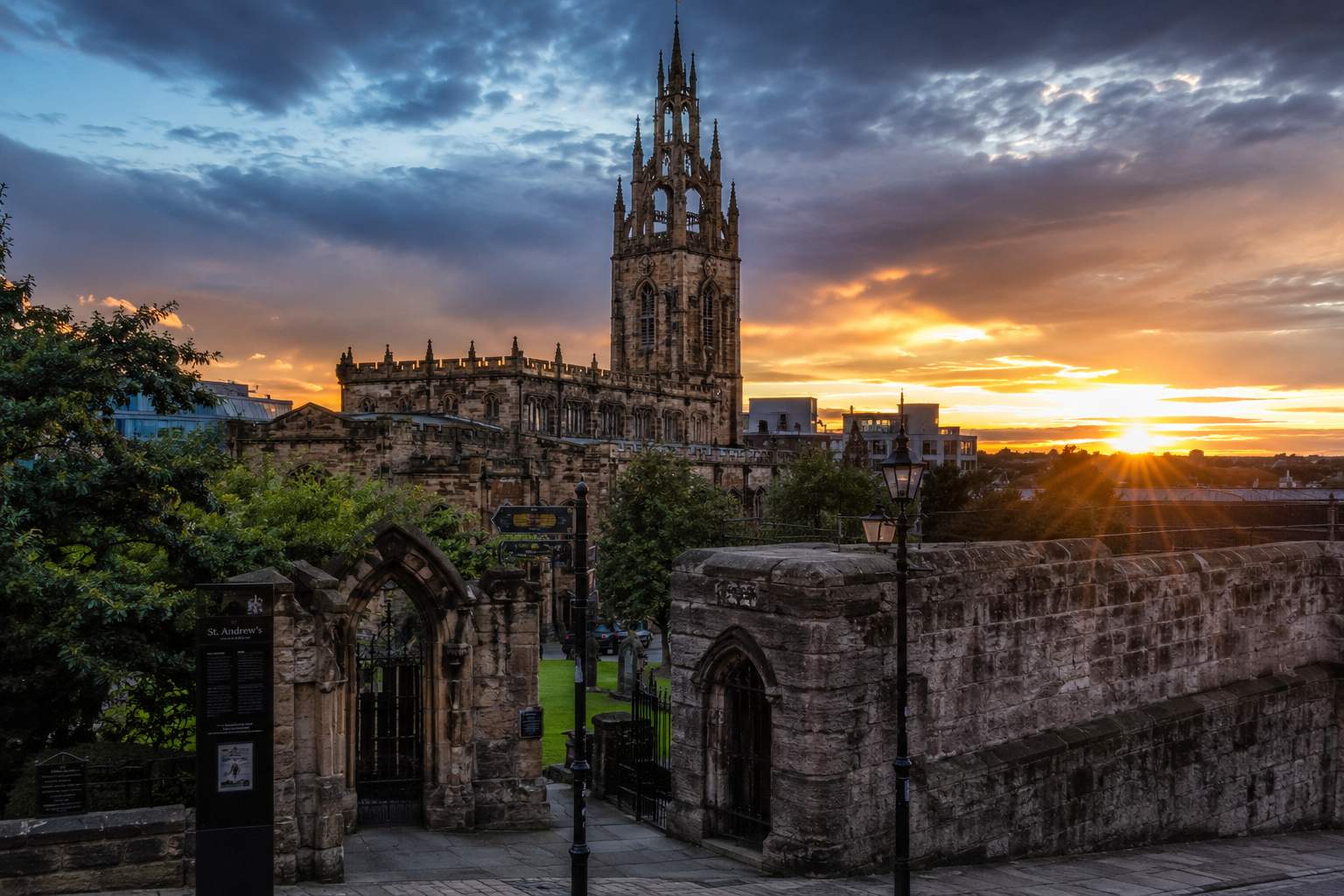
St Andrew's Church.
Location: Newgate Street, Newcastle upon Tyne, NE1 5SS
Approximate Age: Dating from the 12th century, around 850 years old.
Often overshadowed by Newcastle Cathedral, St Andrew's Church is one of the city's oldest surviving churches and one of its hidden historical treasures.
The church dates back to the 12th century, although much of the present structure was built during the 13th and 14th centuries.
One of its most fascinating features is its connection to Newcastle's medieval defensive system. A substantial section of the old town wall still survives immediately beside the church, offering visitors a rare opportunity to see two important pieces of medieval history in a single location.
Throughout its history, St Andrew's has served generations of Newcastle residents. The churchyard contains the graves of several notable local figures, including composer Charles Avison, one of the most influential English musicians of the 18th century.
Despite its city-centre location, the church offers a remarkably peaceful atmosphere, allowing visitors to step away from modern Newcastle and experience a building that has stood for centuries.
St John's Church.
Location: Grainger Street, Newcastle upon Tyne
Approximate Age: Built during the 13th century, around 700 years old.
St John's Church occupies a unique place in Newcastle's religious history. Situated close to the city's commercial heart, it has remained an important place of worship through periods of enormous social and economic change.
The church's tower is one of its defining features and has long been a familiar landmark within the city centre. Throughout medieval and Victorian Newcastle, St John's served a growing urban population that expanded rapidly as trade and industry transformed the region.
Architecturally, the church showcases a blend of medieval and later additions, reflecting the evolving needs of the congregation across several centuries. Visitors can still admire historic stonework, stained glass and memorials that provide insights into Newcastle's past.
As the city developed around it, St John's retained its role as a community hub, demonstrating how historic churches often became anchors of stability during periods of rapid urban growth.
St Ann's Church.
Location: St Ann's Close, Newcastle upon Tyne
Approximate Age: Built in the late 18th century, more than 250 years old.
While younger than some of Newcastle's medieval churches, St Ann's Church occupies a particularly important place in the city's story.
Constructed during the 18th century, the church emerged as Newcastle expanded beyond its medieval boundaries. The Georgian architecture reflects a period when the city was becoming a major centre of trade and commerce.
The church was established to serve a growing population and quickly became a focal point for local residents. Its elegant design contrasts with the heavier medieval appearance of Newcastle's older churches, providing visitors with an insight into changing architectural tastes during the Georgian era.
Today, St Ann's remains an important heritage asset, helping to illustrate how Newcastle evolved from a medieval town into one of Britain's leading urban centres.
St Mary's Cathedral.
Location: Clayton Street West, Newcastle upon Tyne
Approximate Age: Opened in 1844, approximately 180 years old.
St Mary's Cathedral stands as one of the most significant Roman Catholic churches in northern England. While younger than Newcastle's medieval churches, its historical importance is undeniable.
Designed by celebrated architect Augustus Welby Pugin, one of the leading figures of the Gothic Revival movement, the cathedral represents a major chapter in Victorian religious architecture.
Its construction reflected the growing confidence and expansion of Catholic communities in Britain during the 19th century. The building's soaring interior, intricate detailing and impressive stained-glass windows continue to attract worshippers and visitors alike.
The cathedral remains the seat of the Roman Catholic Diocese of Hexham and Newcastle and plays a major role in the religious life of the region.
Why Newcastle's Historic Churches Continue To Attract Visitors.
Historic churches remain among the most visited heritage sites across England. The Church of England continues to collect national attendance and visitor data, recognising the importance of cathedrals and churches as both religious and cultural destinations.
For many visitors, Newcastle's churches offer much more than architecture. They provide direct connections to medieval England, the Industrial Revolution, Victorian expansion and modern community life.
Each church tells a different story. Newcastle Cathedral reflects nearly a millennium of civic and religious history. St Andrew's preserves links to the medieval town walls. St John's illustrates the city's commercial growth. St Ann's showcases Georgian Newcastle, while St Mary's Cathedral highlights the Victorian revival of Gothic architecture.
Together, these buildings create a living timeline of Newcastle's development.
Exploring Newcastle's Religious Heritage Today.
For travellers seeking things to do in Newcastle, historic churches provide a unique perspective on the city's past. Many remain active places of worship while also welcoming tourists, history enthusiasts, photographers and architecture lovers.
Walking between these landmarks allows visitors to experience different eras of Newcastle's history within a relatively compact city centre. From Norman foundations and medieval stonework to Victorian Gothic splendour, the churches reveal layers of history often overlooked by those focused solely on Newcastle's modern attractions.
As heritage tourism continues to grow, these remarkable buildings remain among the city's most enduring and valuable cultural assets, connecting present-day Newcastle with more than nine centuries of history.
Have you visited any of Newcastle's historic churches or discovered a hidden detail during your visit?
Newcastle History
A Journey Through Newcastle's Most Beautiful Historic Churches
Advertisement



Comments (0)
You must be logged in to post comments.
Don't have an account? Register here
No comments yet. Be the first to share your thoughts!