
Andy Burnham was appointed Prime Minister by King Charles III on 20 July 2026, following Keir Starmer's resignation as Labour leader.
This article sets out how the change of leadership happened and who holds the senior positions in the new government.
How the leadership changed.
Pressure on Keir Starmer built through the spring of 2026. By mid-May, more than 95 Labour MPs had publicly called on him to resign or to set out a timetable for departure.
Health Secretary Wes Streeting resigned from the cabinet, along with four junior ministers, among them Jess Phillips, and four ministerial aides. Other MPs signed letters opposing a leadership challenge, and Starmer initially stated he would stand in any contest.
Andy Burnham, then Mayor of Greater Manchester, had been discussed as a potential successor since 2025. Labour rules require leadership candidates to be sitting MPs, and Burnham was not one. He was blocked by the party's National Executive Committee from standing in a by-election in February, but was selected and won the Makerfield by-election on 18 June after the sitting MP stood down.
Starmer announced his resignation as Labour leader four days later, on 22 June.
The contest had one candidate.
Nominations opened on 9 July. Candidates required the support of 81 Labour MPs to enter the ballot.
By 13 July, Burnham had received 349 nominations from Labour MPs, rising to 379 by 15 July. That total made it arithmetically impossible for any other candidate to reach the threshold.
By convention, the outgoing leader, the chair of the National Executive Committee and the party chair did not nominate. With no other eligible candidate by the affiliate deadline, and with the nominations of 23 affiliated organisations, Burnham was declared Labour leader at a special party conference on 17 July.
Starmer resigned as Prime Minister on 20 July, and Burnham was invited by the King to form a government the same day.
The Treasury went to John Healey.
John Healey was appointed Chancellor of the Exchequer. He has previously held ministerial office, including at the Treasury, and served in the shadow cabinet across several briefs.
The appointment was widely described as a surprise by political commentators, given that other figures had been more frequently discussed for the role.
The Home Office kept its existing occupant.
Shabana Mahmood remained Home Secretary, continuing in the post she held under the previous administration.
Continuity in that role means responsibility for policing, immigration, asylum and counter-terrorism policy stays with the same minister through the change of Prime Minister.
Ed Miliband moved to the Foreign Office.
Ed Miliband was appointed Foreign Secretary, moving from his previous brief. He served as Labour leader between 2010 and 2015 and has held several cabinet positions.
Other senior appointments included Jonathan Reynolds, Yvette Cooper and Angela Rayner, each placed in briefs in which they have previous ministerial experience.
Stephen Kinnock was appointed Secretary of State for Wales.
The stated priorities.
In his first speech, Burnham set out three broad themes: devolving power away from Westminster, rebuilding public services and reindustrialising the economy.
He also stated an intention to combine public investment with fiscal responsibility, and committed to early measures aimed at the cost of living.
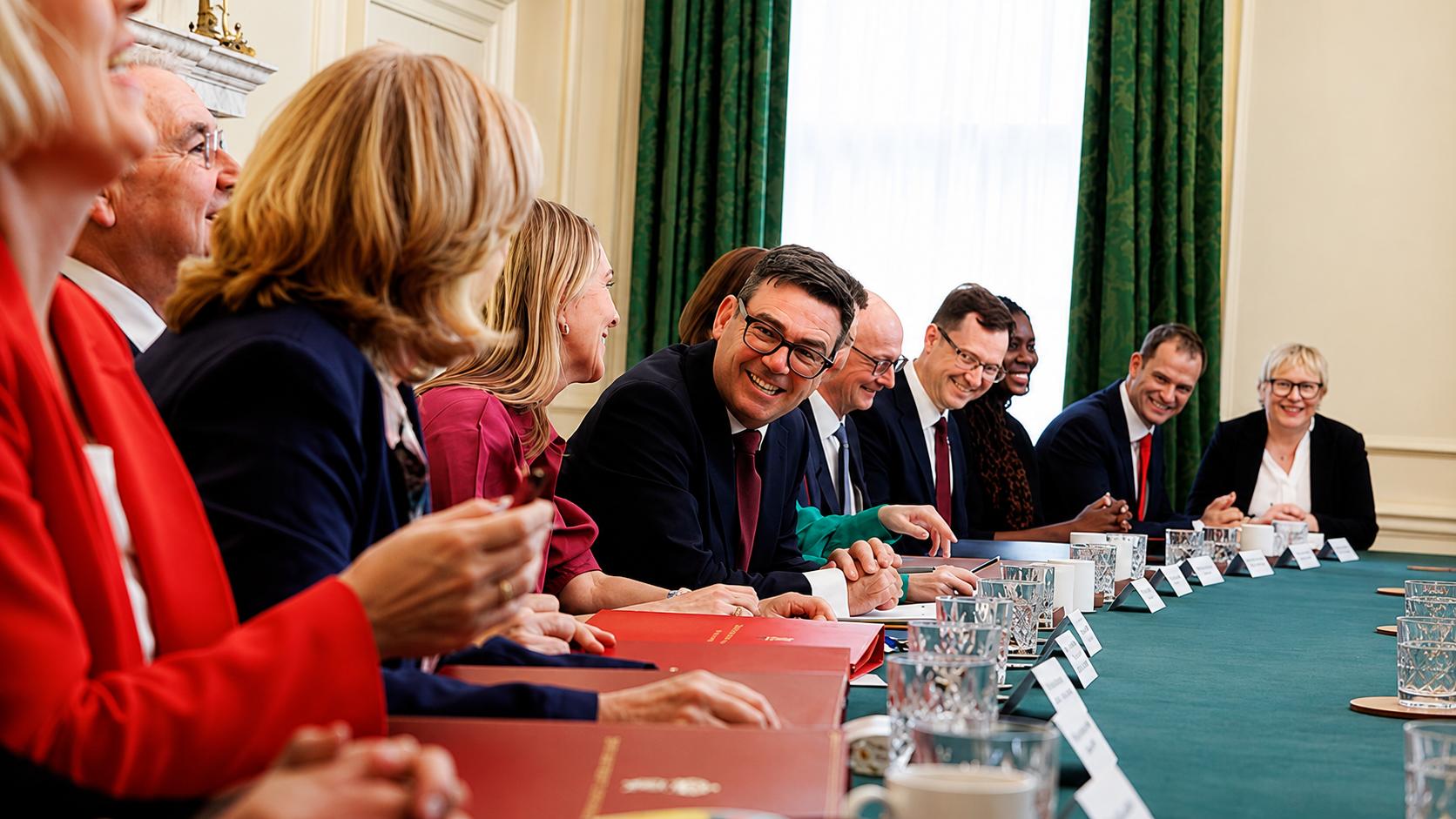
The composition of the cabinet was described by analysts as reflecting those stated priorities, with appointments concentrated among ministers with prior experience in the relevant policy areas rather than solely among close political allies.
The vacancies created by the change.
Burnham's election as an MP at the Makerfield by-election followed the resignation of the sitting member, Josh Simons, which is the mechanism by which a by-election is triggered.
His subsequent appointment as Prime Minister did not create a further vacancy, since he remains MP for that constituency while holding office.
Ministers who resigned during the spring, including the former Health Secretary, returned to the backbenches as MPs rather than leaving Parliament.
The parliamentary position.
Labour won the 2024 general election with a majority of 172 seats, and that majority is unchanged by a change of party leader.
A new Prime Minister taking office between general elections is a normal feature of the British system. The Prime Minister is the person able to command the confidence of the House of Commons, and no general election is required when a governing party changes its leader.
The next general election must be held by 2029 under the Dissolution and Calling of Parliament Act 2022, unless an earlier election is called.
Public opinion at the point of transition.
Polling conducted in late June, before Burnham took office, recorded 14 per cent of respondents satisfied with the way the government was running the country, against 78 per cent dissatisfied.
Voting intention polling around the same period placed Reform UK narrowly ahead of Labour, with the Conservatives third, followed by the Greens and the Liberal Democrats.
Burnham's own personal ratings at that stage were less negative than those recorded for several other party leaders, though still in negative territory.
Share your thoughts.
Which cabinet appointment do you think matters most to the North East?
Political News
Andy Burnham's Cabinet: Who Holds Which Job
Andy Burnham became Prime Minister on 20 July and named his cabinet within days. Here is who holds which brief.
Advertisement

Comments (0)
You must be logged in to post comments.
Don't have an account? Register here
No comments yet. Be the first to share your thoughts!