
Anti-social behaviour is the crime category that shapes how safe people feel on their own streets, often more than the serious offences that make headlines. A major national push launched in 2025 promised to get a grip on it. The honest position, well over a year in, is that the framework is in place but the verdict is not yet in.
A New National Guarantee.
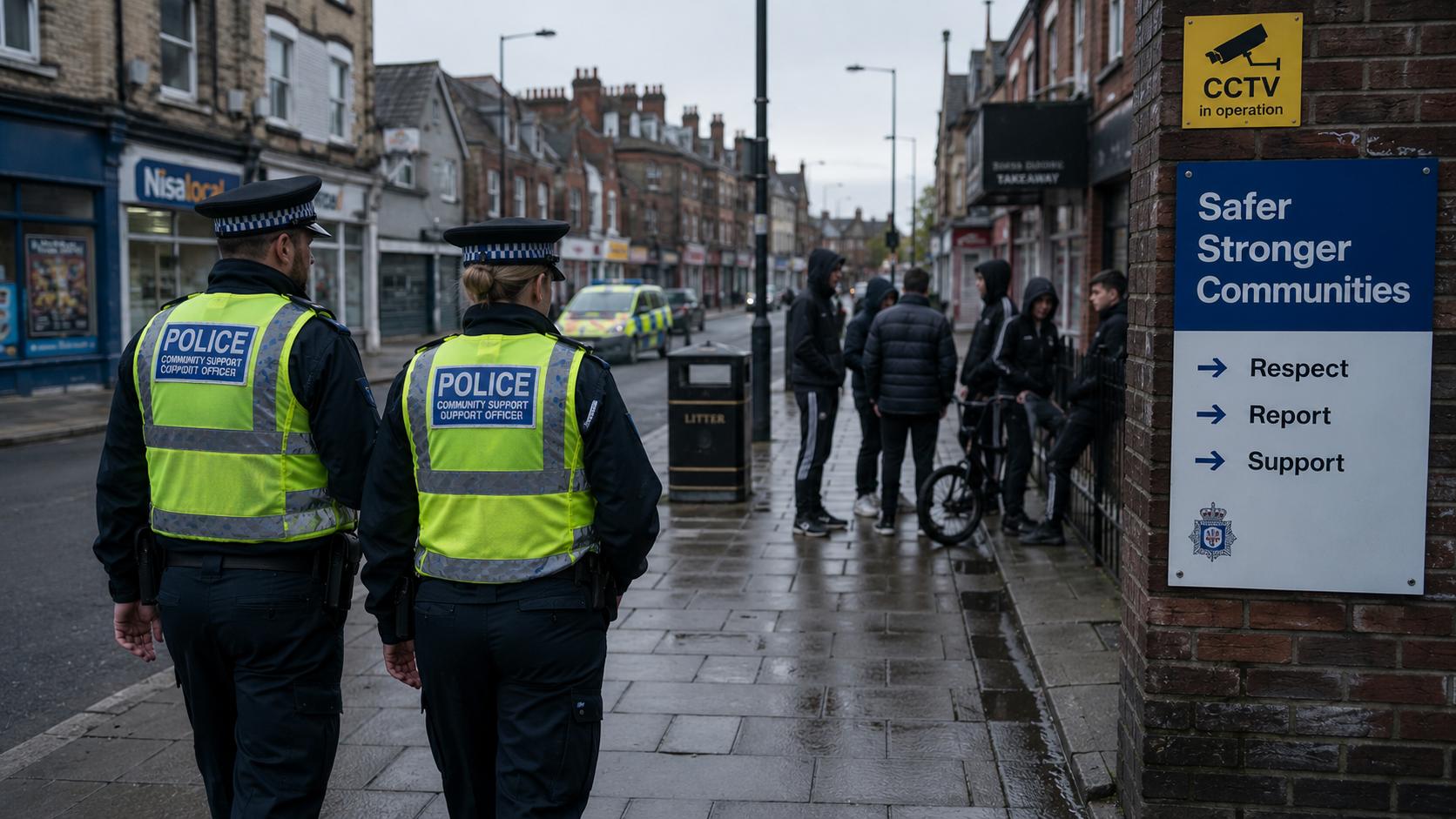
At the heart of the effort is a Neighbourhood Policing Guarantee, announced in April 2025, which sets out what communities should be able to expect from their local teams. Every neighbourhood is promised named, contactable officers, every force is required to appoint a dedicated anti-social behaviour lead, and each is expected to develop a local action plan targeting the problems residents actually report. The emphasis is firmly on visible, accessible officers in town centres, deterring offending and reassuring the public, rather than purely on responding after the event.
Respect Orders.
The most prominent new tool is the Respect Order, designed to deal with the persistent adult offenders who cause the most misery. These orders allow the police and councils to ban individuals from town centres or from drinking in public places where they have repeatedly caused harm, and crucially they can also require offenders to address the root causes of their behaviour through measures such as drug or alcohol treatment or anger management. Breaches are dealt with in the criminal courts, giving the orders sharper teeth than some of the civil powers they partly replace. They are being trialled in pilot areas before any national rollout, with the explicit aim of testing what works before extending it everywhere.
How Success Will Be Judged.
One genuinely positive feature of the current approach is that it comes with a published way of measuring progress. The key yardstick is the proportion of people who say they have experienced or witnessed anti-social behaviour in their area over the previous year, drawn from the long-running national crime survey, which captures the reality of low-level disorder far better than police records alone. Alongside that sit concrete delivery milestones: a dedicated anti-social behaviour lead in every force, targeted for mid-2025, and action plans in place across all forces during 2026. Tracking these openly is a welcome change from vaguer promises of the past.
Why It Is Too Early to Declare Victory.
For all the activity, robust evidence that the measures are reducing anti-social behaviour simply does not exist yet, and anyone claiming otherwise is getting ahead of the data. Pilots take time to run and evaluate, survey measures move slowly and are influenced by many factors beyond policing, and a tool such as the Respect Order cannot be judged on a handful of early cases. The framework is being rolled out and monitored, and independent trackers currently rate progress on introducing the new orders as broadly on course, but on course is not the same as proven to work.
The Local Picture.
On the ground, the approach forces are taking will feel familiar to anyone who has followed community policing: concentrating attention on identified problem locations, often town centres, and working in partnership with councils, housing providers and other agencies to solve recurring problems rather than simply moving them on. This kind of focused, partnership-based work has a reasonable evidence base behind it, particularly when it targets specific high-harm places consistently over time. The risk, as ever, is that pressure on resources pulls officers away from neighbourhood work towards more urgent demands, hollowing out the visible presence the guarantee promises.
What Residents Can Do.
Residents are not merely spectators in this. The action plans are meant to be shaped by what communities report, which makes reporting incidents, attending local meetings and engaging with named officers genuinely consequential rather than a box-ticking exercise. Anti-social behaviour that goes unreported cannot be designed into a plan or used to justify a Respect Order, so the willingness of communities to flag problems directly affects where resources are directed.
A Fair Interim Verdict.
The fairest assessment is that the building blocks for tackling anti-social behaviour more effectively are now in place, with clearer powers, named officers, local plans and an open way of measuring results. That is real progress on paper. Whether it translates into quieter, safer streets that people can feel is a question only time and the survey data can answer, and it deserves to be judged on outcomes rather than announcements. The commitment to measure honestly is encouraging; the proof will be in whether the numbers, and residents' own sense of safety, actually improve.
What Counts as Anti-Social Behaviour.
Part of what makes anti-social behaviour so difficult to tackle, and to measure, is that it covers an enormous range of conduct that affects people in very different ways. At one end sit relatively minor nuisances, such as litter, noise or rowdiness, that can nonetheless wear away at quality of life when they are persistent.
At the other are intimidating and frightening behaviours, including aggressive begging, public drug use, harassment and threats, that can make people afraid to use their own town centre or to let their children play outside. Because the category is so broad, two communities reporting high levels of anti-social behaviour may be experiencing entirely different problems, which is precisely why locally tailored action plans, shaped by what residents actually report, make more sense than a single national template.
It also explains why measuring success is genuinely hard. A drop in recorded incidents might reflect real improvement, or simply less reporting; a rise might reflect a worsening problem, or greater confidence that reporting is worthwhile.
This is why the chosen national yardstick, the proportion of people who say they have experienced or witnessed anti-social behaviour, is valuable, because it captures the lived reality rather than relying solely on what reaches official records.
Judging the new measures fairly will mean watching that broad survey picture patiently over several years, rather than seizing on any single month's figures to declare success or failure.
Over to you.
The powers and plans to tackle anti-social behaviour are now in place, but firm evidence that they are working is still to come.
Has anti-social behaviour got better or worse where you live?
Crime News
Tackling Anti-Social Behaviour: Are the New Measures Working?
New powers, named officers and Respect Orders aim to curb anti-social behaviour, but is it too early to say whether they are working? We look at the evidence.
Advertisement



Comments (0)
You must be logged in to post comments.
Don't have an account? Register here
No comments yet. Be the first to share your thoughts!