
Budapest was formed from two separate cities, hilly Buda on the west bank and flat, grand Pest on the east, united in 1873.
That geography still shapes a visit. Buda offers castles, viewpoints and quiet streets, while Pest holds the grand boulevards, the baths, the markets and most of the nightlife.
Here is how to make sense of it in a couple of days.
Getting there from Newcastle.
Budapest has been served from Newcastle Airport in recent years, with flying time around two hours and forty minutes. Schedules change, so check what is currently operating.
Ferenc Liszt Airport lies south-east of the city. The 100E airport bus runs directly to the centre in around forty minutes and requires a specific ticket rather than a standard transport pass.
Booked transfers and taxis are readily available, and there is an official taxi provider at the terminal.
Where it is and how it works.
Budapest sits in the centre of Hungary, on the Danube, roughly equidistant from Vienna and Belgrade.
The Danube is wide here and crossed by a series of landmark bridges, of which the Chain Bridge is the most famous.
Pest is laid out on a grid of ring roads and radial avenues, and the metro, one of the oldest in the world, is efficient and cheap. Buda is steeper, and a funicular runs from the Chain Bridge up to the castle.
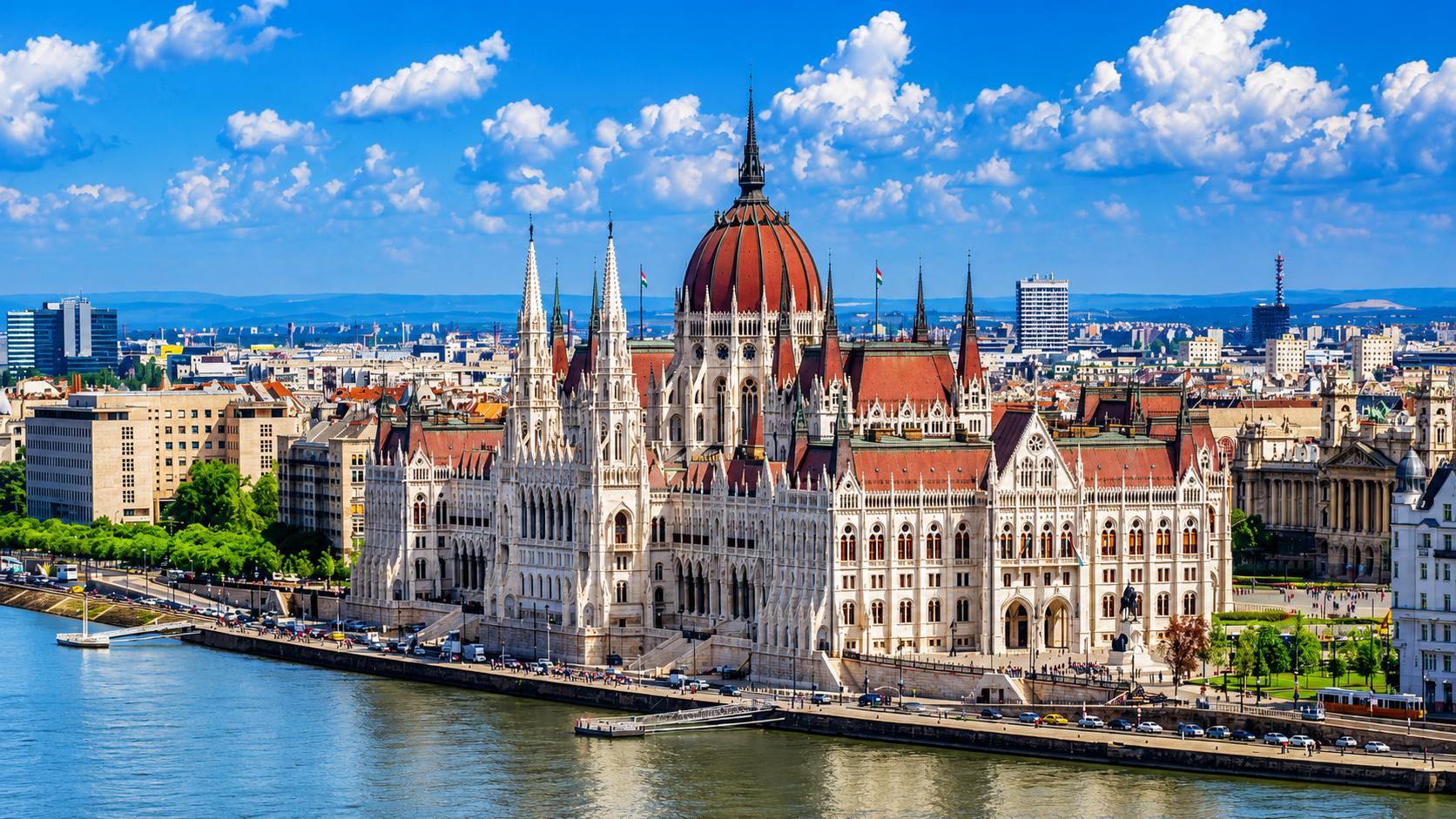
The Parliament dominates the river.
The Hungarian Parliament Building, completed in the early twentieth century, is one of the largest legislative buildings in the world and among the most photographed in Europe.
Interior tours run in several languages and must be booked in advance, with limited daily capacity. The main staircase and the hall housing the crown jewels are the highlights.
It is best seen from the Buda side, particularly after dark when it is floodlit.
Buda Castle and Fishermen's Bastion.
The castle district holds the former royal palace, now housing the National Gallery and the Budapest History Museum.
Nearby, Matthias Church has a spectacularly patterned tiled roof, and the Fishermen's Bastion beside it is a neo-Romanesque terrace built purely as a viewpoint. The panorama across the river is the classic Budapest view.
Much of the terrace is free to access, with a charge for the upper towers. Early morning is considerably quieter.
The thermal baths are the signature experience.
Budapest sits on thermal springs and has bathing culture going back to Roman and later Ottoman occupation.
Széchenyi, in the City Park, is the largest and best known, with grand yellow buildings and outdoor pools that steam dramatically in winter. Gellért has the most beautiful Art Nouveau interior.
Practicalities matter: take a towel, flip-flops and a swimming cap if required for the lap pools. Lockers and cabins are hired on arrival. Some baths have age restrictions or restricted areas for children, so check before going as a family.
It works well with children.
Margaret Island, in the middle of the Danube, is a car-free park with playgrounds, a musical fountain, a small zoo and bike hire.
City Park holds the zoo, one of the oldest in the world, along with a boating lake that becomes an outdoor ice rink in winter and Vajdahunyad Castle, an architectural pastiche built for a millennium exhibition.
The Hungarian Railway Museum, the funicular and the children's railway in the Buda hills, historically staffed by children under adult supervision, are all reliable hits.
Ruin bars are an adult attraction.
The ruin bar phenomenon began when derelict buildings in the old Jewish quarter were converted into bars filled with mismatched furniture and salvaged decoration.
Szimpla Kert is the original and best known. They are atmospheric and lively, and they are firmly evening venues rather than family destinations, though some open during the day as markets and cafés.
The same district contains the Dohány Street Synagogue, the largest in Europe, with a moving memorial garden.
Eating and drinking.
Hungarian food is hearty and paprika-heavy. Goulash is a soup rather than a stew in its home country, and worth trying properly.
Lángos, deep-fried dough topped with sour cream and cheese, is the classic street food, sold at the Great Market Hall among other places.
The market hall itself is worth visiting for the building as much as the produce, with food stalls on the upper floor.
Practical points.
Hungary uses the forint, not the euro, despite EU membership. Amounts run to thousands, which takes adjustment.
Decline any offer to be charged in pounds by a card machine, and use bank ATMs rather than exchange booths in tourist areas.
Be cautious about bars where you have been approached in the street and invited, a long-running scam involving inflated bills. Stick to places you have chosen yourself.
When to go.
Spring and autumn offer pleasant temperatures and fewer crowds.
Summer is hot, and the outdoor baths and the Danube promenades come into their own. Winter is cold, but sitting in a steaming outdoor thermal pool in near-freezing air is one of the city's great experiences, and the Christmas markets are excellent.
Share your thoughts.
Széchenyi or Gellért: which Budapest bath would you choose?
Travel News
Budapest from Newcastle: A City Break Guide
Two cities joined across the Danube, with thermal baths, a vast parliament building and prices that still undercut most of Western Europe.
Advertisement

Comments (0)
You must be logged in to post comments.
Don't have an account? Register here
No comments yet. Be the first to share your thoughts!