
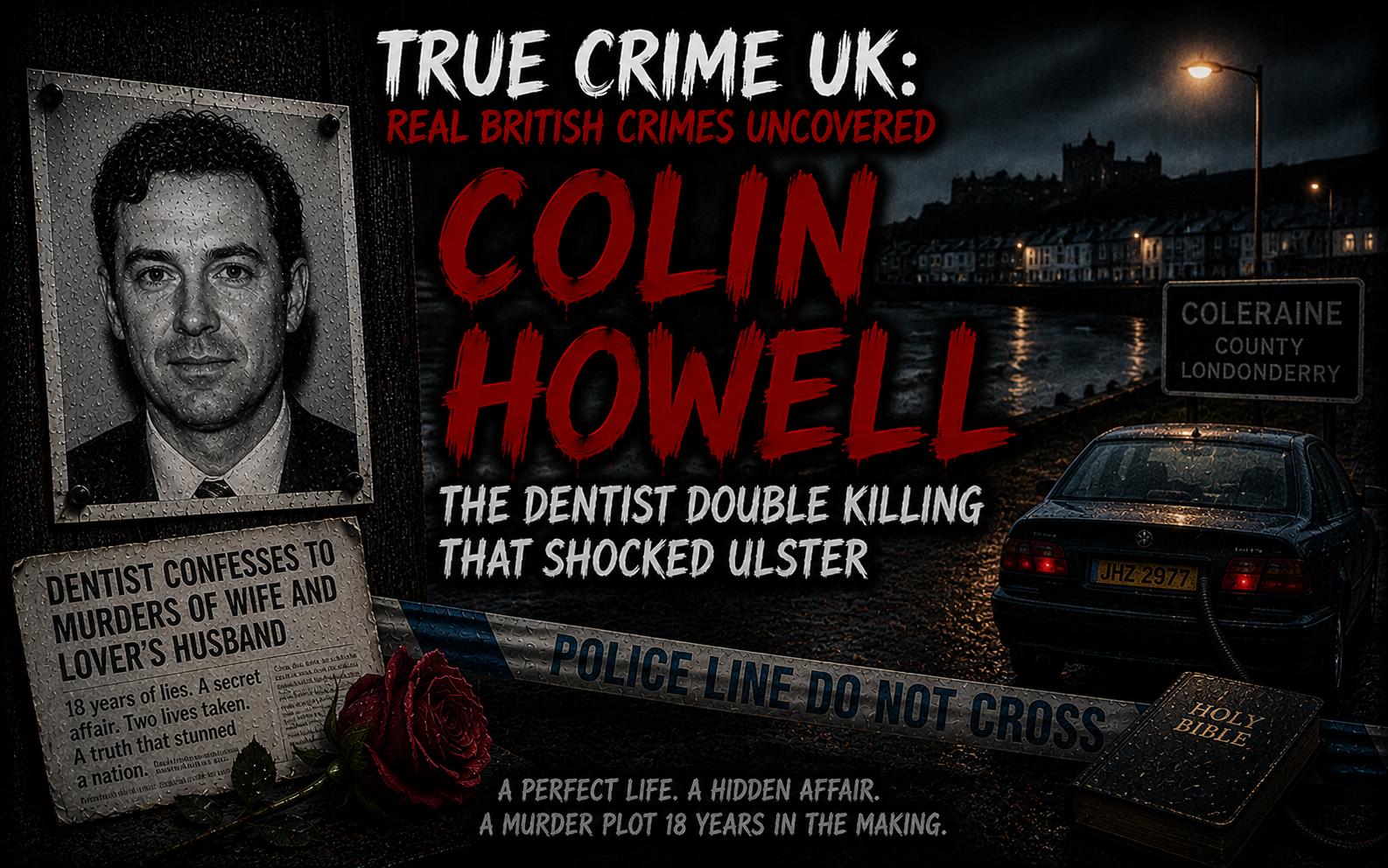
For years, Colin Howell appeared to be the picture of respectability. He was a successful dentist, a family man, and a committed Christian living in Northern Ireland. To neighbours and members of his church community, Howell projected stability, intelligence, and professionalism.
But behind that carefully constructed image lay a horrifying secret.
In 1991, Howell orchestrated the murders of his wife, Lesley Howell, and the husband of his mistress, Trevor Buchanan, in a calculated double killing that remained hidden for nearly two decades. The deaths were initially ruled a suicide pact, and for years nobody suspected the truth.
Then, in 2009, everything changed.
Howell confessed to the murders in graphic detail, exposing one of the most shocking true crime cases in Northern Irish history. The revelations stunned the public because the killer had continued living an apparently ordinary life while carrying the secret for almost twenty years.
The Colin Howell case remains one of the most disturbing examples of deception, manipulation, and hidden violence ever seen in the UK.
Who Was Colin Howell.
Colin Howell was born in Belfast in 1959 and later established himself as a respected dentist in Coleraine, County Londonderry.
Intelligent, articulate, and outwardly charming, Howell became deeply involved in his local Baptist church community. Friends later described him as confident and charismatic, with strong religious beliefs that appeared central to his identity.
He married Lesley Howell, a nurse and devoted mother, and together they built what many viewed as a stable family life.
But beneath the surface, serious cracks had begun forming.
In the late 1980s, Howell began an affair with Hazel Stewart, a Sunday school teacher married to police officer Trevor Buchanan. The relationship developed secretly within their close-knit religious circle, creating a dangerous situation fuelled by obsession, guilt, and fear of exposure.
Investigators later concluded Howell became determined to remove both spouses permanently.
The Secret Affair.
The affair between Colin Howell and Hazel Stewart reportedly intensified rapidly.
Both were active members of the same Baptist church community, which made the relationship particularly scandalous given the religious environment surrounding them. Friends and fellow churchgoers later expressed disbelief that such a secret could have existed unnoticed for so long.
According to court proceedings, Howell became increasingly convinced that divorce would destroy his reputation, career, and standing within the church.
Prosecutors later argued he began viewing murder as the only way to continue his relationship with Hazel Stewart while preserving the appearance of innocence.
The disturbing reality of the case would later reveal just how carefully Howell planned the killings.
The Deaths of Lesley Howell and Trevor Buchanan.
In May 1991, Lesley Howell and Trevor Buchanan were found dead inside a car parked in Castlerock, near the north coast of Northern Ireland.
Police initially believed the pair had entered into a suicide pact.
The scene appeared convincing at first glance. The vehicle contained fumes from a hosepipe connected to the exhaust, and investigators assumed both victims had willingly taken their own lives following emotional struggles.
The deaths shocked the local community.
Trevor Buchanan was a respected Royal Ulster Constabulary officer, while Lesley Howell was widely regarded as a kind and caring nurse devoted to her family.
Although some questions were raised privately, investigators at the time accepted the apparent suicide explanation.
For nearly two decades, the truth remained buried.
How Colin Howell Planned the Murders.
The real horror of the case emerged years later when Colin Howell confessed in extraordinary detail.
According to his admissions, Howell had sedated both victims before staging the scene to resemble a suicide pact.
Prosecutors later stated Howell used carbon monoxide poisoning to kill Lesley Howell and Trevor Buchanan after rendering them unconscious.
The murders were chillingly calculated.
Howell allegedly manipulated the crime scene carefully to ensure investigators would accept the deaths as self-inflicted. He also relied heavily on his respectable public image and the assumptions surrounding mental health and emotional distress at the time.
The deception worked.
For years, Howell continued his career, raised children, and remained active within church circles while carrying the secret of the killings.
Many people who knew him later described the revelation as almost impossible to comprehend.
Life After the Murders.
Following the deaths, Colin Howell and Hazel Stewart eventually married other people.
Howell continued practising dentistry and built a successful professional life. Outwardly, he appeared to move on from the tragedy entirely.
But behind the scenes, Howell’s life slowly unravelled.
Over the following years, he became involved in financial problems, allegations of inappropriate sexual behaviour, and increasingly erratic conduct. Several personal scandals damaged his reputation, though nobody yet connected him to murder.
Investigators later believed Howell’s mental state deteriorated gradually under the weight of the secret he had concealed for years.
The strain eventually pushed him toward confession.
The Confession That Shocked Northern Ireland.
In 2009, nearly eighteen years after the deaths, Colin Howell walked into a police station and confessed to the murders.
The confession stunned detectives.
Initially, some investigators reportedly struggled to believe Howell’s account because the deaths had long been treated as closed cases. But as he provided increasingly detailed information, it became clear the respected dentist was telling the truth.
Howell described how he sedated his wife and Trevor Buchanan before killing them and staging the scene to resemble suicide.
The revelations horrified Northern Ireland.
Many people could not understand how such a carefully planned double murder had remained hidden for so long.
The case also sent shockwaves through church communities across Ulster because of Howell’s longstanding role as a prominent religious figure.
For the families of the victims, the confession reopened emotional wounds that had never fully healed.
The Arrest of Hazel Stewart.
Following Howell’s confession, investigators turned their attention toward Hazel Stewart.
Police believed Stewart had known about the murders and participated in aspects of the cover-up.
Stewart consistently denied involvement.
However, prosecutors argued she knowingly entered into a conspiracy with Howell that ultimately led to the deaths of their spouses.
The legal battle surrounding Stewart became one of the most closely watched criminal proceedings in Northern Ireland.
Her defence team claimed Howell acted alone and later manipulated events to implicate her falsely.
The prosecution presented a different picture.
They argued the affair provided motive and that Stewart knowingly benefited from the deaths.
The courtroom drama gripped the public for years.
The Trials and Convictions.
Colin Howell pleaded guilty to murdering his wife Lesley Howell and Trevor Buchanan in 2010.
During sentencing, the judge described the killings as cold, calculating, and deeply evil.
Howell received a lengthy prison sentence, though many people questioned whether any punishment could truly reflect the enormity of the crimes.
The trial of Hazel Stewart followed separately.
After multiple legal proceedings and appeals, Stewart was eventually convicted in 2011 of involvement in the murders and sentenced to prison.
The convictions brought a degree of closure to the victims’ families, though the emotional devastation caused by the case continued lingering throughout Northern Ireland.
Why the Case Fascinated the Public.
The Colin Howell murders became one of the most discussed true crime stories in modern Northern Irish history for several reasons.
First, the deception lasted almost twenty years.
Many people found it deeply unsettling that a respected professional could commit such calculated murders and continue living normally for nearly two decades without detection.
Second, the religious backdrop of the case intensified public fascination.
The murders unfolded within a conservative church environment where appearances, morality, and reputation carried enormous weight. The contrast between Howell’s public persona and private actions shocked communities across the UK.
Finally, the method of the killings and the staged suicide scene created a level of psychological complexity rarely seen in British murder cases.
The idea that two innocent deaths had been quietly accepted as suicide for years deeply disturbed the public.
The Psychological Side of Colin Howell.
Criminal psychologists later examined Howell’s behaviour extensively.
Many experts described him as highly manipulative, narcissistic, and emotionally detached from the suffering he caused.
Even after confessing, Howell often spoke about the murders in disturbingly calm and clinical terms. Some observers noted he appeared more focused on explaining his reasoning than expressing genuine remorse.
Investigators also explored whether Howell’s eventual confession stemmed from guilt, deteriorating mental health, religious pressure, or fear that the truth would eventually emerge independently.
The exact motivation remains debated.
What is clear, however, is that Howell maintained the deception for an extraordinarily long time while functioning successfully within everyday society.
That fact alone continues to unsettle many people who follow the case.
The Lasting Impact of the Colin Howell Case.
More than thirty years after the murders, the Colin Howell case still casts a dark shadow across Northern Ireland.
The story exposed how dangerous individuals can hide behind positions of trust, professional success, and religious respectability while secretly committing horrific acts.
For many people, the case shattered assumptions about what killers are supposed to look like.
There was no violent criminal background, no obvious warning signs visible to the wider public, and no immediate suspicion after the deaths occurred.
Instead, the murders remained hidden beneath layers of manipulation, staging, and carefully maintained appearances.
The case also forced renewed scrutiny on how sudden deaths were investigated during the early 1990s and whether warning signs had been missed.
Today, Colin Howell remains one of the most notorious killers in Northern Irish criminal history.
The deaths of Lesley Howell and Trevor Buchanan continue to resonate because of the sheer betrayal involved - two innocent people murdered by individuals they trusted most.
Even decades later, the case remains one of the UK’s most chilling examples of hidden violence concealed beneath an apparently ordinary life.
Do you believe Colin Howell would ever have been caught if he had not confessed to the murders himself?
Share your thoughts in the comments and join the discussion surrounding one of Northern Ireland’s most disturbing true crime cases.
Crime News
Colin Howell Murders - The Dentist Double Killing That Shocked Ulster
Advertisement

Comments (0)
You must be logged in to post comments.
Don't have an account? Register here
No comments yet. Be the first to share your thoughts!