
Dublin is arguably the easiest international city break from Newcastle. The flight is around an hour, the language is shared and the Common Travel Area removes much of the usual friction.
It is also a genuinely walkable capital with a compact centre, strong museums that cost nothing to enter and a coastline reachable by suburban train.
Here is how to make the most of a couple of days.
Getting there from Newcastle.
The Dublin route has been served from Newcastle Airport over many years by more than one carrier, with flying time around an hour. Schedules and airlines change, so confirm current options when booking.
Dublin Airport sits north of the city, with frequent express bus services into the centre taking around thirty to forty-five minutes depending on traffic and stop.
Under Common Travel Area arrangements, British and Irish citizens do not require a passport for travel between the two countries. However, airlines require photographic identity documents, and most in practice ask for a passport, so take one.
Where it is and how it works.
Dublin sits on Ireland's east coast at the mouth of the River Liffey, which divides the city into the traditionally more affluent south side and the north side.
The centre is small. Trinity College, Grafton Street, Temple Bar and the main museums are all within a twenty-minute walk of one another.
O'Connell Street is the main northside thoroughfare, with the Spire at its centre, and the two halves are linked by a series of bridges including the pedestrian Ha'penny Bridge.
The headline attractions.
Trinity College houses the Book of Kells, a ninth-century illuminated manuscript, displayed alongside the Long Room library. Tickets are timed and booking ahead is strongly advised.
The Guinness Storehouse is the most visited paid attraction in the country, occupying a converted fermentation plant, and finishes with a pint in the top-floor Gravity Bar with panoramic views. It is commercial and busy, and most visitors enjoy it anyway.
Kilmainham Gaol is the most affecting historical site in the city, central to the story of Irish independence. Tours are guided, capacity is limited and tickets are released in advance, so plan early.
EPIC, the Irish Emigration Museum, tells the story of the diaspora using interactive displays and consistently rates highly with visitors.
The national museums are free.
Ireland's National Museum operates across several sites, covering archaeology, decorative arts and natural history, and admission is free.
The archaeology branch on Kildare Street holds the bog bodies and an outstanding collection of prehistoric gold, and it is among the best free museums anywhere in these islands.
The National Gallery, also free, holds a strong European collection. Chester Beatty, in the Dublin Castle grounds, holds an exceptional collection of manuscripts and is another free entry.
It suits families well.
Dublin Zoo sits within Phoenix Park, one of the largest enclosed city parks in Europe, and is comfortably a full day out. The park itself has a herd of wild fallow deer roaming freely.
The Natural History Museum, known locally as the Dead Zoo, is a Victorian cabinet-style museum that children tend to find fascinating.
Dublinia recreates Viking and medieval Dublin in an interactive format aimed squarely at families, and the Viking Splash amphibious tour is reliably popular.
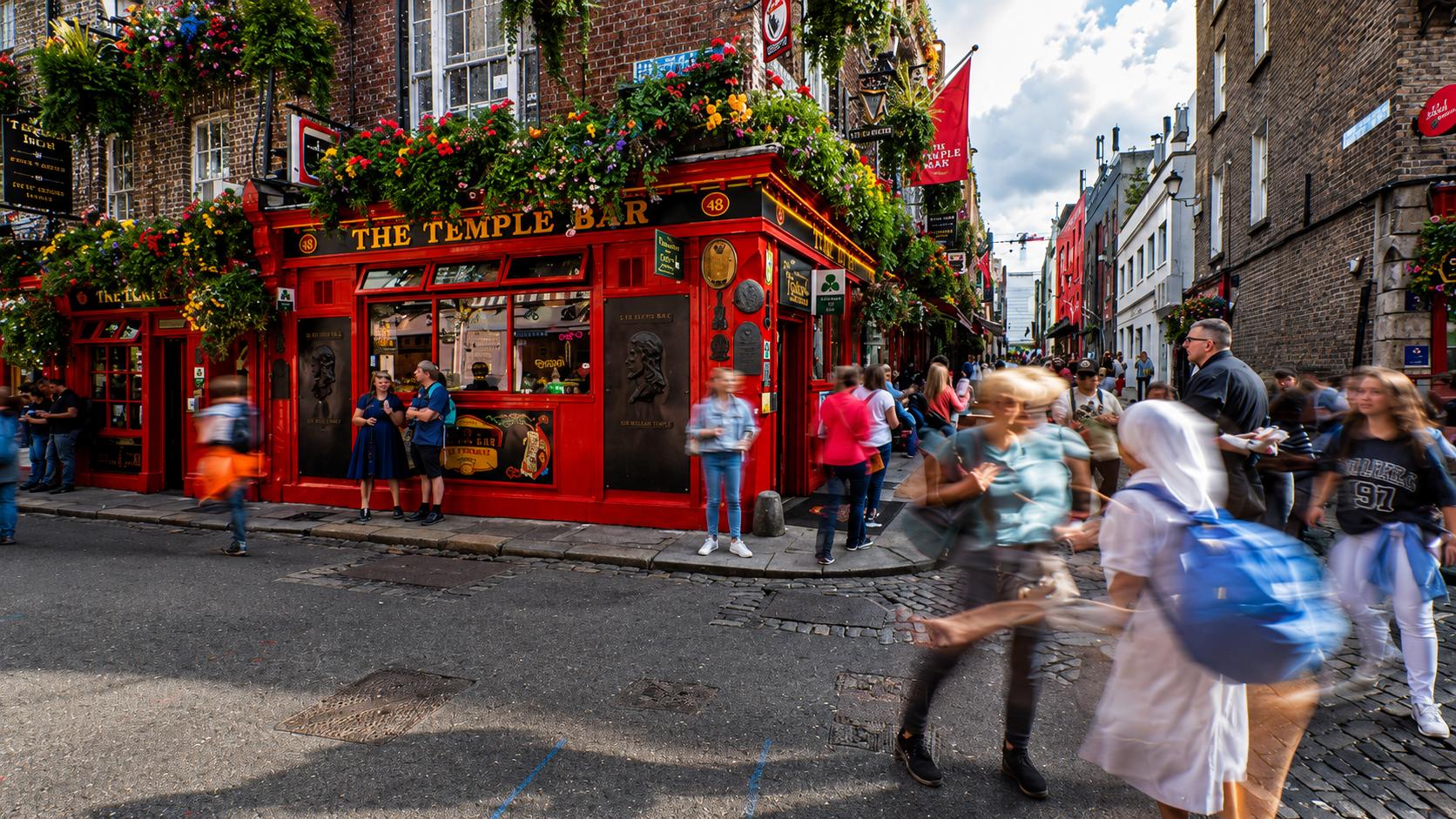
Temple Bar is worth knowing about.
Temple Bar is the cobbled quarter marketed heavily to visitors. It is atmospheric, it has live music every night, and it is significantly more expensive than anywhere else in the city.
A pint there can cost several euro more than a few streets away. Locals generally drink elsewhere, and following that example is worthwhile.
For traditional music in less commercial surroundings, ask at your accommodation for recommendations away from the main tourist streets.
The coast is easy to reach.
The DART, Dublin's coastal suburban railway, runs north and south along the bay and turns a city break into something more varied.
Howth, to the north, is a fishing village with a cliff walk, seafood restaurants and a market. Bray and Greystones, to the south, are connected by an excellent cliff path walk of around two hours.
Dún Laoghaire has a long pier walk and good ice cream. All are within around thirty to forty minutes of the centre.
Practical points.
Ireland uses the euro, not sterling, which catches out a surprising number of visitors from the UK.
Card payment is widely accepted. Tipping is customary but modest, generally around ten per cent in restaurants.
Dublin accommodation is expensive by European standards, and prices rise sharply around major sporting fixtures and public holidays. Booking early matters more here than in many cities.
When to go.
Summer offers the longest days and the best chance of coastal walking weather, but it is the busiest and priciest period.
St Patrick's Day in mid-March brings a large festival and a full city. It is a genuine experience and an extremely busy one.
Spring and autumn are the sensible compromise. Irish weather is changeable year-round, so waterproofs are non-negotiable whatever the forecast says.
Share your thoughts.
What is the best thing you have done on a weekend in Dublin?
Travel News
Dublin from Newcastle: A City Break Guide
An hour in the air and no passport control queue in the usual sense, Dublin is the most straightforward city break available from the North East.
Advertisement

Comments (0)
You must be logged in to post comments.
Don't have an account? Register here
No comments yet. Be the first to share your thoughts!