
Ask who the greatest sporting hero of nineteenth-century Tyneside was and the answer is not a footballer. Football had barely been organised.
The answer is a boat builder from Dunston whose funeral in 1870 drew a crowd estimated in the tens of thousands, lining the route from Newcastle out to Whickham.
Harry Clasper was a champion oarsman, an innovative boat designer and a genuine folk hero, at a time when rowing was the biggest spectator sport in the North East.
Here is that story.
Rowing was a mass spectator sport.
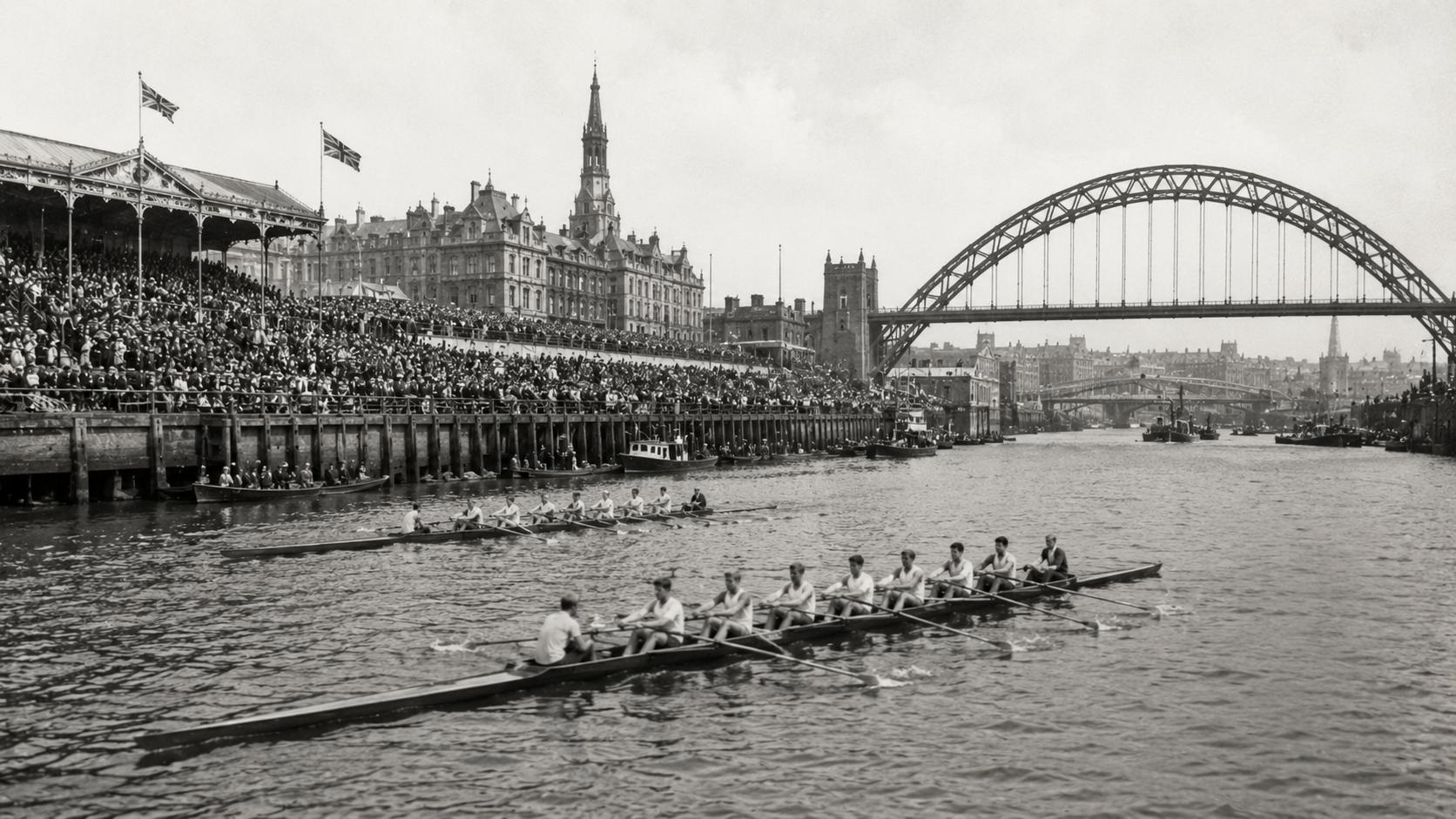
It is difficult now to appreciate the scale. Professional sculling and crew racing on the Tyne drew crowds of many thousands to the banks, with substantial betting attached.
Races were reported in detail in the national press, results were telegraphed across the country, and leading oarsmen were celebrities in a way that has few modern equivalents.
The Tyne was the centre of it. The river's working population included large numbers of keelmen and watermen for whom rowing was daily labour, and the transition from work to competition was natural.
Clasper came from that world.
Harry Clasper was born in 1812 at Dunston, into a family connected to the river. He worked variously as a wherryman, a coke burner and a pitman before establishing himself as a boat builder.
He began racing in the 1830s and 1840s, competing both as a sculler and in crews, frequently rowing alongside his brothers.
His crews won championships on the Thames as well as the Tyne, and he became recognised as among the finest oarsmen of his generation.
His innovations changed boat design.
Clasper's lasting contribution was technical. He was central to the development of the outrigger, which moves the rowlock away from the hull on a projecting frame.
That change allowed boats to be built narrower without losing leverage, dramatically reducing drag and increasing speed.
He also worked on keelless hull designs and refined the fine, narrow racing shell that became standard. Modern racing boats descend directly from the principles he developed.
The claim that he single-handedly invented the outrigger is contested, as several builders were working on similar problems simultaneously, but his role in perfecting and popularising it is not seriously disputed.
Robert Chambers was the other great name.
Clasper's contemporary Robert Chambers, born at St Anthony's in 1831, became world sculling champion and is regarded by many as the finest sculler of the era.
Chambers came from similar circumstances, working as a puddler in an ironworks, and his victories were celebrated across Tyneside with the fervour later reserved for football.
He died young, in 1868, and his funeral also drew enormous crowds. Both men are commemorated with memorials, and both feature in the regional folk tradition.
The river was the arena.
Races typically ran between fixed points on the Tyne, and spectators lined the banks, crowded onto bridges and hired boats to follow.
The scale of betting was substantial, and disputes about starts, fouling and course-taking were common enough to generate their own controversies and rematches.
Newspapers of the period devoted considerable column space to the sport, and the coverage gives a vivid picture of how central it was to Tyneside life.
Why the sport declined.
Professional rowing faded from the late nineteenth century for several reasons.
The rise of organised football, with regular fixtures, enclosed grounds and paying gates, offered a more reliable commercial model and captured working-class audiences.
Rowing itself split along class lines, with amateur governing bodies excluding those who worked with their hands, a definition that specifically barred the men who had made the professional sport what it was. That exclusion did lasting damage.
Industrial change on the river, and the growth of shipping traffic, made racing conditions increasingly difficult.
The pubs and streets remember them.
The names of the great Tyneside oarsmen survive in the region's pubs, streets and public monuments, often unnoticed by people who pass them daily.
Clasper's memorial at Whickham was funded by public subscription, an indication of how widely his death was felt across the river communities.
Robert Chambers is similarly commemorated, and both men appear in local histories, folk songs and the archives of Tyneside newspapers that covered their races in exhaustive detail.
The legacy is still visible.
Rowing continues on the Tyne and across the region, with clubs at Newcastle, Durham, Tyne and elsewhere, and Durham Regatta remains one of the oldest and largest events of its kind in the country.
Clasper is commemorated by a memorial at Whickham, and his name appears on buildings, streets and, at various times, on vessels on the river he raced.
The Blaydon Races, the region's best-known song, dates from this era and reflects a Tyneside where sporting crowds and river culture were inseparable.
For a period of roughly forty years, the biggest names in North East sport were oarsmen, and the biggest crowds gathered on the riverbank. It is a chapter of regional history that deserves to be better known.
Share your thoughts.
Had you heard of Harry Clasper before, or is this history new to you?
Sports News
Harry Clasper and the Golden Age of Tyne Rowing
Before football, the biggest sporting crowds on Tyneside gathered on the riverbanks, and the greatest local hero was a boat builder from Dunston.
Advertisement




Comments (0)
You must be logged in to post comments.
Don't have an account? Register here
No comments yet. Be the first to share your thoughts!