
Krakow was Poland's royal capital for centuries and escaped the wholesale destruction inflicted on Warsaw, leaving an old town of exceptional quality.
It is compact, affordable and unusually varied, offering everything from a dragon's cave to a working salt mine, alongside one of the most significant memorial sites in Europe.
Here is how to plan a visit.
Getting there from Newcastle.
Krakow has been served from Newcastle Airport in recent years, with flying time around two hours and twenty minutes. Carriers and frequencies change, so check current availability.
John Paul II Airport lies west of the city, connected to Kraków Główny station by a rail shuttle taking around twenty minutes.
The old town is a short walk from the main station through a shopping centre and park.
Where it is and how it works.
Krakow sits in southern Poland, on the Vistula, close to the Czech and Slovak borders and within reach of the Tatra Mountains.
The old town is enclosed by the Planty, a ring of parkland laid out where the medieval walls once stood. Everything within it is walkable in minutes.
South of the old town lies Kazimierz, the historic Jewish quarter, and beyond the river Podgórze, site of the wartime ghetto.
The main square is the largest of its kind.
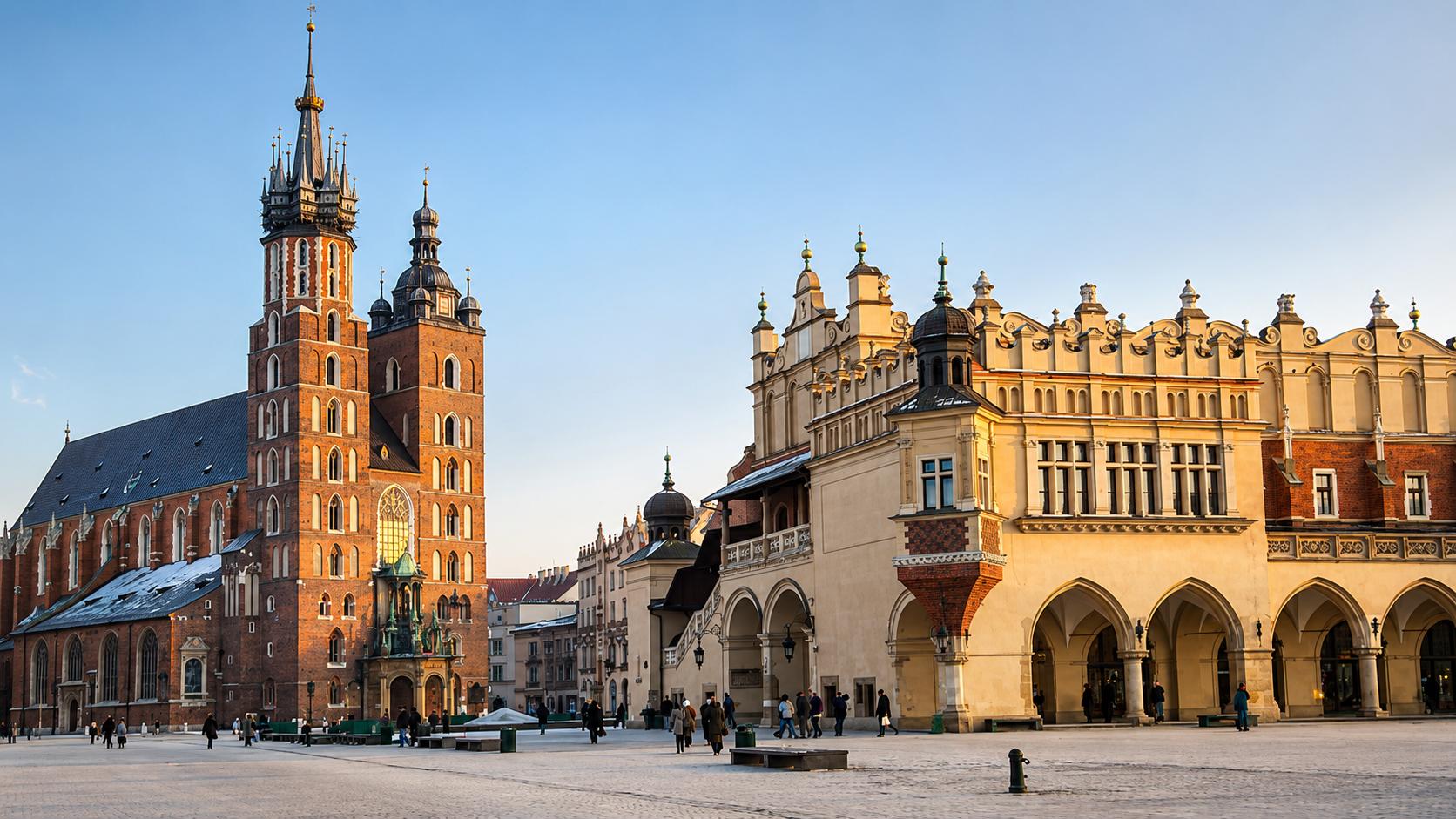
Rynek Główny is generally described as the largest medieval market square in Europe, and its scale is genuinely striking on first arrival.
At its centre stands the Cloth Hall, a Renaissance trading hall now housing souvenir stalls at ground level and a gallery of Polish art above.
St Mary's Basilica dominates one corner. Every hour a trumpet call, the hejnał, is played from the tower and breaks off abruptly mid-phrase, commemorating a trumpeter said to have been shot while sounding the alarm during a Mongol raid.
The altarpiece inside, carved by Veit Stoss in the fifteenth century, is one of the great works of Gothic sculpture and is opened daily.
Wawel has a castle and a dragon.
Wawel Hill, above the river, holds the royal castle and cathedral where Polish monarchs were crowned and buried.
Different parts of the complex are ticketed separately with limited daily numbers, so arriving early or booking ahead is advisable.
Beneath the hill is the Dragon's Den, a limestone cave associated with the legend of the Wawel dragon, with a fire-breathing metal dragon sculpture outside. Children reliably rate it the best thing in the city.
Kazimierz is the most atmospheric district.
The historic Jewish quarter fell into decline after the war and has since been revived, retaining synagogues, cemeteries and a distinctly different character from the old town.
The Galicia Jewish Museum and the Old Synagogue provide historical context, and Plac Nowy is the centre of the district's food and bar scene.
Across the river, Oskar Schindler's Enamel Factory now houses an excellent museum about the occupation of Krakow, focusing on the city and its people rather than the film.
The salt mine is a proper day out.
Wieliczka Salt Mine, a short distance outside the city, is a UNESCO World Heritage Site and has been worked since the Middle Ages.
The tourist route descends through chambers carved entirely from salt, including a full underground chapel with chandeliers made of salt crystal.
Tours are guided and take a couple of hours, involving several hundred steps down at the start. It is genuinely impressive and works well for families with children old enough to manage the walking.
Auschwitz-Birkenau requires careful thought.
The former camp complex lies around an hour and a half west of Krakow and is visited by very large numbers of people from the city.
Entry is free but requires an advance reservation, and guided tours are compulsory at busy times. Book well ahead, as places are limited.
The site museum advises that a visit is not suitable for children under fourteen. That guidance is offered seriously and is worth respecting rather than treating as a formality.
Set aside most of a day, dress for the weather since much of the site is outdoors, and expect to need time afterwards. It is not something to combine with other sightseeing.
Practical points.
Poland uses the złoty, not the euro. Card payment is widespread.
Krakow remains good value by Western European standards, particularly for food and drink, though prices in the main square carry a premium.
Polish food is worth exploring: pierogi dumplings, żurek sour rye soup, bigos hunter's stew and obwarzanek, the ring-shaped bread sold from carts across the city.
English is widely spoken by younger people and in the tourist trade.
When to go.
Late spring and early autumn offer the best weather and manageable crowds.
Winters are cold, frequently well below freezing, but the Christmas market in the main square is excellent and the old town looks superb under snow.
Summer is warm and busy, with the square filled with outdoor tables well into the evening.
Share your thoughts.
Would you take children to Krakow, and how would you handle the difficult history?
Travel News
Krakow from Newcastle: A City Break Guide
Krakow combines Europe's largest medieval market square with a salt mine, a castle dragon and one of the most sobering sites on the continent.
Advertisement

Comments (0)
You must be logged in to post comments.
Don't have an account? Register here
No comments yet. Be the first to share your thoughts!