
For decades Malaga was somewhere people passed through on the way to a resort. That has changed substantially, and the city now stands comparison with any Spanish destination for a short break.
It has Roman and Moorish remains, a serious museum offering, a proper city beach and a restored old town full of squares and terraces.
Here is what to do and why it works particularly well with children.
Getting there from Newcastle.
Malaga is among the longer-established routes from Newcastle Airport, served by more than one carrier over many years, with flying time around three and a quarter hours. Frequencies vary considerably by season.
Malaga Airport sits just west of the city, and the Cercanías suburban train reaches the city centre in around twelve minutes. It is one of the easiest airport transfers in Europe.
The same line continues to Torremolinos, Benalmádena and Fuengirola, which is useful for anyone combining city and coast.
Where it is and how it works.
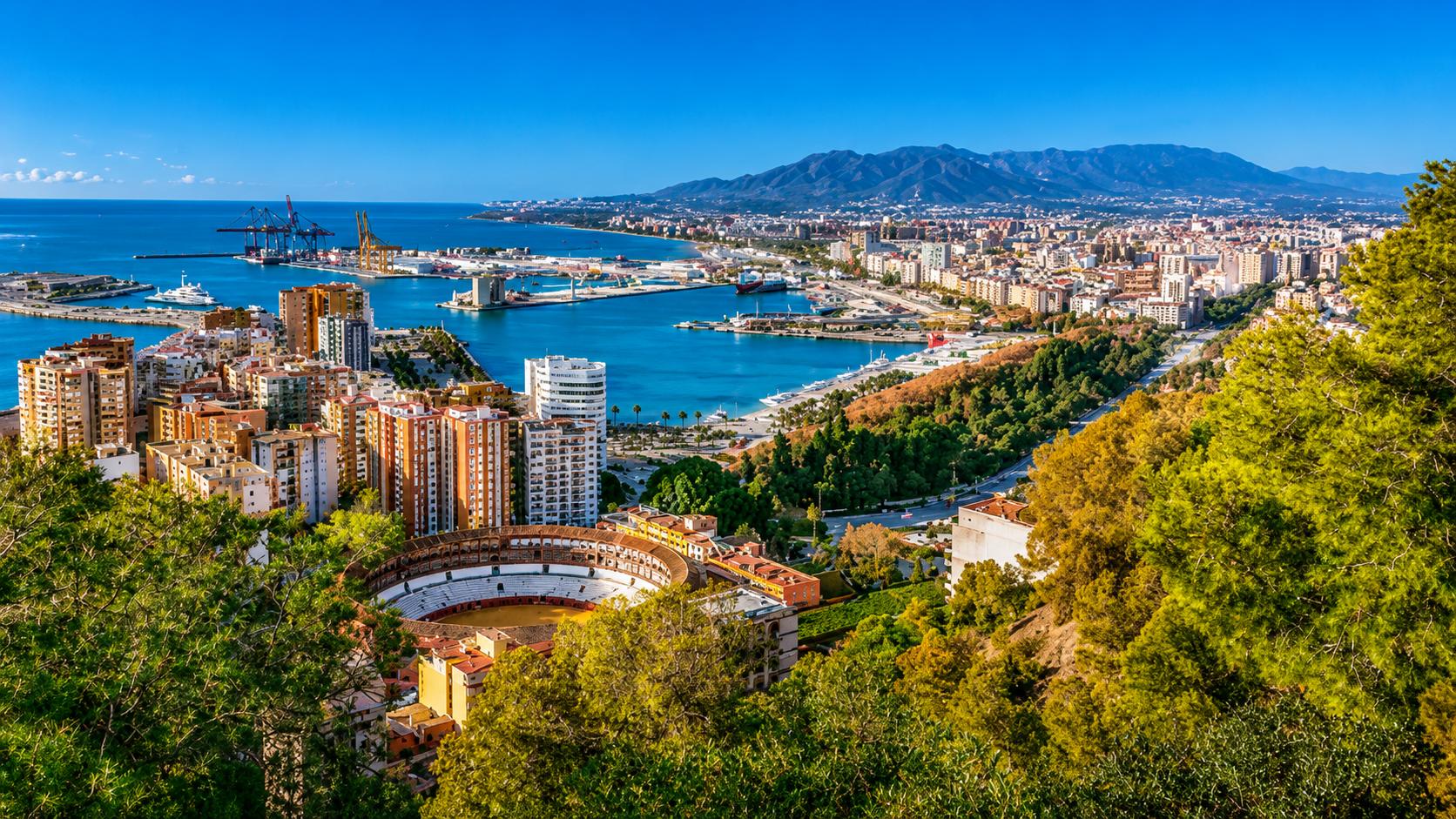
Malaga sits on Spain's southern Mediterranean coast in Andalusia, with the Montes de Málaga rising immediately behind.
The historic centre is compact and largely pedestrianised, centred on the cathedral and the marble-paved Calle Larios.
The port area was redeveloped into Muelle Uno, a waterfront promenade of shops and restaurants connecting the centre to the beach.
Moorish fortifications dominate the hill.
The Alcazaba is an eleventh-century Moorish palace-fortress rising directly behind the Roman theatre, with terraced gardens, courtyards and water channels.
Above it, connected by a walled path, sits the Gibralfaro castle with commanding views over the city, the port and the bullring.
A combined ticket covers both, and a bus runs up to Gibralfaro for anyone who would rather not walk the climb in the heat.
At the foot of the Alcazaba, the Roman theatre was rediscovered in the 1950s and is free to view.
Picasso was born here.
The Picasso Museum occupies a sixteenth-century palace in the old town and holds a substantial collection donated by the artist's family, covering the full span of his career.
His birthplace on Plaza de la Merced is a separate, smaller museum.
Malaga has invested heavily in culture more widely. The Centre Pompidou Málaga sits under a distinctive coloured glass cube on the waterfront, and the Carmen Thyssen Museum holds Spanish painting in a restored palace.
The cathedral has one tower.
Malaga Cathedral is known locally as La Manquita, meaning the one-armed lady, because its second tower was never completed.
The interior is grand baroque, and rooftop tours are available for those who want the views and do not mind the stairs.
Whether the missing tower's funds went to support American independence, as local tradition holds, is disputed by historians, but it is repeated by every guide in the city.
Beaches make it work for families.
La Malagueta is the main city beach, a short walk from the centre, with sand, showers, lifeguards in season and a line of restaurants behind.
The espetos, sardines skewered and grilled over driftwood fires in old boats on the sand, are a Malaga speciality and should not be missed.
Beyond the beach, the city has an aquarium at nearby Benalmádena, a large botanical garden north of the centre and a cable car up Mount Calamorro. The Automobile and Fashion Museum surprises many visitors by being genuinely engaging for children.
Day trips are excellent.
Granada and the Alhambra are reachable in around an hour and a half by bus or train. Alhambra tickets must be booked well in advance and sell out weeks ahead in season.
Ronda, dramatically sited across a gorge, is a classic day out, as are the white villages of the interior.
The Caminito del Rey, a walkway pinned to the walls of a gorge north of the city, is spectacular and requires advance booking. There is a minimum age, so check before planning it as a family outing.
Eating and drinking.
Andalusian food centres on fried fish, cured ham, gazpacho and salmorejo, and the local sweet wine is a Malaga speciality.
Tapas culture is strong, and the traditional pattern is to move between bars rather than settle in one. Eating times run late, with dinner rarely before nine.
Prices in the centre remain reasonable by Northern European standards, particularly for lunch.
When to go.
Malaga has one of the mildest climates in Europe, and the shoulder seasons are excellent, with warm days from March through to November.
Midsummer is very hot, and sightseeing needs to work around the middle of the day.
Winter is mild and pleasantly quiet, with daytime temperatures often comfortable for walking, though swimming is for the hardy.
Holy Week processions in the spring are a major event and fill the city, so book far ahead or avoid it depending on your preference.
Share your thoughts.
Would you use Malaga as a base for the coast, or stay in the city itself?
Travel News
Malaga from Newcastle: A City Break Guide
Long treated as the gateway to the Costa del Sol, Malaga has quietly become one of Spain's most rewarding city breaks in its own right.
Advertisement

Comments (0)
You must be logged in to post comments.
Don't have an account? Register here
No comments yet. Be the first to share your thoughts!