
For years, Margaret Fleming was treated as little more than a name on paperwork.
Official records suggested she was alive and living quietly in Inverkip, a small village on Scotland’s west coast. Benefits continued being claimed in her name, letters arrived at the address linked to her, and outwardly nothing appeared unusual.
But behind the closed doors of an isolated bungalow, investigators would eventually uncover one of Scotland’s most disturbing fraud and murder cases.
Margaret Fleming, a vulnerable woman with learning difficulties, had not been seen for years.
When police finally began investigating her disappearance properly, they uncovered a chilling web of deception involving forged letters, fraudulent benefit claims, and a couple accused of hiding the truth for nearly two decades.
The case horrified the public because of the sheer cruelty involved. Margaret was not a wealthy target or famous figure. She was a vulnerable woman who appeared to vanish quietly while the people responsible for her care allegedly exploited her absence for financial gain.
Even today, the Margaret Fleming case remains one of the most haunting true crime stories in modern Scottish history.
Who Was Margaret Fleming.
Margaret Fleming was born in 1980 and spent much of her early life within the care system.
She had learning difficulties and was considered vulnerable from a young age. Reports later revealed she struggled with aspects of independent living and often relied heavily on support from others around her.
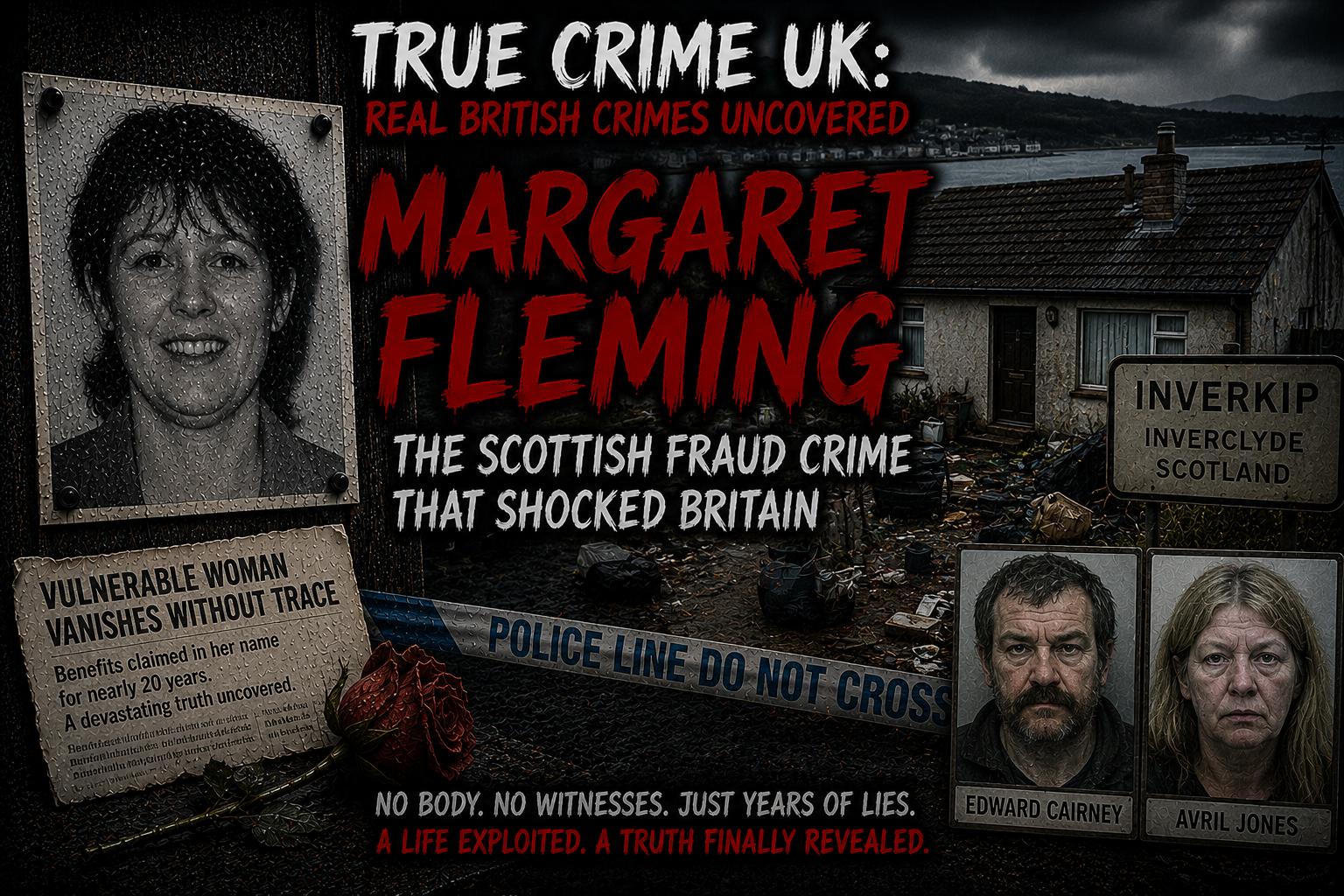
As a teenager, Margaret became connected to Edward Cairney and Avril Jones, a couple living in Inverkip, Inverclyde.
Eventually, she moved into their home.
At first, the arrangement appeared relatively ordinary. Cairney and Jones later portrayed themselves as carers and close companions who had taken Margaret in to help provide stability and support.
Friends and neighbours initially saw little reason for concern.
Margaret was described as quiet and shy, someone who often stayed indoors and rarely drew attention to herself. People who encountered her occasionally remembered a vulnerable young woman who appeared dependent on those around her.
Over time, however, concerns slowly began emerging about Margaret’s welfare and wellbeing.
The most alarming issue was simple but deeply troubling.
Nobody seemed to know where she actually was.
Margaret Fleming Vanishes.
Margaret Fleming was last reliably seen in public around the year 1999.
Neighbours, healthcare workers, and local residents gradually stopped seeing her altogether. Yet despite her complete disappearance from everyday life, little immediate action was taken.
That fact would later become one of the most disturbing aspects of the entire case.
Over the following years, Cairney and Jones allegedly continued claiming benefits in Margaret’s name.
Authorities later estimated more than £180,000 was fraudulently obtained after Margaret vanished.
What shocked investigators most was how effectively the deception appeared to work for years.
According to court proceedings, forged letters and fabricated explanations were repeatedly used to convince officials Margaret was still alive but preferred avoiding contact with services and outsiders.
Excuses ranged from claims she was anxious around people to suggestions she simply wanted privacy.
Meanwhile, no confirmed sightings of Margaret emerged.
As years passed, suspicions slowly began building.
Family members reportedly lost contact with Margaret entirely, while officials became increasingly concerned by the absence of direct interaction with her.
Still, the truth remained hidden for nearly two decades.
The Fraud Investigation Begins.
The investigation that eventually exposed the truth began not as a murder inquiry, but as a benefits fraud case.
In 2016, the Department for Work and Pensions launched concerns regarding long-term claims linked to Margaret Fleming. Officials struggled to verify her circumstances and became increasingly suspicious after repeated failed attempts to establish direct contact.
Police Scotland soon became involved.
Officers visited the Inverkip bungalow connected to Cairney and Jones and began asking questions about Margaret’s whereabouts.
The responses raised immediate concerns.
According to investigators, the couple provided inconsistent explanations about when Margaret had last been seen and why she remained isolated from virtually everyone around her.
Sometimes they claimed she was travelling. Other times they insisted she disliked authority figures and wanted no involvement with official agencies.
Detectives quickly realised there was virtually no evidence proving Margaret remained alive.
As investigators dug deeper, the scale of the mystery became impossible to ignore.
No bank activity, medical records, social interactions, employment history, or confirmed sightings suggested Margaret had been alive for many years.
Police increasingly feared something terrible had happened.
A House Filled With Secrets.
As investigators searched the property occupied by Edward Cairney and Avril Jones, they discovered conditions many described as disturbing and deeply neglected.
The bungalow reportedly contained enormous amounts of clutter, rubbish, animal waste, and unsanitary conditions. Detectives spent extensive periods examining the property for forensic evidence that might explain what happened to Margaret Fleming.
Photographs shown during court proceedings revealed rooms overflowing with debris and signs of long-term neglect.
Investigators searched the house carefully, examining floors, walls, drains, gardens, and nearby land.
Despite detailed searches, investigators never recovered Margaret’s body.
That absence created major challenges for prosecutors.
However, detectives believed the overwhelming circumstantial evidence strongly suggested Margaret had died years earlier and that her disappearance had been deliberately concealed.
Police later argued the couple’s primary motivation had been financial gain.
By continuing to claim benefits in Margaret’s name while pretending she remained alive, prosecutors alleged Cairney and Jones maintained a long-running fraud that lasted for years.
The emotional impact of the revelations shocked Scotland.
Many people struggled to comprehend how someone could disappear for such a long period without authorities intervening effectively.
The Human Cost Behind the Case.
One of the reasons the Margaret Fleming case resonated so strongly with the public was because it highlighted the vulnerability of isolated adults living dependent lives behind closed doors.
Margaret was not part of a high-profile social circle. She did not have regular employment, an active public life, or extensive family support networks nearby.
Investigators later suggested those vulnerabilities may have made it easier for her disappearance to go unnoticed.
Advocates for vulnerable adults later argued the case exposed serious failings in social care oversight and welfare monitoring systems.
Questions emerged about whether stronger welfare checks or better communication between agencies could have identified concerns years earlier.
For many people, the tragedy of Margaret Fleming was not simply about murder.
It was about neglect, invisibility, and the quiet exploitation of someone unable to protect herself fully.
The Trial of Edward Cairney and Avril Jones.
The case finally reached court in 2019 at the High Court in Glasgow.
Prosecutors accused Edward Cairney and Avril Jones of murdering Margaret Fleming and concealing her death while fraudulently claiming benefits in her name.
Throughout the trial, jurors heard extensive evidence regarding the couple’s behaviour, financial records, forged documents, and repeated lies to authorities.
Witnesses testified that Margaret had effectively disappeared from public life decades earlier.
The prosecution argued it was impossible to believe she had voluntarily vanished without leaving behind any trace whatsoever.
Although no body was ever discovered, prosecutors maintained the evidence clearly pointed toward foul play.
Defence lawyers argued there was insufficient proof Margaret had actually been murdered and claimed the Crown could not establish exactly when or how she died.
The trial attracted major media attention across Scotland because of the unusual and deeply unsettling nature of the allegations.
For many people following proceedings, the case felt almost unimaginable.
A vulnerable woman had seemingly disappeared for years without anyone truly noticing.
The Evidence Presented in Court.
Prosecutors built their case carefully around circumstantial evidence.
Financial records showed benefits continuing to be claimed long after Margaret vanished from public life. Investigators also uncovered allegedly forged letters intended to convince authorities Margaret remained alive.
Witnesses described increasingly bizarre attempts to explain her absence.
At times, Cairney and Jones allegedly claimed Margaret simply disliked visitors or wanted isolation from society. But prosecutors argued these explanations became impossible to believe over time.
Police officers involved in the investigation also testified regarding the complete absence of any modern evidence showing Margaret alive after the late 1990s.
No healthcare appointments, no confirmed sightings, no employment activity, and no social interactions existed.
For prosecutors, the picture painted by the evidence was devastatingly clear.
Margaret Fleming was dead, and the people benefiting financially from her disappearance had hidden the truth for years.
The Verdict.
In July 2019, both Edward Cairney and Avril Jones were convicted of Margaret Fleming’s murder.
Jurors concluded the pair had killed Margaret and concealed her death while continuing to profit from benefits claimed in her name.
The judge later described the crime as callous, manipulative, and motivated by greed.
Both defendants received lengthy prison sentences.
Yet despite the convictions, one enormous question still remained unanswered.
What actually happened to Margaret Fleming?
Without a body, investigators could never publicly explain precisely how she died or where her remains were hidden.
That uncertainty continues haunting the case to this day.
Public Reaction Across Scotland.
The Margaret Fleming case generated enormous public reaction throughout Scotland.
Many people expressed outrage not only over the murder itself, but over the apparent failure of systems meant to protect vulnerable individuals.
The idea that someone could disappear for nearly two decades while benefits continued being claimed in their name shocked the public deeply.
Media coverage focused heavily on Margaret’s vulnerability and the quiet, almost invisible nature of her disappearance.
Unlike many murder cases involving sudden violence or dramatic confrontations, this tragedy unfolded gradually through silence, deception, and neglect.
That quiet cruelty disturbed many observers more than overt violence might have.
True crime followers across the UK also became fascinated by the legal complexity of securing murder convictions without a body.
The case demonstrated how prosecutors increasingly rely on circumstantial evidence when physical remains cannot be recovered.
The Mystery That Still Haunts Scotland.
One of the most disturbing aspects of the Margaret Fleming case is that her body has never been found.
Police carried out multiple searches connected to the investigation, but no confirmed trace of her remains was ever recovered.
That absence has left many people deeply unsettled.
Investigators believe Margaret likely died sometime around the late 1990s or early 2000s, but the precise circumstances surrounding her death remain unclear publicly.
For true crime followers across the UK, the case became symbolic of how vulnerable individuals can disappear quietly when oversight systems fail.
Many commentators later questioned how Margaret could vanish for so long without authorities intervening sooner.
The case also sparked wider conversations surrounding adult safeguarding, care systems, and the protection of vulnerable people living dependent lives behind closed doors.
The Lasting Legacy of the Margaret Fleming Case.
Today, the Margaret Fleming murder case remains one of Scotland’s most tragic and haunting criminal investigations.
Unlike many high-profile murder cases involving sudden violence or public attacks, this story unfolded slowly over decades through silence, deception, and neglect.
That quiet cruelty is precisely what disturbed so many people.
Margaret Fleming was a vulnerable woman who appeared to disappear almost invisibly while those around her allegedly continued benefiting financially from her absence.
The case forced uncomfortable questions about how society protects vulnerable adults and how easily isolation can hide abuse for years.
Even after the convictions, the mystery surrounding Margaret’s final moments continues lingering over the case.
Without a body or definitive forensic evidence explaining exactly what happened, parts of the story remain unknown.
But for many people across Scotland, one truth remains painfully clear - Margaret Fleming deserved far better than the fate she suffered.
Her story continues serving as a grim reminder that some of the most disturbing crimes are not always the loudest or most violent. Sometimes they unfold quietly, hidden behind ordinary homes, paperwork, and years of silence.
Do you believe authorities could have discovered the truth about Margaret Fleming much earlier?
Share your thoughts in the comments and join the discussion on one of Scotland’s most disturbing modern true crime cases.
Crime News
Margaret Fleming Murder Case - The Scottish Fraud Crime That Shocked Britain
Advertisement



Comments (0)
You must be logged in to post comments.
Don't have an account? Register here
No comments yet. Be the first to share your thoughts!