
The cost of a holiday is not only what you paid for the flights and the hotel. A surprising amount of money leaks away in transaction fees, poor exchange rates and charges that nobody mentions until the statement arrives.
None of it is difficult to avoid. It just requires knowing about a handful of specific traps, most of which are designed to be easy to fall into.
Your everyday debit card is probably the expensive option.
Most high street current accounts apply a foreign transaction fee, typically around three per cent, to every purchase made in a foreign currency. Some also apply a separate cash withdrawal fee, and some charge a flat amount per transaction on top.
Spend a thousand pounds abroad on a card charging three per cent and you have paid thirty pounds for the privilege, which is a decent meal out.
Several banks and app-based providers offer accounts with no foreign transaction fees, and specialist travel cards do the same. Opening one takes minutes and is the single most effective thing most travellers can do to reduce costs.
Check what your own card charges before you travel rather than assuming, since the terms differ enormously even between accounts at the same bank.
Always pay in the local currency.
This is the trap that catches the most people and costs the most money for the least reason.
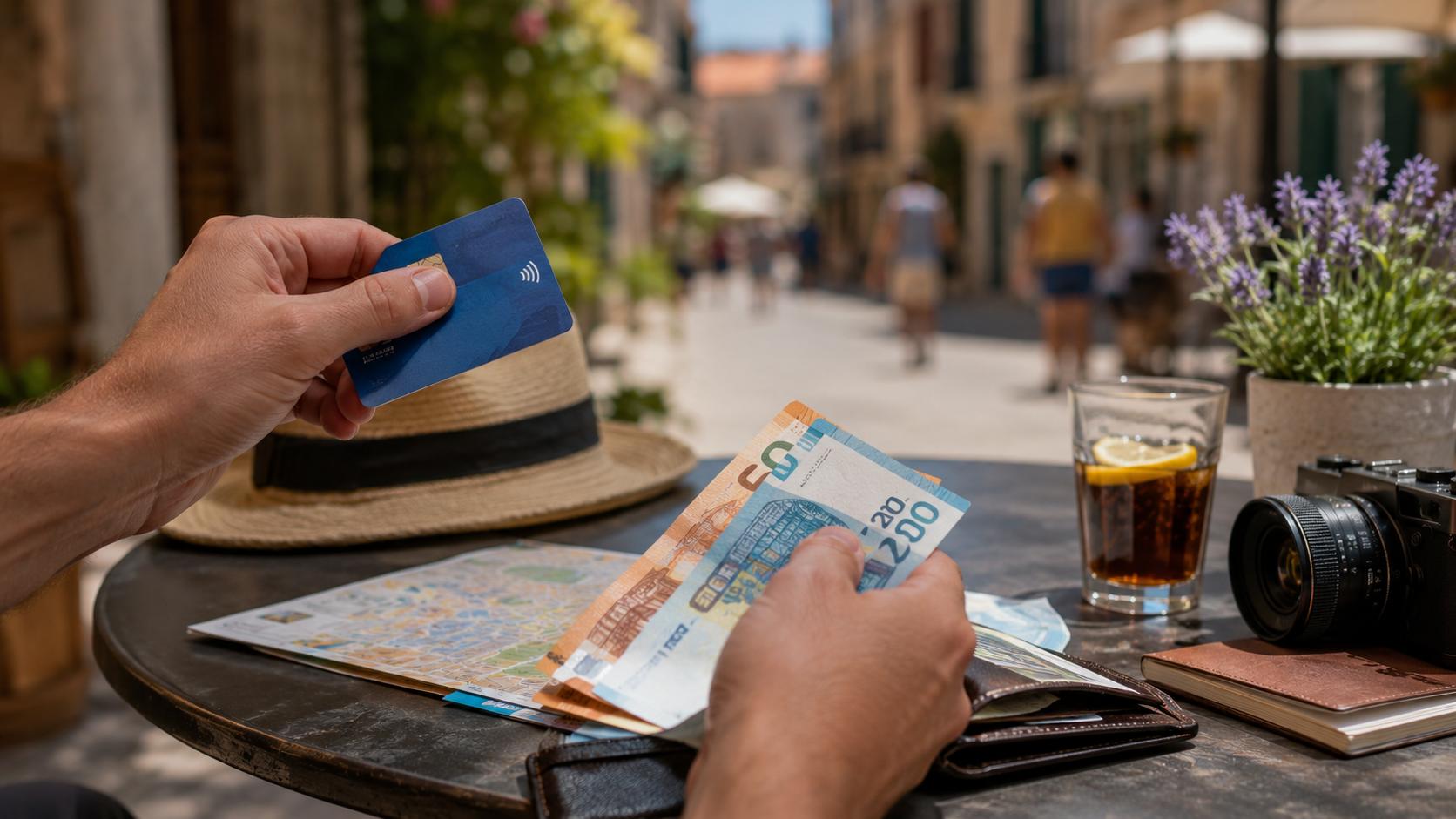
When you pay by card abroad, the terminal or cash machine will frequently offer to convert the transaction into pounds, presenting it as a helpful service so you know exactly what you are spending. This is called dynamic currency conversion, and the exchange rate applied is set by the merchant's payment provider rather than by your card scheme.
It is almost always worse, sometimes substantially, and there is frequently a further markup buried inside it.
Always choose to pay in the local currency. Your card provider will then convert at the card scheme rate, which is close to the interbank rate and far better than anything a shop terminal will offer.
The same applies to cash machines, which will ask the same question with the same misleading framing.
Cash still matters, but less than it did.
Card acceptance has spread enormously, and in much of northern Europe cash is close to redundant. In parts of southern and eastern Europe, and in many places outside Europe, cash remains essential for small purchases, markets, taxis and tips.
Carry some, but do not carry a great deal. A modest amount for the first day and for emergencies, topped up from cash machines as needed, is safer and cheaper than bringing everything from home.
Airport bureaux de change offer the worst rates you will encounter anywhere, and buying currency at the airport is close to a voluntary donation. If you must buy in advance, order online for collection or delivery, which is substantially better.
Never use the currency exchange desks in tourist areas offering commission-free conversion, since the commission is simply built into the rate.
Cash machines abroad.
Use bank-operated machines rather than the independent ones found in shops, hotels and tourist areas, which frequently charge high fixed fees on top of poor rates.
Withdraw larger amounts less frequently where a fixed fee applies, and smaller amounts more frequently where the risk of loss or theft is the greater concern.
Decline the conversion offer, as above.
Check whether your card charges a cash withdrawal fee even on a fee-free travel account, as some do.
Credit cards give you protection that debit cards do not.
For significant purchases, a credit card offers statutory protection that makes the card provider jointly liable with the supplier where something goes wrong, for transactions within a defined value range.
That matters for flights, accommodation and package elements booked directly. If an airline fails or a hotel booking evaporates, a credit card claim is a considerably stronger position than a debit card chargeback, though chargeback is also worth pursuing.
Paying by credit card and clearing the balance in full avoids interest while retaining the protection.
Practical points before departure.
Tell your bank if you are travelling somewhere unusual. Most no longer require this, since fraud systems are better than they were, but a blocked card in a foreign country is a serious inconvenience.
Take more than one card, from different providers, and keep them separately. A single card that is lost, blocked or eaten by a machine leaves you stranded.
Know your PIN, since contactless limits are lower abroad and chip and pin is used more widely.
Set up mobile banking before you go and check that you can receive verification messages abroad, since roaming and two-factor authentication interact badly for some travellers.
Keep an emergency reserve of currency separate from your wallet.
Insurance is not a money issue until it is.
The largest single financial risk of a holiday is a medical emergency, and travel insurance is the only realistic protection. Declare pre-existing conditions honestly, since a policy invalidated by non-disclosure is worth nothing at exactly the moment it matters.
The Global Health Insurance Card provides access to state healthcare in the EU and some other countries on the same basis as a local resident, but it is not a substitute for insurance and does not cover repatriation, private treatment or lost belongings.
Share your thoughts.
Have you ever been caught by the pay in pounds trick at a foreign card machine?
Travel News
Money Abroad: Cards, Cash and Charges for Newcastle Travellers
Advertisement


Comments (0)
You must be logged in to post comments.
Don't have an account? Register here
No comments yet. Be the first to share your thoughts!