
For fifty-six years it was the answer to a poignant trivia question, the last major trophy Newcastle United had won. In 1969 the club lifted the Inter-Cities Fairs Cup, the forerunner of the UEFA Cup, in the very first European campaign in its history. That triumph over the Hungarian side Ujpesti Dozsa became a legend on Tyneside, a story of unlikely European adventure that sustained supporters through the long decades that followed before silverware returned to St James' Park in 2025.
An Unlikely European Journey.
Newcastle qualified for the competition almost by quirk of the rules of the time, which limited each city to a single representative, and few expected the campaign to end in glory. Managed by Joe Harvey, a man who had captained the club to FA Cup success in the early 1950s, Newcastle approached Europe with characteristic determination. The team was built on resilience and togetherness rather than individual superstars, and as the rounds passed they grew in belief, dispatching a series of respected continental opponents on their march towards the final.
The Road to the Final.
The journey took Newcastle across Europe against clubs from the Netherlands, Portugal, Spain and beyond, with each tie demanding courage and discipline. They overcame Rangers in a fiercely contested semi-final, a result that carried particular weight given the intensity of the occasion, and reached a two-legged final against Ujpesti Dozsa of Budapest. The Hungarians were a gifted side, and Newcastle would need to be at their very best across both legs to bring the trophy home to Tyneside.
A Captain's Final.
The hero of the final was the captain, Bobby Moncur, a rugged and determined Scot who had spent years fighting for his place at the club before becoming its inspirational leader. Across the two legs of the final Moncur scored three goals, an astonishing contribution from a defender, and his performances embodied the spirit of the team. The first leg at St James' Park ended in a commanding three-nil victory, with Moncur to the fore, giving Newcastle a cushion to take to Hungary.
The Drama of Budapest.
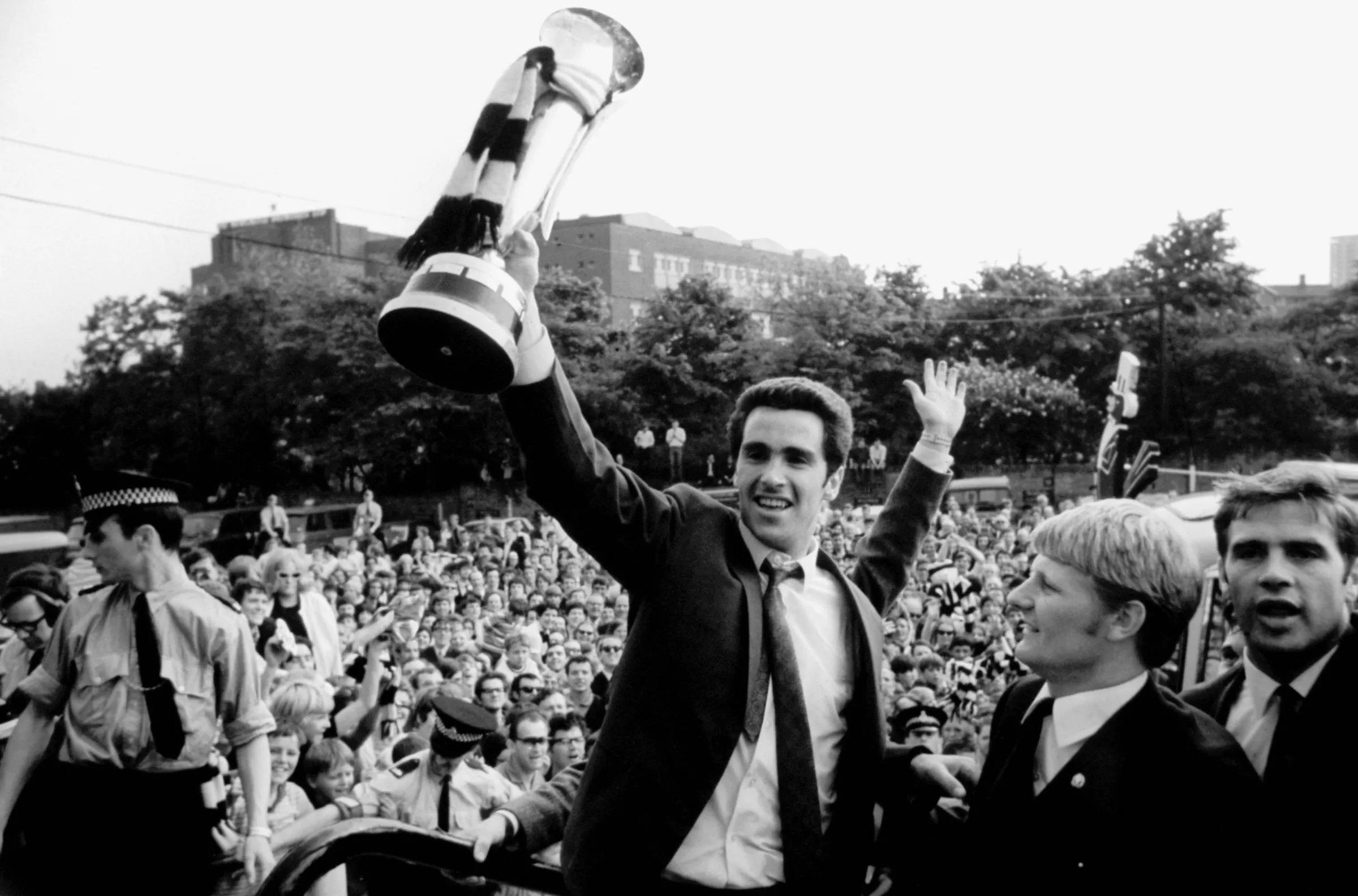
The second leg in Budapest tested every ounce of the team's resolve. Ujpest came out determined to overturn the deficit and threatened to do so, but Newcastle steadied themselves and ultimately won the night as well, completing a six-two aggregate triumph. The image of Moncur lifting the trophy, the first Newcastle captain to raise major silverware since the 1950s, became one of the defining pictures in the club's history. For the players and supporters who travelled, it was a night that would never be surpassed in their footballing lives.
The Long Shadow of 1969.
What nobody could have known that summer was how long the wait for the next trophy would be. As the years turned into decades, the 1969 Fairs Cup grew ever more precious in the memory, a reminder that Newcastle had once conquered Europe. Bobby Moncur, with characteristic warmth, often said he hoped to lose his status as the last Newcastle captain to lift silverware, and that he wished it would happen soon. His wish was finally granted in 2025, and in a fitting gesture he was invited to present the trophy to the St James' Park crowd, linking the generations across more than half a century.
Why the Triumph Still Resonates.
The 1969 victory matters because it proved that Newcastle United belonged on the European stage and could win against the odds. The campaign was achieved without lavish spending or a galaxy of stars, relying instead on organisation, character and the unbreakable bond between the team and its supporters. In an age when European football has become the preserve of wealthy elites, the romance of that run feels all the more remarkable, a story of a proud club seizing its chance and refusing to let it slip.
A Bridge Between Eras.
For younger supporters, the 1969 Fairs Cup can feel like ancient history, a grainy tale from before colour television was universal. Yet the triumph remains a vital part of the club's identity, a thread connecting the modern Newcastle to the heroes of the past. The names of that team are honoured in the club's hall of fame, and the trophy itself stands as testament to a golden European night. When supporters dream of continental glory once more, they look back to 1969 and to the captain who scored in a final and carried a city's hopes on his shoulders, proof that great European nights are part of the Newcastle story.
A Team of Unsung Heroes.
What gave the 1969 triumph its special character was the nature of the team that achieved it. This was not a side packed with household names and international superstars, but a group of honest, hard-working professionals who believed in one another and in their manager. Players who had been written off or who had fought for years to establish themselves found, in that European campaign, the stage on which to write their names into history. The goalkeeper produced vital saves, the defenders held firm against gifted continental forwards, and the whole team ran themselves into the ground for the cause. It was a triumph of collective spirit over individual brilliance, the kind of success that supporters cherish most deeply because it reflects the values they hold dear. In an age when football increasingly rewards wealth and star power, the memory of that united, unfashionable side carries a particular resonance. They proved that determination, organisation and togetherness could overcome more celebrated opponents, and they gave the supporters a model of what their club could achieve. The unsung heroes of 1969 remain honoured on Tyneside precisely because they embodied the qualities that the region most admires in its sporting teams.
Over to you.
The 1969 Fairs Cup proved that European glory has always been part of the Newcastle story.
Do you think the spirit of 1969 can inspire a new era of European nights on Tyneside?
Sports News
European Glory: Newcastle United and the 1969 Fairs Cup
The story of Newcastle United's 1969 Inter-Cities Fairs Cup win over Ujpesti Dozsa, captain Bobby Moncur's heroics and a European triumph cherished for decades.
Advertisement



Comments (0)
You must be logged in to post comments.
Don't have an account? Register here
No comments yet. Be the first to share your thoughts!