
In the 1980s, British middle-distance running enjoyed a golden age that has never been equalled, and at its heart stood a tall, elegant runner from the banks of the Tyne. Steve Cram, known to the world as the Jarrow Arrow, was a world champion and a record-breaker who shared the stage with Sebastian Coe and Steve Ovett during an era when the nation dominated the sport. His achievements brought enormous pride to the North East and confirmed the region's place at the very summit of athletics.
A Jarrow Boy with Talent to Spare.
Steve Cram was born in Gateshead in 1960 and grew up in nearby Jarrow, training with the Jarrow and Hebburn Athletics Club. His talent announced itself early, and he competed at a senior international level while still a teenager, marking him out as a prodigy. Tall and graceful, with an enormous stride, he ran with a smooth efficiency that made his speed seem effortless. He lacked the explosive final kick of some rivals, so he developed the tactic of running the finish out of them, launching his decisive effort from far out and daring others to keep pace.
The World Champion of 1983.
Cram's breakthrough on the global stage came at the inaugural World Athletics Championships in Helsinki in 1983, where he won the fifteen hundred metres gold medal. In a tactical final he outkicked a field of outstanding runners over the closing stages to become the first ever world champion at the distance. The victory established him as a major force and earned him recognition as the BBC Sports Personality of the Year, making him a household name across Britain. At a stroke he had joined the elite of world middle-distance running.
Olympic Silver and a Fierce Rivalry.
At the 1984 Olympic Games in Los Angeles, Cram lined up in a fifteen hundred metres final that featured himself, Coe and Ovett, the world champion alongside the Olympic champion and the world record holder, a measure of British dominance that has never been repeated. Cram won the silver medal behind Coe, his season having been disrupted by injury, but the achievement underlined his standing among the greatest runners of the age. The rivalry between the three British stars captivated the public and inspired a generation of young athletes.
Nineteen Days That Stunned the World.
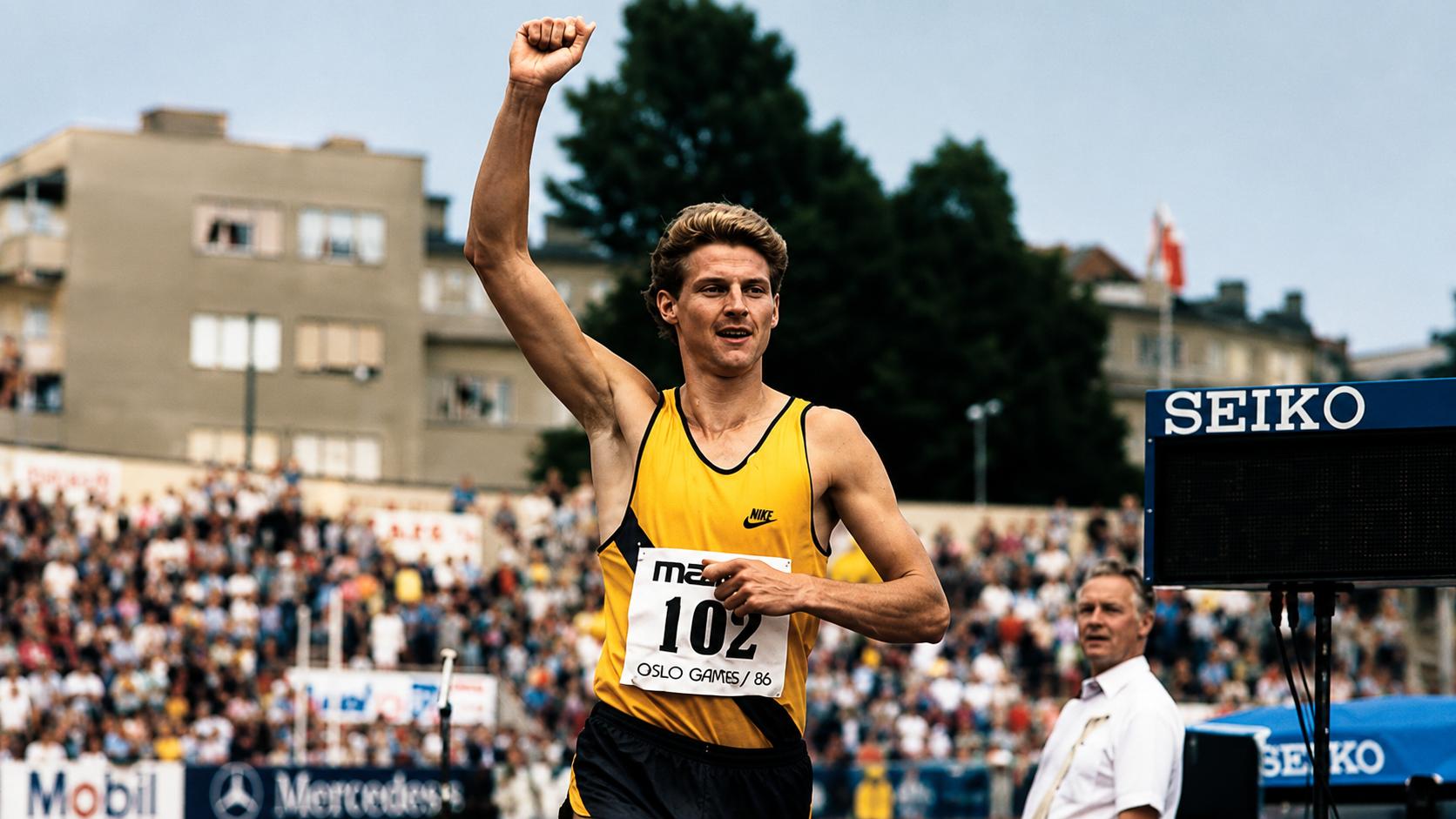
The summer of 1985 produced the most extraordinary chapter of Cram's career. Over a span of just nineteen days he set world records in three different events, the fifteen hundred metres, the mile and the two thousand metres, an astonishing burst of brilliance that placed him at the pinnacle of the sport. He became the first man to run the fifteen hundred metres in under three minutes and thirty seconds, breaking a barrier that had stood as a benchmark of human performance. His mile record in Oslo, achieved in a thrilling tactical duel, stood for many years and remained a European record long afterwards.
A Champion at Every Level.
Cram's collection of honours extended across the major championships of his era. He won multiple Commonwealth Games and European Championship gold medals, defending titles and proving his consistency against the best in the world. His combination of championship success and record-breaking speed marked him as one of the finest British athletes of all time, and his performances helped to make athletics a hugely popular television sport during the 1980s, drawing massive audiences to meetings at home and abroad, including at Gateshead.
A Life Beyond the Track.
After retiring from competition, Cram became one of the most respected broadcasters in athletics, bringing his deep knowledge and calm authority to the commentary box for many of the sport's biggest occasions. He also gave back to wider society, serving as the chancellor of a North East university and co-founding a charity supporting children overseas. His continued involvement in the sport and his community reflected the same dedication that had defined his running career, and he remained a beloved figure across the region.
A Lasting Inspiration.
The Jarrow Arrow remains an icon of North East sport, a runner who took the name of his home town around the world and brought it glory. His records and championship victories belong to a golden age, but his influence endures in the young athletes he has inspired and in the pride he gave to a region that has always valued its runners. Steve Cram proved that a boy from Jarrow could become the fastest in the world, and that achievement continues to shine as one of the great stories of Tyneside sporting excellence.
The North East Running Culture.
Steve Cram did not emerge from nowhere. He was the product of a deep and thriving running culture in the North East, a tradition sustained by dedicated clubs, volunteer coaches and a community that valued the sport. The region has long produced outstanding distance and middle-distance runners, and the local clubs provided the structure and encouragement that allowed talent to develop. Cram trained alongside others who pushed him to improve, learning his craft in the unglamorous setting of club nights and local races before the world ever knew his name. That grassroots foundation was essential to his success, and his achievements in turn inspired a new generation of young runners across the area to lace up their spikes and dream. The relationship between the champions at the top and the clubs at the base is a virtuous circle, each sustaining the other, and Cram understood and honoured that connection throughout his life. His later work supporting athletics and young people reflected a recognition that he owed much to the culture that had shaped him. The story of the Jarrow Arrow is therefore also the story of North East running itself, a tradition of excellence built on community, dedication and a shared love of the sport that continues to this day.
Join the conversation.
Steve Cram carried the name of Jarrow around the world and into athletics history.
Do you remember the golden age of British middle-distance running in the 1980s?
Sports News
The Jarrow Arrow: Steve Cram and a Golden Age of Running
The story of Steve Cram, the Jarrow Arrow, who became 1500m world champion in 1983 and set three world records in 19 days during athletics' British golden age.
Advertisement





Comments (0)
You must be logged in to post comments.
Don't have an account? Register here
No comments yet. Be the first to share your thoughts!