
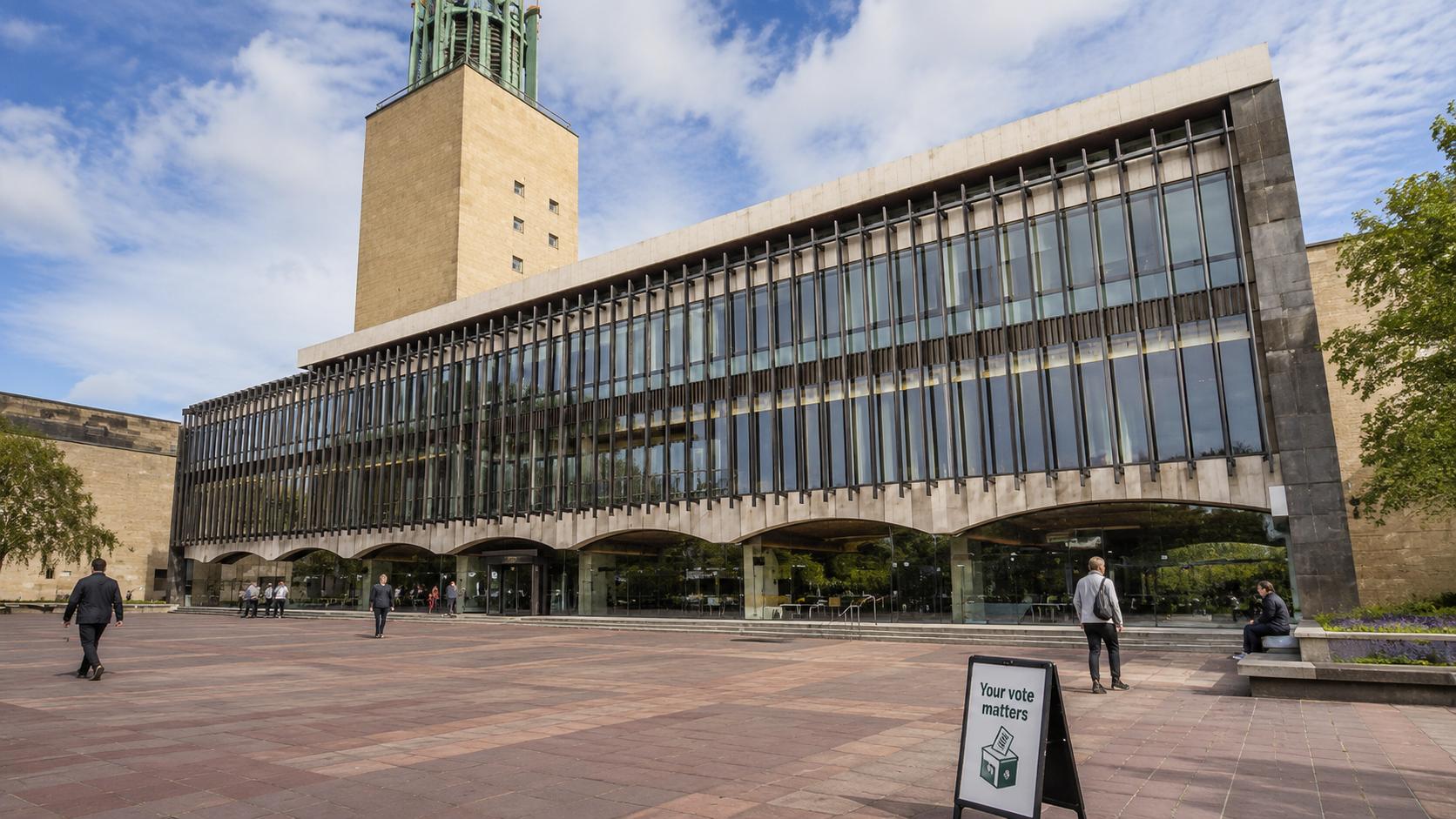
Newcastle went to the polls on Thursday 7 May 2026 in an election unlike any the city has held in recent memory. Every one of the 78 council seats was contested, and the result reshaped the composition of the authority entirely.
This article sets out who stood, what each party received and where the council stands afterwards.
All 78 seats were up at once.
Newcastle City Council normally elects by thirds, with roughly a quarter of the authority chosen each year across a four-year cycle.
That pattern was interrupted in 2026 by a review of the city's ward boundaries. Following those changes, the council moved to 26 wards each returning three councillors, and all 78 seats were contested simultaneously.
Voters could therefore select up to three candidates on their ballot paper rather than one. Counting took place the following day, Friday 8 May.
Six parties and a number of independents stood.
The Liberal Democrats, the Green Party, Reform UK and Labour each fielded a full slate of 78 candidates, contesting every seat in the city.
The Conservatives stood 35 candidates, contesting fewer than half the available seats. Newcastle Independents put forward two candidates, and nine independent candidates stood across various wards. The Trade Unionist and Socialist Coalition also contested seats.
The presence of four parties standing full slates was itself notable, and reflected a considerably more contested election than the city has typically seen.
The Liberal Democrats won the most seats.
The Liberal Democrats emerged with 25 of the 78 seats, a net gain of two, giving them just under a third of the council.
That made them the largest single group, though well short of the 40 seats required for an overall majority.
Their vote share was 23.10 per cent, amounting to 56,238 votes, an increase of 1.70 percentage points on their previous performance.
The Greens and Reform UK finished level on seats.
The Green Party took 24 seats, a net gain of 22, transforming a small group into one of the largest on the council.
Reform UK also took 24 seats. As the party had not previously held representation on Newcastle City Council, all 24 were gains, and it entered the chamber as a joint second-largest group at its first contest of the full authority.
The two parties therefore held identical seat numbers, each with 30.77 per cent of the council.
The Greens polled the most votes overall.
On vote share the ordering differed from the seat outcome. The Green Party received the largest number of votes of any party, with 65,742 votes and 27.01 per cent of the total, an increase of 12.71 percentage points.
Reform UK received 58,925 votes, or 24.21 per cent, placing them second on votes cast.
The Liberal Democrats, who won the most seats, were third on votes with 56,238.
This divergence between votes and seats is a normal feature of the first-past-the-post system used in English local elections, under which candidates are elected by winning the most votes in a ward rather than in proportion to citywide support.
Labour lost 43 seats.
Labour, which had been the largest party on the council before the election, was reduced to two seats.
The party contested all 78 seats and received 43,426 votes, a share of 17.84 per cent, down 22.76 percentage points on its previous result.
Labour had already lost overall control of the council following the 2024 election, when the authority moved into no overall control while Labour remained the largest single party. The 2026 result removed the party from that position.
The Conservatives won no seats.
The Conservatives received 9,120 votes across the 35 seats they contested, a share of 3.75 per cent, down 6.75 percentage points. The party finished without representation on the council.
Independent candidates collectively won three seats, with 8,266 votes and 3.39 per cent of the total.
Newcastle Independents, standing two candidates, received 1,453 votes and 0.60 per cent, and did not win a seat.
The council is in no overall control.
With 40 seats required for a majority and the largest group holding 25, no party can pass a budget or a policy decision without the support of others.
In practice, authorities in this position operate either through a formal coalition, a looser arrangement in which one group runs the council with the agreement of others, or on a vote-by-vote basis with majorities assembled for each decision.
Committee places, including scrutiny committees, are typically allocated in proportion to group sizes.
What happens next.
Councillors elected in May 2026 will serve until the next scheduled election for the authority. Under the revised arrangements following the boundary review, the council's future electoral cycle is a matter determined by the relevant orders and by the council itself.
By-elections are held where a seat becomes vacant between scheduled elections, following a resignation, disqualification or death.
Full results by ward, including individual candidate vote totals, are published by Newcastle City Council on its website, along with turnout figures for each ward.
Share your thoughts.
Did the result in your ward surprise you?
Political News
Newcastle's May 2026 Council Election: The Full Picture
All 78 seats were contested on 7 May under new ward boundaries, and the result left no party in control of Newcastle City Council.
Advertisement


Comments (0)
You must be logged in to post comments.
Don't have an account? Register here
No comments yet. Be the first to share your thoughts!