
The central policy of the new government is the redistribution of power and money away from Westminster towards England's regions.
Its most visible element opened on Friday 24 July, when the Prime Minister launched a new office in Manchester.
This article sets out what has been announced, what has been floated but not confirmed, and what critics have said about the approach.
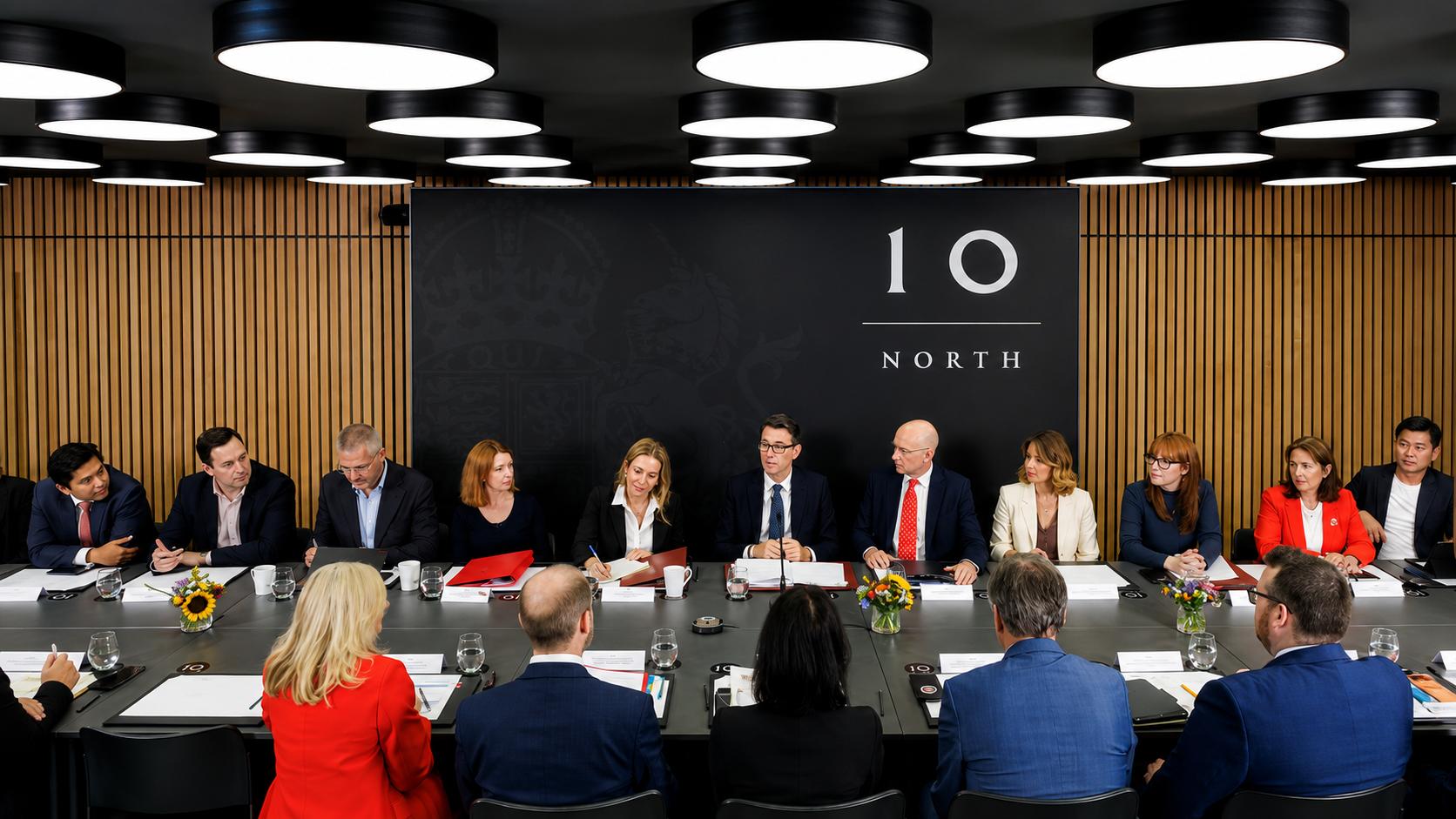
Number 10 North is a prime ministerial office in Manchester.
The new office, described by the government as a situation room for growth, is intended to function as a base from which the Prime Minister works for approximately one day each week.
The stated purpose is to coordinate national and local government in agreeing long-term economic strategy, and to support regions in setting growth ambitions.
Although headquartered in Manchester, the government has said its remit covers regions across the north of England, the Midlands and Yorkshire.
The National Economic Council has been revived.
Alongside the new office, the government has re-established the National Economic Council, a body originally created in 2008 to respond to the global financial crisis.
The Prime Minister chaired its first meeting at Number 10 North, convening senior ministers alongside regional mayors.
Including elected regional mayors in a body of that kind represents a change in how such meetings have typically been composed.
The case rests on comparative figures.
The argument advanced for greater regional control cites the United Kingdom's position as one of the most centralised economies among developed countries.
According to OECD figures, the share of UK tax revenue raised at subnational level was under 5 per cent in 2023. The equivalent figures were around 14 per cent for France, 24 per cent for Spain and close to a third for Germany.
Analysis published by PwC in 2019 estimated that if the rest of the UK moved even halfway towards London's productivity levels, the national economy would be at least 4 per cent larger.
Several powers have been discussed.
Beyond the structures announced, advisers have floated a range of possible transfers of power, none of which has been confirmed as policy.
These have included greater local control over utilities such as water, energy and transport, and mechanisms allowing local authorities to raise and retain more of their own revenue.
The possibility of a local income tax has been reported as among the ideas under discussion. No legislation has been brought forward on any of these points at the time of writing.
A ten-year industrial plan has been proposed.
The Prime Minister has stated an intention to produce a ten-year plan supporting every region to set industrial ambitions, alongside changes to public procurement.
On procurement, the stated position is that policy has historically prioritised lowest cost from international suppliers, and that greater weight should be given to supporting UK-based suppliers.
Reindustrialisation has been identified as one of the government's central objectives, alongside housing and education reform.
Critics question whether it constitutes devolution.
Several academics and policy analysts have argued that Number 10 North does not itself transfer power.
Alan Trench, an academic and policy adviser, described the creation of the office as de-concentration rather than devolution, a practice found in highly centralised states, arguing that in itself it does not signify any transfer of power and at most relocates public sector jobs.
Michael Keating, professor of politics at the University of Aberdeen, noted what he described as the irony of addressing centralisation by establishing a central government department that determines allocations.
Nicola McEwen described giving the office a strategic role as positive, while stating that the key test would be whether it engages with devolved institutions and changes practice within Whitehall.
Trench also said that a body of this kind was badly needed and long overdue.
The devolved nations sit outside much of it.
Several early policy announcements apply to England only, because the relevant powers are devolved to Scotland, Wales and Northern Ireland.
The Prime Minister met the leaders of the Scottish and Welsh governments during a visit to Scotland, and has ruled out supporting independence referendums.
Plaid Cymru won the Senedd elections held in May 2026 and has sought additional powers over policing, justice, rail and the Crown Estate. The Secretary of State for Wales, Stephen Kinnock, said he was not entirely convinced by that request.
What it means for the North East.
The North East already has a mayoral combined authority covering seven local authority areas, established in 2024, with an elected mayor and devolved responsibilities in transport, skills and regeneration.
Any further transfer of powers would apply through that structure. The inclusion of regional mayors in the National Economic Council gives the region's mayor a formal seat at a national economic body.
No specific commitments relating to the North East had been announced at the time of writing.
Share your thoughts.
What powers would you most want transferred to the North East?
Political News
Number 10 North: What Burnham's Devolution Plan Involves
The new government's flagship policy is shifting power out of Westminster, starting with a prime ministerial office in Manchester.
Advertisement


Comments (0)
You must be logged in to post comments.
Don't have an account? Register here
No comments yet. Be the first to share your thoughts!