
Sunderland AFC is among the most successful clubs in English football history by trophy count, a fact that surprises anyone whose knowledge begins in the Premier League era.
Six league titles, two FA Cups and a period of genuine dominance before the First World War put the club firmly in the sport's establishment.
Here is the story of Wearside football and the club at its centre.
It began with a schoolteacher.
The club was founded in 1879 as the Sunderland and District Teachers Association Football Club, established by James Allan, a Scottish schoolteacher working in the town.
Membership was quickly opened beyond teachers, and the name shortened. The club turned professional and joined the Football League in 1890.
Success came almost immediately. Sunderland won the league title in 1892, retained it in 1893, and won again in 1895, establishing themselves as one of the dominant sides of the era.
The Team of All Talents.
That early side earned the nickname the Team of All Talents, reportedly bestowed after a visiting official watched them play.
Further titles followed in 1902 and 1913, the latter accompanied by an FA Cup final appearance that they lost, denying them a double.
A sixth league title arrived in 1936, followed by the FA Cup in 1937. That remains the last league championship the club has won.
Roker Park was home for a century.
Sunderland moved to Roker Park in 1898 and stayed for ninety-nine years.
At its peak the ground held enormous crowds, and the Roker Roar became a byword for atmosphere generated by a packed, steep-sided stadium close to the pitch.
It hosted matches at the 1966 World Cup, and generations of supporters regarded it with the kind of affection usually reserved for people.
1973 remains the defining day.
Sunderland were a Second Division side when they reached the FA Cup final in 1973 against Leeds United, then among the strongest teams in Europe.
Ian Porterfield scored the only goal. Jim Montgomery produced a double save in the second half that is still regularly cited as the finest in the competition's history.
The image of manager Bob Stokoe running onto the pitch at the final whistle in his raincoat and trilby became one of English football's enduring photographs, and a statue of that moment stands outside the current stadium.
It remains one of the great cup upsets, and on Wearside it has never stopped mattering.
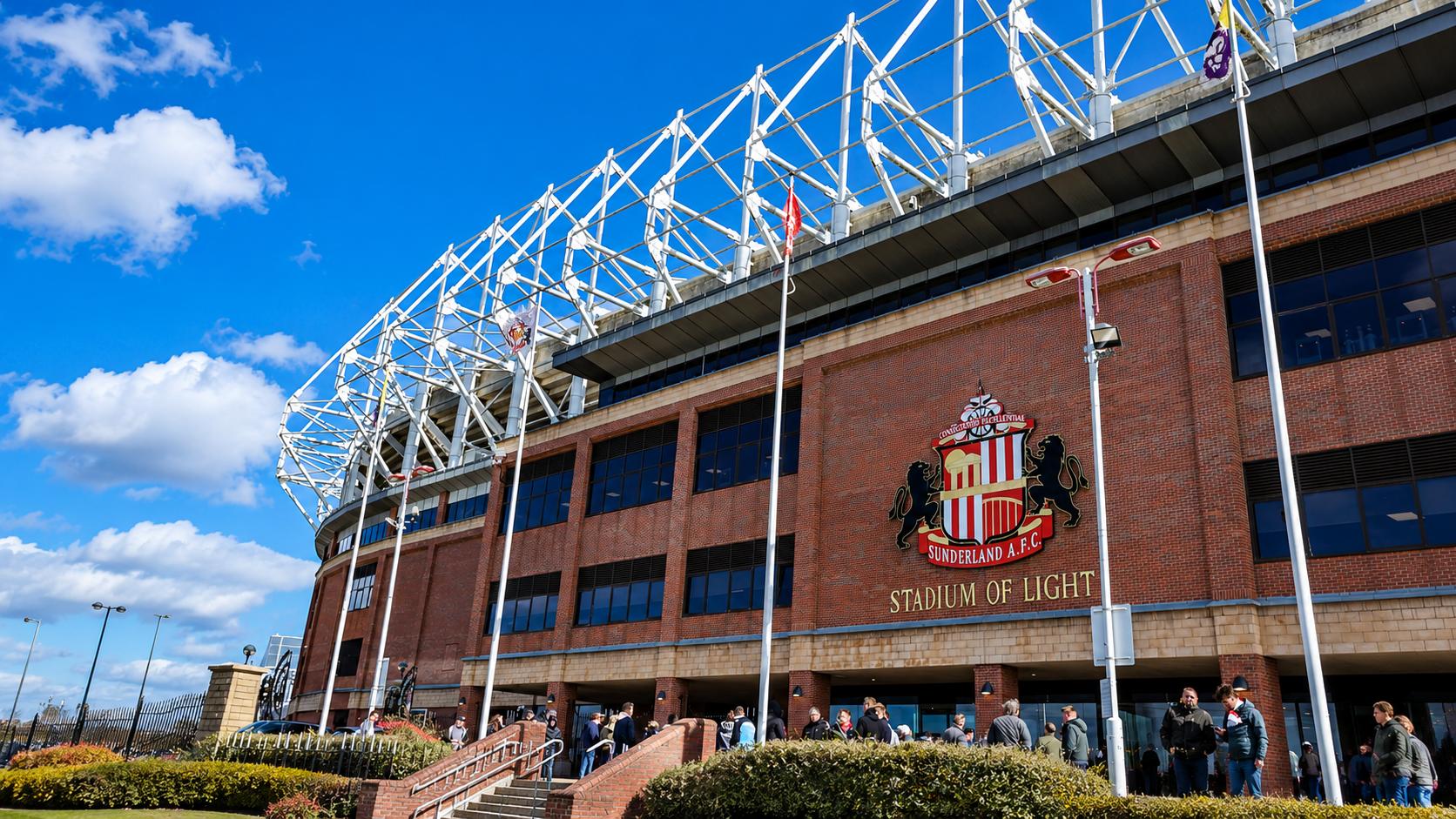
The Stadium of Light replaced Roker Park.
In 1997 the club moved to a new stadium at Monkwearmouth, built on the site of the former Wearmouth Colliery.
The name and the design deliberately acknowledge that history. A miner's Davy lamp monument stands at the entrance, and the connection between the club and the coalfield that sustained the town is made explicit rather than left implicit.
The stadium is among the largest in England and was subsequently expanded, and it has hosted international football and major concerts alongside club matches.
The Quinn and Phillips era brought the last sustained top-flight success.
The partnership of Niall Quinn and Kevin Phillips at the turn of the century produced two seventh-place Premier League finishes and, in Phillips, a striker who won the European Golden Shoe.
Quinn later returned as chairman, and the period is remembered as the club's most successful in the modern era.
What followed was considerably harder. A series of relegations took the club into the third tier by 2018, the lowest point in its history.
The decline was filmed.
The Netflix documentary series following the club during that period brought Sunderland a global audience for reasons nobody at the club would have chosen.
It was unusually candid, showing boardroom decisions, dressing room frustration and, most memorably, the effect of results on supporters whose lives were bound up with the team.
It also, unexpectedly, won the club considerable affection worldwide, and attendances remained extraordinary for the division throughout.
The recovery has been substantial.
Sunderland's crowds in League One consistently exceeded those of many Championship and some Premier League clubs, a fact that says a great deal about the town's relationship with the team.
Promotion back to the Championship came in 2022, and the club returned to the Premier League in 2025 through the play-offs, restoring top-flight football to Wearside after an absence of eight years.
The club has since operated with a notably young squad and a recruitment model built around developing players rather than buying established ones.
The supporters are the constant.
Sunderland's away following has long been among the largest in English football relative to the club's division, and it grew rather than shrank during the years in the third tier.
Attendances above thirty thousand in League One were routine, figures that exceeded most Championship clubs and a number in the division above.
That loyalty has been the club's most reliable asset through every period of difficulty, and it is the reason the club never lost its status as a genuinely big institution regardless of where it was playing.
Wearside football is bigger than one club.
Sunderland's dominance of the local landscape is considerable, but the wider area supports a substantial non-league scene, strong junior football and a growing women's game.
Sunderland's women's team has its own history and has competed at the top level of the domestic game, producing several England internationals.
For a city of its size, the concentration of footballing history is remarkable, and the appetite for it has never been in doubt.
Share your thoughts.
What is the greatest day in Sunderland AFC's history?
Sports News
Sunderland AFC and the Story of Wearside Football
Six league titles, one of the most famous cup upsets in English football and a stadium built on a colliery: Sunderland's story is not a small one.
Advertisement



Comments (0)
You must be logged in to post comments.
Don't have an account? Register here
No comments yet. Be the first to share your thoughts!