
The rules for taking a pet out of Great Britain changed substantially after Brexit, and a great many owners still believe they can travel on the pet passport in the drawer. They cannot, and finding that out at a ferry check-in desk is an expensive way to learn it.
The current system is workable, but it requires planning measured in weeks rather than days, involves a vet appointment that is not cheap, and has to be repeated for every trip.
The old pet passport no longer works.
Pet passports issued in Great Britain are no longer valid for travel to the European Union. If yours was issued in Great Britain, it is not the document you need, regardless of what it says inside or when it expires.
Passports issued in an EU country or in Northern Ireland remain valid, which is why some owners with a connection to either continue to use one.
Everyone else needs an animal health certificate.
What an animal health certificate involves.
An animal health certificate is issued by an official veterinarian, which is a vet with specific authorisation. Not every practice has one, so the first step is finding a vet locally who can issue certificates and booking well in advance.
The certificate must be issued within ten days of the date you enter the EU, which creates a tight window. It is valid for onward travel within the EU for four months and for return to Great Britain within that period.
Crucially, it covers one trip only. A second trip means a second certificate, a second appointment and a second fee, which typically runs to a substantial sum and is one of the main reasons owners reconsider.
The vaccination timing catches people out.
The dog, cat or ferret must be microchipped, and the microchip must be implanted before or at the same time as the rabies vaccination. A vaccination given before the chip does not count and must be repeated.
Rabies vaccination must be given at least twenty-one days before travel. That three-week wait is not negotiable and is where most last-minute plans collapse.
Boosters must be kept up to date, and if a booster is missed the twenty-one day wait applies again from the new vaccination.
Tapeworm treatment for the return.
Dogs returning to Great Britain must be treated for tapeworm by a vet between twenty-four and one hundred and twenty hours before arriving, and the treatment must be recorded.
That means finding a vet abroad, in a foreign language, within a specific window before your ferry or flight. It is entirely doable but needs arranging before you leave rather than discovering on the last day.
The same requirement applies for entry to a small number of countries including Ireland, Finland, Malta and Norway, so a trip to Ireland involves it in both directions.
Getting there is the harder problem.
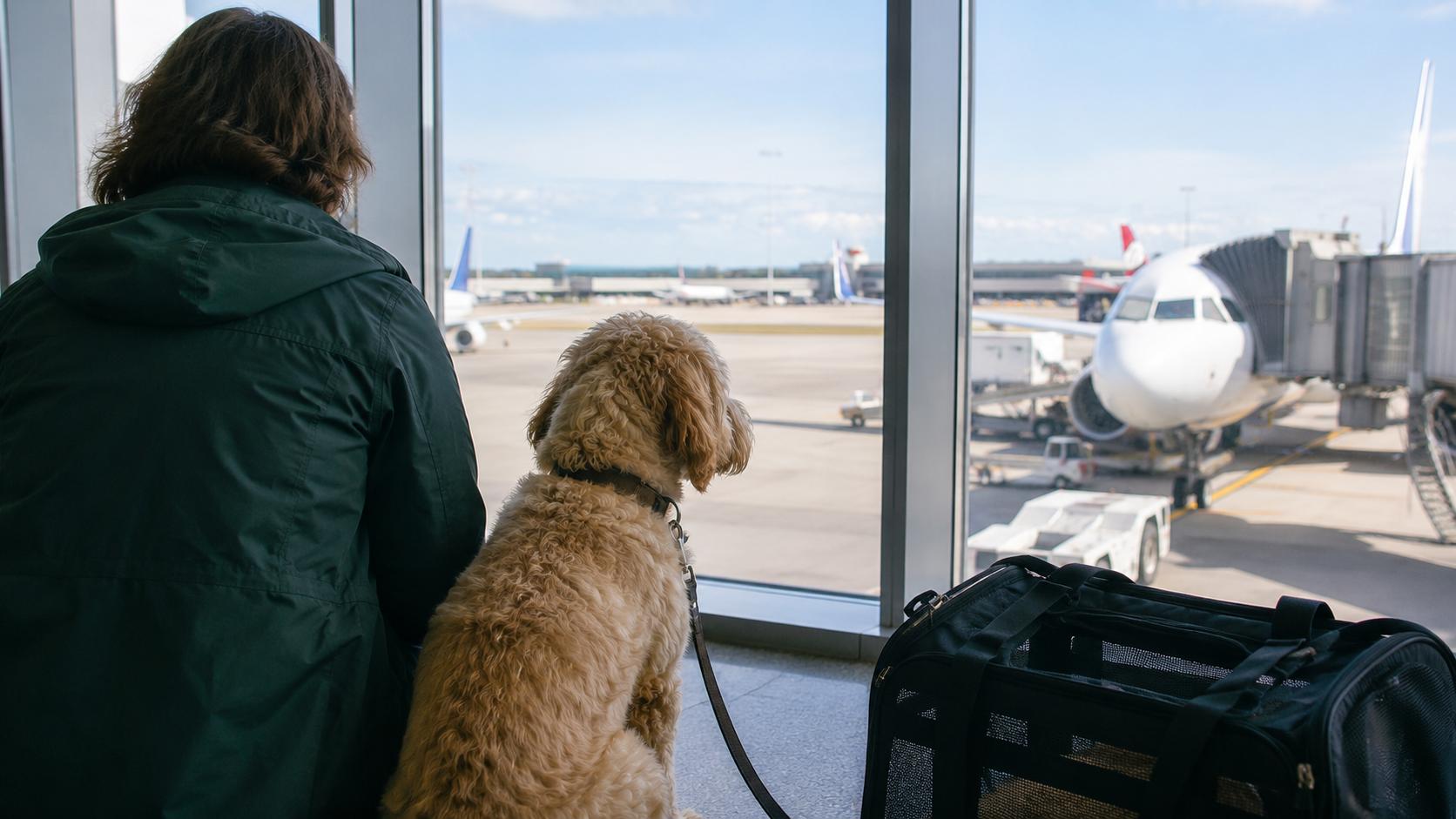
This is the practical constraint that shapes most pet travel from the North East. Most UK airlines do not carry pets in the cabin, and pets travelling by air generally have to go as manifest cargo through specialist handling, which is expensive, stressful for the animal and not available on all routes.
Assistance dogs are a separate matter and travel in the cabin by arrangement.
For most people, that means going by sea or by tunnel. The ferry from North Shields to the Netherlands allows pets, with arrangements including pet-friendly cabins and kennels, and it puts you on the continent with your car and your dog without any flying at all. For a North East owner it is the obvious route.
Alternatively, driving south to the Channel crossings adds a long day at each end but opens up more sailings and the tunnel, where pets stay in the vehicle throughout.
Country-specific rules apply on top.
Some countries have breed restrictions, muzzling requirements in public or on transport, and rules about dogs in vehicles. Certain breeds banned or restricted in the UK may also be restricted elsewhere, and rules differ.
Check the requirements of the specific country, and any country you are passing through, rather than assuming EU-wide uniformity.
Think about whether the dog should go at all.
Long journeys, heat, unfamiliar environments and disrupted routine are hard on animals, and some cope far better than others. Brachycephalic breeds with short muzzles are at particular risk in heat and are refused by many carriers for that reason.
Continental summer temperatures are a serious consideration. A dog left in a car in southern Europe in August will die, and it happens every year.
Rabies is present in parts of Europe, as are tick-borne diseases, leishmaniasis and heartworm that are uncommon or absent here. Discuss preventative treatment with your vet as part of the planning, not as an afterthought.
For many owners, a good kennel or a trusted sitter is the kinder answer, and there is no shame in concluding that.
Coming home.
On return to Great Britain, the animal health certificate covers you within its validity, along with the tapeworm treatment record for dogs.
Checks are carried out at the point of entry, and an animal without correct documentation can be refused entry, quarantined at the owner's expense or returned, all of which are outcomes worth several hours of preparation to avoid.
Share your thoughts.
Have you taken a pet abroad since the rules changed, and was it worth the paperwork?
Travel News
Taking Your Dog Abroad: Pet Travel Rules From Newcastle
Advertisement





Comments (0)
You must be logged in to post comments.
Don't have an account? Register here
No comments yet. Be the first to share your thoughts!