
Getting into a stranger's car late at night is an act of trust that most people perform without a second thought. The entire licensing system for taxis and private hire vehicles exists to make that trust reasonable, and it is considerably more involved than the plate on the back of the vehicle suggests.
It is also more confusing than it should be, because two different types of vehicle operate under two different sets of rules, and the difference determines what you are legally entitled to do and what protections apply.
Hackney carriages and private hire are not the same thing.
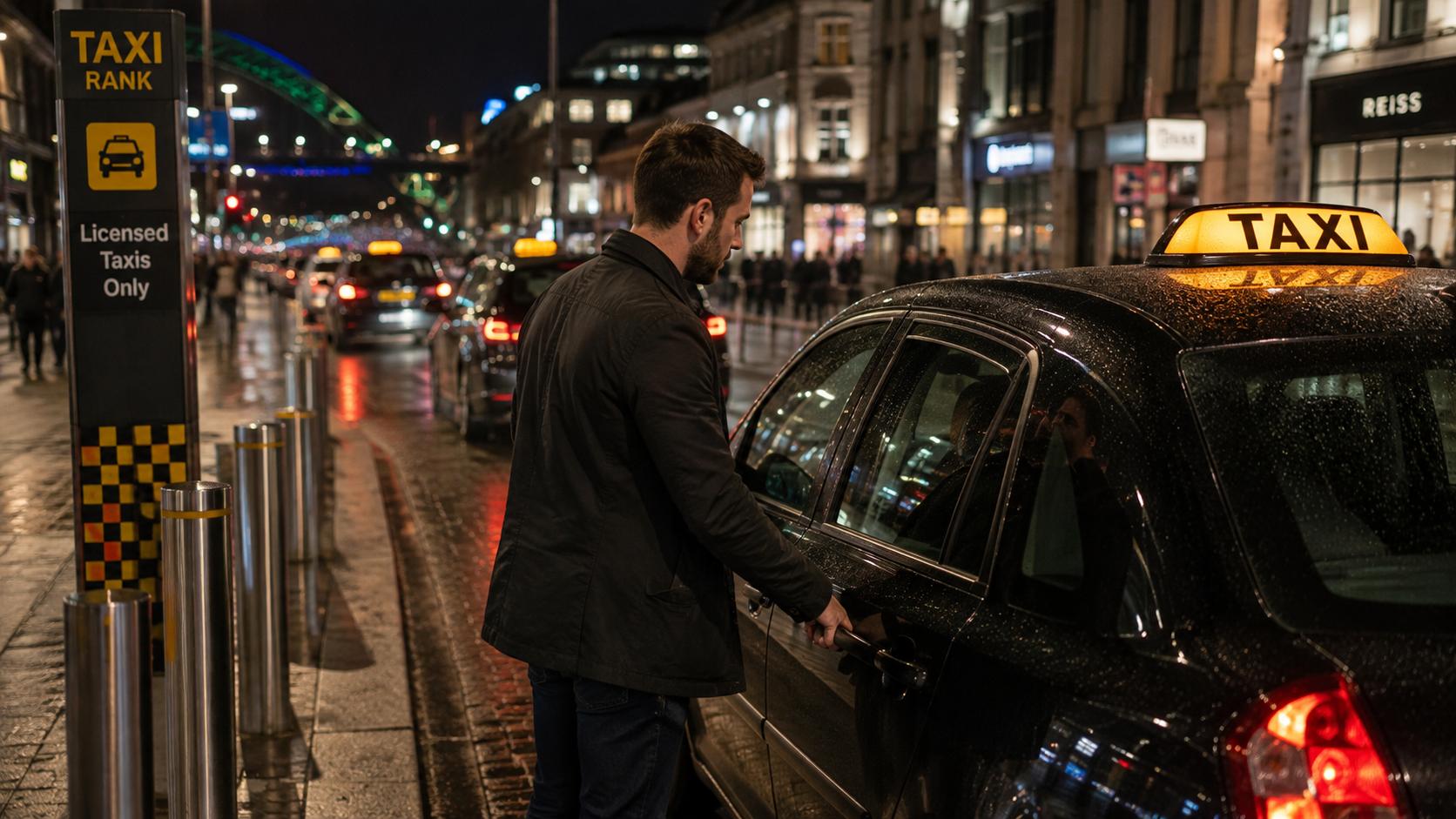
A hackney carriage, the traditional taxi, can be hailed in the street and can wait on a designated rank. It is licensed by the local authority for the district it operates in and is the only type of vehicle that may legally pick up a passenger who has not pre-booked.
A private hire vehicle must be booked in advance through a licensed operator. It cannot legally be flagged down, and it cannot pick up from a rank. This includes vehicles booked through apps, which are private hire regardless of how immediate the booking feels.
The distinction matters for insurance as much as for law. A private hire vehicle carrying a passenger who was not booked through the operator may be operating outside the terms of its insurance, which leaves the passenger without cover in a collision. That is the practical reason the rule exists, and it is why an unbooked vehicle offering a ride outside a club is a genuine risk rather than a technicality.
Three separate licences are involved.
The system licenses the driver, the vehicle and, for private hire, the operator who takes the bookings. All three must be in order for a journey to be lawful.
Driver licensing involves an enhanced criminal record check including the barred lists, a medical assessment to a specified standard, a driving licence check, a knowledge or local test in many areas, and increasingly a safeguarding and disability awareness element. Checks are repeated at renewal, and many authorities now require drivers to subscribe to a service that flags new convictions between renewals rather than waiting.
Vehicle licensing covers mechanical condition through more frequent and more demanding tests than an ordinary MOT, age limits in some cases, insurance, signage and plates, and requirements around accessibility.
Operator licensing covers the booking process, record keeping and the requirement to retain details of every booking, which is what allows a journey to be traced afterwards.
The national register closed a serious loophole.
For years the weakness in the system was that a driver refused or stripped of a licence in one area could simply apply in a neighbouring one, and the second authority might never learn why the first had said no.
A national register of refusals and revocations now exists, and licensing authorities are expected to check it and to record their own decisions on it. Statutory standards issued to authorities have also pushed towards greater consistency in criminal record policies, safeguarding training and the handling of complaints.
The remaining structural problem is cross-border hiring. A vehicle, driver and operator licensed in one authority can lawfully carry out bookings taken in that area but performed elsewhere, which has produced significant numbers of vehicles working in cities where they were not licensed and where local standards may differ. It is a widely acknowledged issue that requires primary legislation to resolve properly.
CCTV, and the argument about it.
Some licensing authorities require CCTV in licensed vehicles, some permit it, and the arguments cut both ways. Recording protects drivers against false allegations and violent passengers, and protects passengers by creating evidence where an allegation is made against a driver.
Against that sit real privacy concerns about continuous recording of private conversations in an enclosed space, and questions about who holds the footage, how long it is kept and who can access it. Where audio recording is involved the concerns are sharper still.
What passengers can do on the night.
The practical checks take seconds. Confirm the vehicle is the one you booked, by registration rather than by make and colour. Confirm the driver knows your name and destination rather than volunteering them yourself, because a driver who is expecting you will have your details.
Look for the licence plate on the vehicle and the driver's badge, which should be displayed. Sit in the back. Share your journey with someone through the app or by message. If anything feels wrong, do not get in, and if you are already in, ask to be dropped somewhere public and busy.
Never accept a ride from a vehicle that approaches you offering one, however plausible the explanation. A legitimate private hire vehicle will not do this, and a legitimate taxi will be plated and on a rank or hailed by you.
Complaints go to the licensing authority.
Complaints about a driver or vehicle go to the authority that issued the licence, which is not necessarily the council area where the journey took place. The plate will identify it.
Serious matters, particularly anything involving an assault or sexual offence, should go to the police first, and the licensing authority will act alongside any criminal process rather than waiting for it to conclude.
Keep the booking reference, the plate number and the time, because a complaint with those details can be investigated and one without them frequently cannot.
Share your thoughts.
Do you check the plate and driver details before getting into a taxi, or is it something you only think about afterwards?
Crime News
Taxi Licensing in Newcastle and Passenger Safety
Advertisement




Comments (0)
You must be logged in to post comments.
Don't have an account? Register here
No comments yet. Be the first to share your thoughts!