
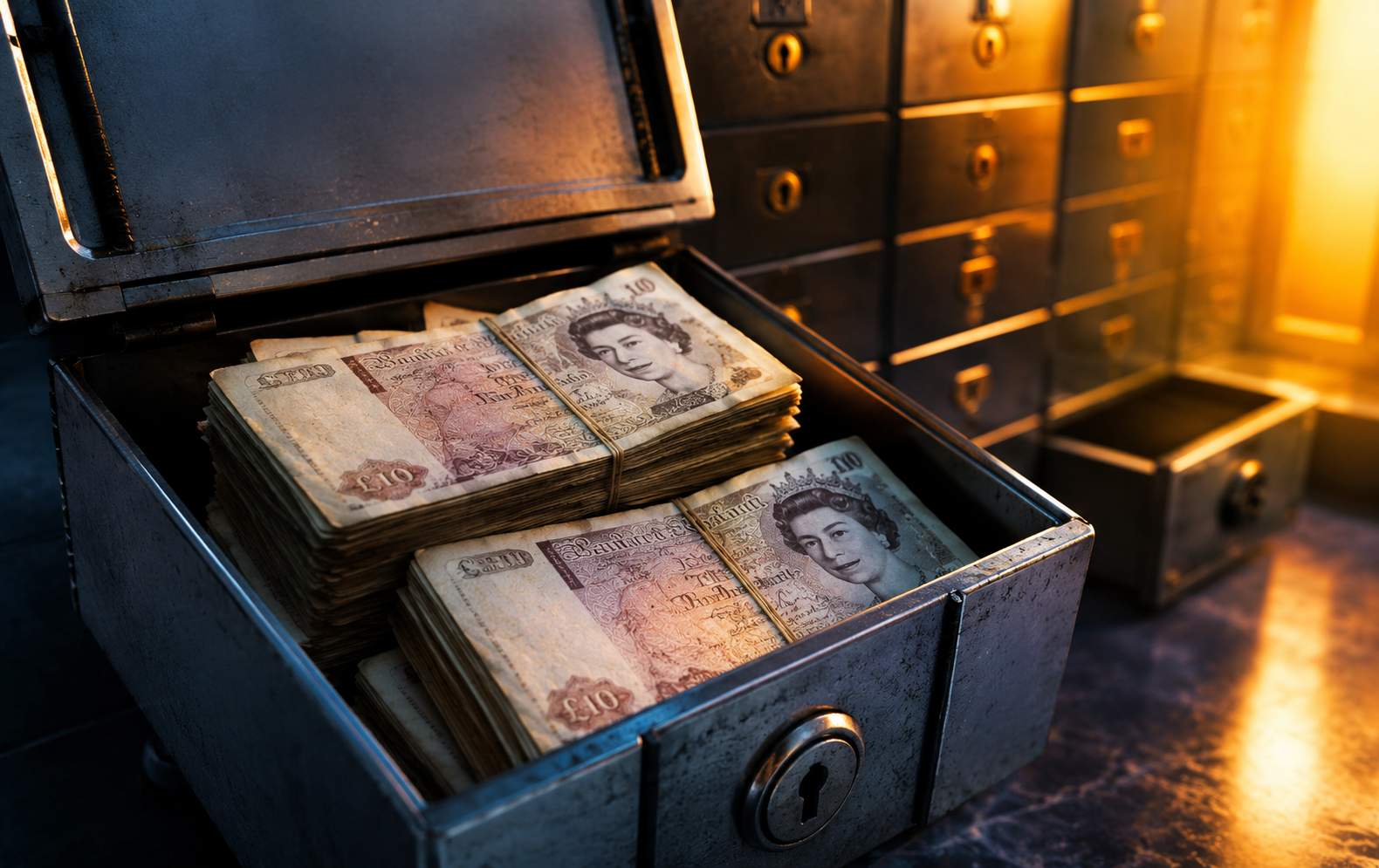
Imagine placing £10,000 inside a safety deposit box half a century ago, locking the door, and walking away. No interest. No investments. No withdrawals. Just cold, hard cash sitting untouched for 50 years.
At first glance, finding £10,000 today might feel like discovering a hidden treasure. After all, £10,000 is still £10,000. The notes may have changed and some older banknotes would no longer be legal tender, but the face value remains the same.
The reality, however, is far less exciting.
While the money would still exist, inflation would have silently chipped away at its purchasing power year after year. What once represented a substantial sum of money in the 1970s would buy only a fraction of the same goods and services today.
The story offers a fascinating glimpse into one of the most important financial lessons of all time. Money that sits idle does not simply stand still. In real terms, it gradually loses value.
The Starting Point - £10,000 In 1976.
Fifty years ago, in 1976, £10,000 was a significant amount of money in Britain.
The average UK house price was around £13,000 to £15,000 depending on the region, meaning £10,000 could cover a large portion of a property purchase. Average annual earnings were only a few thousand pounds, making £10,000 worth several years of income for many workers.
According to inflation data based on Office for National Statistics and Bank of England calculations, prices have increased by approximately 834 percent since 1976. In practical terms, something costing £1 in 1976 costs around £9.34 today.
That means £10,000 in 1976 would need to grow to approximately £93,400 today simply to maintain the same purchasing power.
How Inflation Changed The Value Of £10,000 Over Time.
The table below shows the equivalent value needed in each decade to match the buying power of the original £10,000 held in 1976.
Year Equivalent Value
1976 £10,000
1980 £16,800
1990 £31,700
2000 £42,800
2010 £56,100
2020 £73,300
2026 £93,400
Source calculations based on long-term UK inflation data derived from ONS and Bank of England datasets.
In other words, if your £10,000 remained untouched in a box, you would still physically have £10,000 today. However, in terms of purchasing power, it would feel more like having around £1,070 in 1976 money.
That represents one of the hidden dangers of holding large amounts of cash over very long periods.
What Could £10,000 Buy In 1976 Compared With Today?.
The figures become even more striking when viewed through real-world examples.
In the mid-1970s, £10,000 could purchase a modest home outright in some parts of Britain or provide a substantial deposit in many areas. Today, average UK house prices exceed £260,000, making the same cash sum only a small fraction of the purchase price.
Cars tell a similar story. Popular family vehicles that sold for a few thousand pounds in the 1970s now cost tens of thousands.
Even everyday spending has changed dramatically. Food, utilities, transport, holidays and entertainment all cost considerably more than they did half a century ago.
The result is simple. The £10,000 remained numerically unchanged, but the lifestyle it could buy shrank year after year.
Why Inflation Is Often Called The Silent Wealth Killer.
Inflation does not arrive all at once. It works slowly and relentlessly.
A few percentage points each year may not sound significant, but over decades the effects become enormous. This is because inflation compounds in much the same way that investment returns compound.
The Bank of England targets inflation at around 2 percent annually because stable prices help maintain economic confidence. However, Britain has experienced periods of much higher inflation, particularly during the 1970s and early 1980s.
When inflation rises faster than savings, the purchasing power of cash declines.
Someone opening a forgotten safety deposit box today would therefore face a surprising reality. The money survived, but much of its economic value did not.
What If The Money Had Been Left In A Savings Account Instead?.
Even modest interest could have made a considerable difference.
If the £10,000 had earned an average annual return of 3 percent after fees and taxes over 50 years, it would have grown to approximately £43,800.
That is far better than leaving the cash idle, but still below the roughly £93,400 needed to fully match inflation-adjusted purchasing power.
This highlights another important lesson. Saving alone is not always enough. To preserve and grow wealth over long periods, returns generally need to outpace inflation.
What If The Money Had Been Invested In The Stock Market?.
The outcome changes dramatically when investments enter the picture.
Historically, global stock markets have delivered average long-term returns of around 7 percent to 10 percent annually before inflation.
Had £10,000 been invested and achieved an average annual return of 8 percent over 50 years, the investment could have grown to approximately £469,000.
At 10 percent annual growth, the figure would exceed £1.1 million.
While markets never rise in a straight line and past performance does not guarantee future results, the comparison demonstrates the extraordinary power of compounding over long periods.
Instead of losing purchasing power, the money would likely have multiplied many times over.
What If The Money Had Been Used To Buy Property?.
Property is another asset class that has generated significant long-term wealth in the UK.
Average house prices have risen dramatically since the 1970s. While regional differences are substantial, many properties have increased in value by more than tenfold over the past five decades.
A £10,000 property purchase in the mid-1970s could potentially be worth hundreds of thousands of pounds today depending on location.
Rental income would have provided an additional return on top of capital growth.
This is one reason property has long been viewed as a hedge against inflation.
The Gold Comparison.
Gold is often promoted as a store of value during periods of economic uncertainty.
Someone who used £10,000 to buy gold in 1976 would have experienced significant price fluctuations over the decades. However, gold prices today are substantially higher than they were during the mid-1970s.
Although gold does not generate income like stocks or property, it has historically helped preserve purchasing power during inflationary periods.
The comparison shows that productive assets are not the only alternative to holding cash.
The Psychology Behind Hidden Cash.
Stories about forgotten money continue to fascinate people because they tap into a universal dream.
Many people imagine finding an old suitcase, secret safe or dusty safety deposit box filled with cash.
Yet these stories often overlook inflation.
Finding £10,000 hidden away for 50 years may feel exciting, but financially it is very different from discovering an investment portfolio that has been compounding during the same period.
The difference illustrates one of the biggest distinctions between saving and investing.
Saving protects money.
Investing grows money.
Over long periods, that difference can be worth hundreds of thousands of pounds.
The Bigger Lesson For Savers Today.
The safety deposit box thought experiment is not really about a forgotten £10,000.
It is about understanding what happens when money remains inactive.
Inflation has quietly reduced the value of cash throughout modern history. While keeping emergency savings is important, large amounts of money left uninvested for decades face a significant risk of losing purchasing power.
The figures show that £10,000 locked away in 1976 would still be £10,000 today, but it would have lost nearly 90 percent of its original spending power. To retain the same buying power, that money would need to be worth roughly £93,400 in 2026.
For investors, homeowners and long-term savers, the lesson is clear. Time can either work for your money or against it. The choice often comes down to where that money is kept.
If you discovered a forgotten £10,000 from 1976 today, would you feel rich or disappointed?
Lifestyle News
The £10,000 Experiment That Shows Why Inflation Matters
Advertisement




Comments (0)
You must be logged in to post comments.
Don't have an account? Register here
No comments yet. Be the first to share your thoughts!