
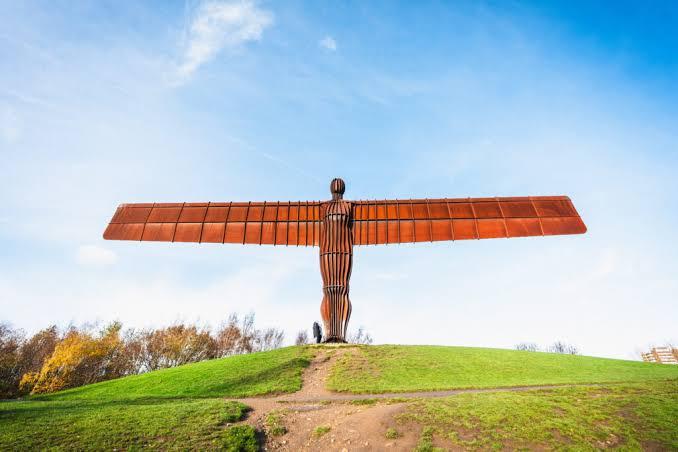
Standing with its great wings outstretched on a hilltop beside the A1, the Angel of the North has become one of the most recognisable landmarks in Britain and a powerful symbol of the North East. This monumental steel sculpture, gazing out over Gateshead and the surrounding countryside, welcomes travellers to the region and has been embraced with deep affection by the people who live in its shadow. It is a modern icon in every sense.
A Monumental Work of Art.
The Angel of the North is the work of the celebrated British sculptor Antony Gormley, and it was completed in 1998. Its scale is genuinely staggering: the figure stands twenty metres tall, as high as a five-storey building, with a wingspan of fifty-four metres, wider than that of a jumbo jet. Made from weathering steel and weighing around two hundred tonnes, it is one of the largest sculptures in Britain and is believed to be the largest angel sculpture in the world. Its sheer size, combined with its commanding hilltop position, makes it an unforgettable sight, dominating the landscape for all who pass by.
The Story of Its Creation.
The idea for a great landmark sculpture on this site emerged in the early 1990s, when Gateshead Council sought a striking image to mark the southern approach to the town. Antony Gormley was chosen to create the work, although the project was not without controversy, and the artist himself was initially reluctant, famously remarking that he did not make motorway art. Once it was in place, however, attitudes changed dramatically, and many who had been sceptical came to love the Angel. It has since become synonymous with Gateshead and the wider region, a source of genuine local pride and a much-photographed emblem of the North East.
A Tribute to the Region's Heritage.
The Angel's location is rich with meaning, for it stands on the site of former colliery pithead baths, where miners once washed after their shifts underground. Gormley spoke of the poetic resonance of this connection, of men who had worked in the dark beneath the earth, now commemorated by a figure standing in the light above it. The sculpture thus serves as a tribute to the region's industrial past, particularly its coal-mining heritage, and to the transition from that industrial age to a new era. This deep connection to the history and identity of the North East is part of what makes the Angel so meaningful to local people.
The Design and Its Meaning.
Like much of Antony Gormley's work, the Angel is based on a cast of the artist's own body, giving the abstract form a human foundation. One of its most thoughtful features is the angle of its wings, which are not flat but tilted slightly forward, creating, in Gormley's words, a sense of embrace. The rusty, oxidised colour of the weathering steel, which forms a protective surface as it ages, gives the sculpture its distinctive warm appearance and helps it sit naturally within the landscape. The vertical ribs across its body and wings are not merely decorative but help the structure withstand the powerful winds that sweep across its exposed hilltop.
Seen by Millions.
Few works of public art are seen by so many people. Positioned beside one of the country's busiest roads and a major rail line, the Angel of the North is viewed by enormous numbers of travellers every year as they pass through the region. For countless people, catching sight of the Angel is the moment they know they have arrived in the North East, and it has taken on the role of a guardian and a welcoming figure for the area. Many visitors also stop to see it up close, walking right up to the base of the sculpture to appreciate its remarkable scale and presence.
Built to Last.
The Angel of the North was designed and engineered to endure, with the intention that it should stand for well over a hundred years. Its construction involved deep foundations to anchor the enormous structure securely against the wind, and durable materials chosen to weather the elements gracefully. This sense of permanence is fitting for a work that has come to symbolise the enduring spirit and identity of the region. More than two decades after its unveiling, the Angel stands as strong and as striking as ever, firmly established as a fixture of the landscape and the local imagination.
A Symbol of the North East.
The Angel of the North has achieved something rare for a piece of public art: it has become a genuine and beloved symbol of a whole region. It represents the North East's history, its resilience and its forward-looking spirit, and it has been embraced as an emblem of local identity and pride. From a controversial proposal to a cherished icon, its journey mirrors the way great public art can come to define a place.
For anyone travelling through the North East, the Angel of the North is an essential sight, a magnificent and moving landmark that captures the character of the region in steel and stands watch over it with outstretched wings.
An Inspiration to the Region.
Since its unveiling, the Angel of the North has inspired the people of the region in countless ways, becoming far more than simply a sculpture by a roadside. It has appeared in films and television, featured in artwork and merchandise, and been adopted as a rallying symbol for the North East on numerous occasions. On memorable occasions it has even been dressed in an enormous football shirt by fans celebrating the region's sporting passions, a playful sign of just how deeply it has been embraced. The Angel has come to represent the identity, resilience and pride of the North East, and its image is reproduced endlessly on everything from postcards to logos. For local people, it is a source of genuine affection and ownership, a landmark that belongs to them and speaks of who they are. This remarkable transformation, from a controversial proposal into a cherished emblem of a whole region, demonstrates the extraordinary power of public art to capture the spirit of a place and its people.
Share your thoughts.
We would love to hear your memories and opinions, so leave a comment below, especially about what the Angel means to you.
Does spotting the Angel of the North still tell you that you are home?
Travel News
The Angel of the North: A Modern Icon
A guide to the Angel of the North, Antony Gormley's towering steel sculpture at Gateshead that has become a symbol of the North East.
Advertisement


Comments (0)
You must be logged in to post comments.
Don't have an account? Register here
No comments yet. Be the first to share your thoughts!