
Newcastle upon Tyne has always been a city that looks beyond its own borders. From centuries of shipbuilding and coal exports to today's thriving universities, digital industries and cultural attractions, the city has built lasting relationships across the globe. One of the most enduring examples is its network of official twin cities.
City twinning became popular after the Second World War as a way of promoting peace, friendship and cultural understanding. While many people know the names of Newcastle's international partners, fewer understand why these cities were selected or what makes each destination unique.
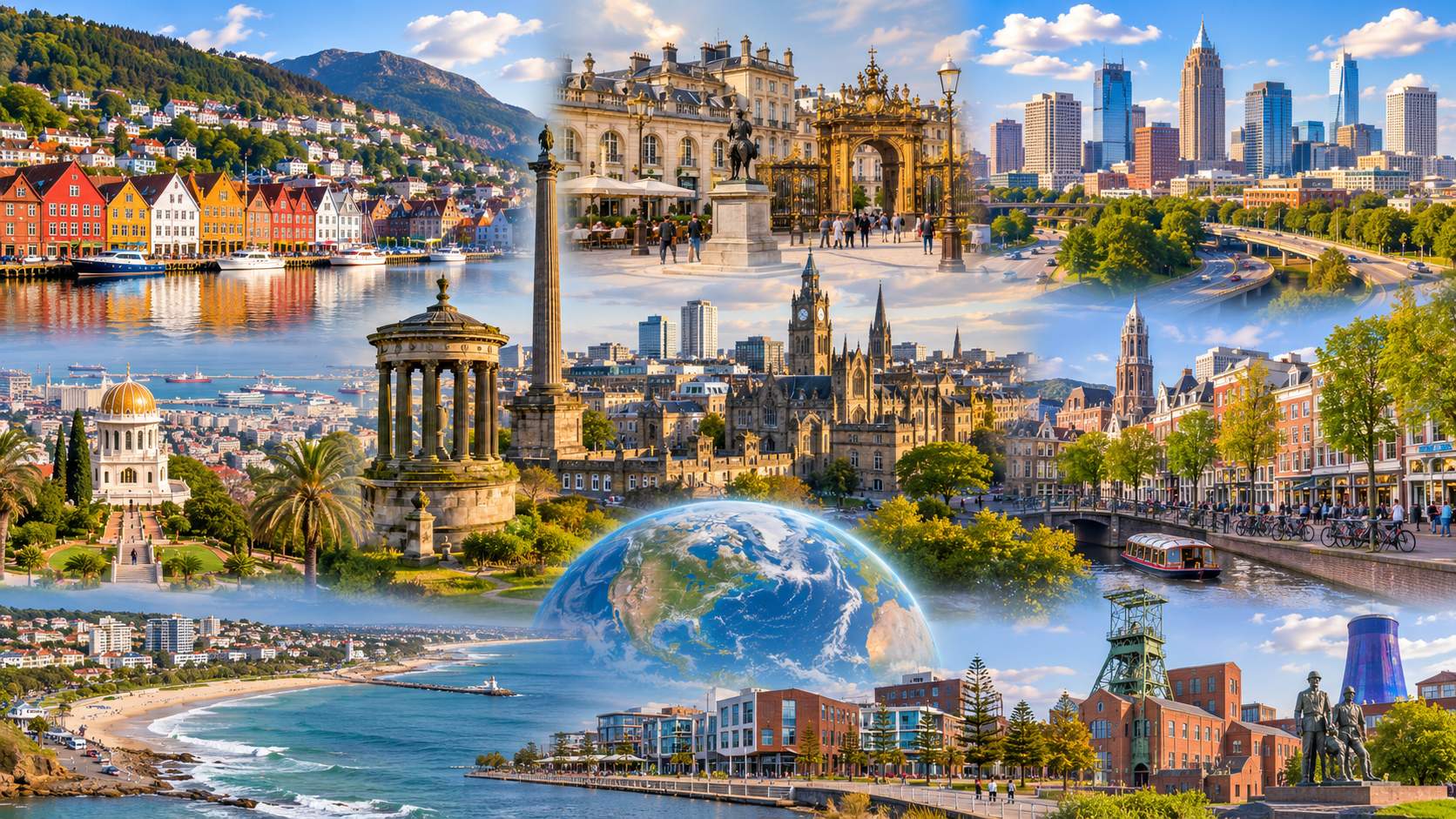
From Norway's spectacular fjords to Australia's thriving harbour city, Newcastle's twin cities each tell a different story about history, trade, education and shared values that continue to connect the North East with communities around the world.
Bergen, Norway.
Bergen became one of Newcastle's earliest twin cities in 1968, reflecting centuries of maritime links across the North Sea. Long before official agreements existed, ships regularly travelled between North East England and Norway, carrying timber, fish and other goods that helped shape both economies.
Today, Bergen has a population of around 290,000 and is widely regarded as Norway's gateway to the fjords. Surrounded by mountains and dramatic coastline, it welcomes millions of visitors each year and is recognised as a UNESCO World Heritage city thanks to its historic Bryggen waterfront.
The relationship with Newcastle continues through education, tourism and cultural exchanges. Both cities are proud of their maritime heritage, strong music scenes and reputation as gateways to spectacular natural landscapes. Newcastle residents visiting Bergen often discover similarities in the friendliness of local people despite the different surroundings.
Nancy, France.
Newcastle's partnership with Nancy was established in 1963 and remains one of its longest-standing international friendships.
Located in north eastern France, Nancy is home to approximately 105,000 residents, while its wider metropolitan area exceeds 430,000 people. The city is internationally recognised for Place Stanislas, widely regarded as one of Europe's finest public squares and listed as a UNESCO World Heritage Site.
The connection developed as Europe sought closer cooperation following the devastation of the Second World War. Educational exchanges, language learning and cultural programmes have remained central to the partnership.
Nancy is also famous for its Art Nouveau architecture and thriving university population. Much like Newcastle, students play a major role in shaping the city's economy and cultural life, helping create a vibrant atmosphere throughout the year.
Atlanta, United States.
Atlanta joined Newcastle's family of twin cities in 1977 and represents one of the city's most significant international relationships outside Europe.
Home to more than 510,000 people within the city and over six million across the metropolitan area, Atlanta is one of the fastest-growing economic centres in the United States. It is known worldwide as the headquarters of major companies including Coca-Cola, Delta Air Lines, UPS and Home Depot.
For Newcastle, the partnership has helped encourage business links, educational collaboration and cultural exchange. Both cities have undergone remarkable economic transformations, moving from traditional industrial strengths towards technology, innovation and professional services.
Atlanta is also recognised as one of the world's busiest aviation hubs through Hartsfield-Jackson Atlanta International Airport, handling more than 100 million passengers annually in recent years. While Newcastle International Airport operates on a much smaller scale, both cities rely heavily on international connectivity to support economic growth.
Groningen, Netherlands.
Newcastle's partnership with Groningen reflects the close historic links between north east England and the Netherlands through trade, shipping and higher education.
Groningen has a population of around 240,000 and is often described as one of Europe's youngest cities because roughly one quarter of its residents are students. The University of Groningen, founded in 1614, is among the oldest universities in the Netherlands and enjoys an international academic reputation.
Like Newcastle, cycling plays an increasingly important role in local transport planning. Groningen is frequently ranked among the world's most bicycle-friendly cities, with more bicycles than residents and an extensive network of dedicated routes.
The partnership has encouraged educational cooperation, environmental discussions and cultural projects while highlighting the similarities between two regional cities that continue to innovate despite their historic roots.
Haifa, Israel.
Haifa became one of Newcastle's twin cities in 1997, strengthening international cultural and educational links.
With a population of around 290,000, Haifa is Israel's third-largest city and one of its most important ports. The city is famous for the stunning Baháʼí Gardens, a UNESCO World Heritage Site that attracts visitors from around the globe.
Haifa is also recognised as a leading centre for scientific research and higher education, thanks to institutions including the Technion and the University of Haifa. This emphasis on innovation mirrors Newcastle's own reputation as a centre for research, particularly through Newcastle University and Northumbria University.
As with many international partnerships, the relationship has focused on encouraging dialogue, educational opportunities and greater understanding between communities.
Newcastle, Australia.
Perhaps Newcastle's most obvious twin city is its namesake in New South Wales, Australia.
Established as an official partnership in 1985, the relationship celebrates shared heritage while recognising how both cities have evolved into modern regional powerhouses.
Australia's Newcastle has a population approaching 350,000 across the greater metropolitan area and was historically one of the country's leading coal export centres. Like Newcastle upon Tyne, it has successfully diversified into education, healthcare, tourism and advanced industries.
Both cities share strong sporting traditions, active waterfront regeneration projects and internationally respected universities. Visitors often notice striking similarities in their industrial histories before discovering two cities that have reinvented themselves for the twenty first century.
The partnership has supported sporting exchanges, educational visits and cultural projects while celebrating a shared name recognised around the world.
Gelsenkirchen, Germany.
Gelsenkirchen joined Newcastle's network of twin cities in 1947, making it one of the earliest partnerships established in the aftermath of the Second World War.
Located in Germany's Ruhr region, Gelsenkirchen has a population of approximately 260,000 and is perhaps best known internationally as the home of football club FC Schalke 04.
Historically, both cities were built on coal mining and heavy industry. The shared experience of industrial growth, economic change and regeneration created natural common ground between communities rebuilding after wartime devastation.
Today, Gelsenkirchen is investing in renewable energy, technology and urban redevelopment while preserving its industrial heritage, reflecting many of the same priorities seen across Newcastle and the wider North East.
Why city twinning still matters.
Some people question whether city twinning remains relevant in today's digital world, but supporters argue these relationships continue to provide meaningful opportunities.
Educational exchanges allow students to experience different cultures while universities collaborate on research projects. Businesses gain international connections that may support future investment, tourism benefits from increased awareness and cultural organisations enjoy opportunities to showcase local talent overseas.
For Newcastle, these partnerships also reinforce its reputation as an outward-looking regional capital with global ambitions. Whether through business, education, music, sport or tourism, each twin city represents another bridge between the North East and the wider world.
At a time when international cooperation is increasingly important, Newcastle's network of twin cities continues to demonstrate that friendships formed decades ago can still deliver lasting value for future generations.
Share your thoughts.
Which of Newcastle's twin cities would you most like to visit, and why?
Local News
The Fascinating History Of Newcastle's 7 Twin Cities Around The World
Advertisement




Comments (0)
You must be logged in to post comments.
Don't have an account? Register here
No comments yet. Be the first to share your thoughts!