
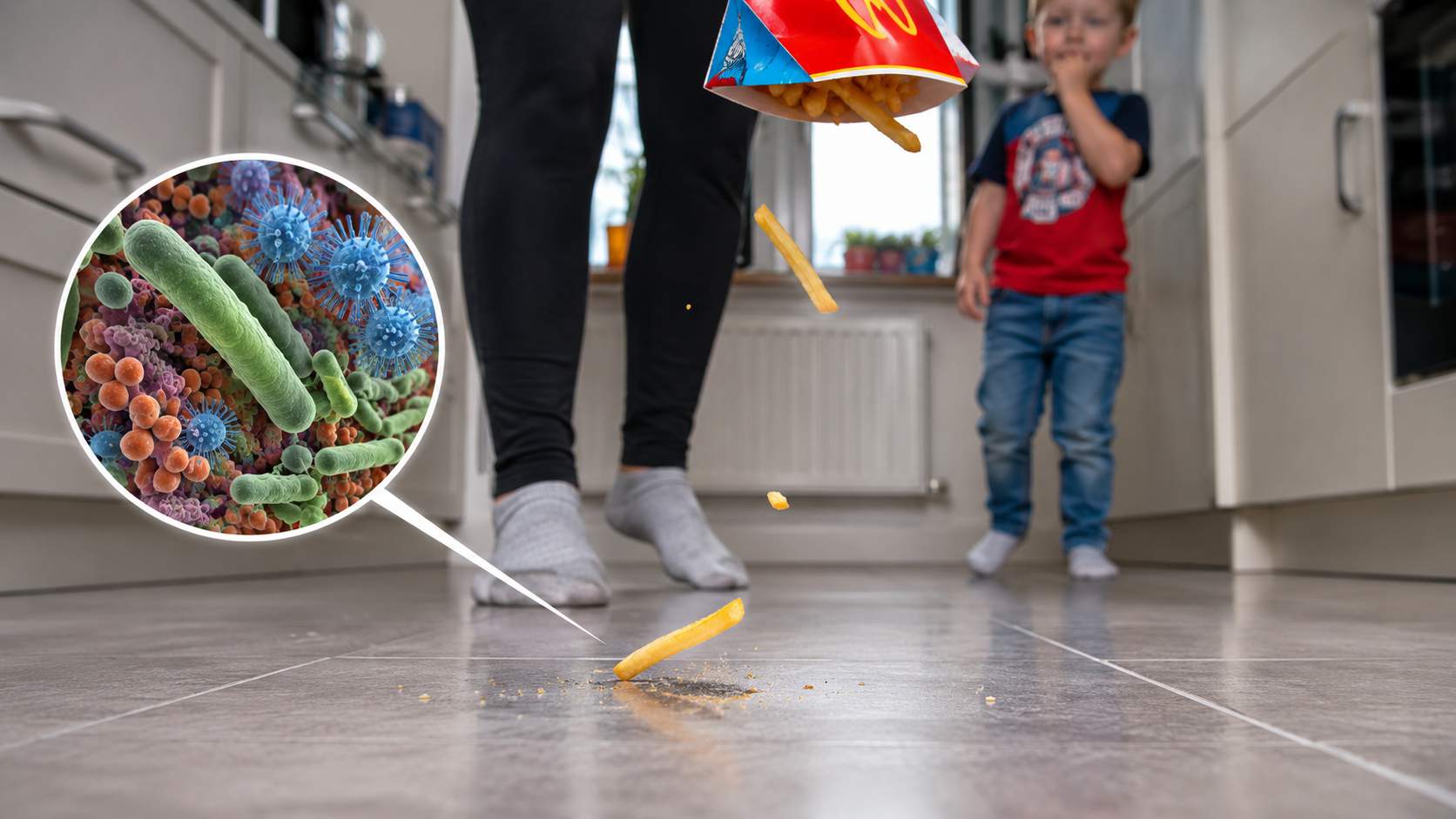
The five second rule has saved countless chips, biscuits and slices of pizza from being thrown away. Whether it is a takeaway dropped on a Newcastle kitchen floor or a snack lost during a family gathering in Gateshead, many people still believe that food picked up within five seconds is safe to eat.
But is there any truth behind the famous rule, or is it simply one of Britain's most enduring food myths?
Where the five second rule comes from.
Nobody knows exactly where the five second rule originated, but it has been part of popular culture for decades. The idea is simple. If food is picked up quickly after hitting the floor, bacteria supposedly do not have enough time to contaminate it.
The belief remains surprisingly common. Researchers studying the topic found that many people admit to eating food that has fallen on the floor, particularly when it is a favourite treat or appears visually clean.
For many households across Newcastle and the wider North East, it is a familiar decision. Do you throw it away, or risk it?
What science says about dropped food.
The most comprehensive research into the five second rule was carried out by Rutgers University scientists. Their findings showed that bacteria can transfer from a surface to food in less than one second, meaning contamination can happen almost instantly.
Researchers tested four foods across four different surfaces and found that while longer contact times generally increased contamination, there was no magical five second safety window.
One of the most interesting findings involved moisture. Wet foods absorbed bacteria far more easily than dry foods. Watermelon was among the highest risk foods tested, while gummy sweets were among the lowest.
In simple terms, a dropped chip covered in sauce could be more vulnerable to contamination than a dry biscuit.
Surprising statistics people should know.
Several findings from scientific studies may surprise readers:
Rutgers researchers conducted 2,560 separate measurements while testing the rule.
Food contamination was observed in less than one second under certain conditions.
Four different surfaces were tested, including carpet, wood, tile and stainless steel.
Moist foods consistently picked up more bacteria than dry foods.
Carpet surprisingly transferred less bacteria than tile and stainless steel in laboratory testing.
While these figures came from controlled experiments, they highlight how complicated food contamination can be.
Why Newcastle households should be cautious.
Most homes across Newcastle, Sunderland and Northumberland are unlikely to have laboratory levels of dangerous bacteria on their floors. However, real-world risks still exist.
Shoes can bring dirt and bacteria indoors. Pet owners may unknowingly spread germs around the home. Kitchen floors can also contain traces of raw meat juices or food residue that are invisible to the naked eye.
Experts say the biggest concern is not ordinary dirt but the possibility of harmful bacteria such as salmonella or E. coli being transferred to food. Even a quick rinse may not completely remove contamination.
Young children, older adults and people with weakened immune systems face a greater risk from foodborne illness and should be particularly careful.
When is dropped food most risky.
The highest risk situations typically involve:
Wet or sticky foods.
Hard surfaces such as tile or laminate flooring.
Areas frequently used by pets.
Kitchen floors near food preparation zones.
Foods intended for children or vulnerable individuals.
Although the five second rule contains a tiny grain of truth because longer contact usually means more contamination, scientists say it is far too simplistic to be considered a reliable food safety rule.
What should you do if food falls on the floor.
The safest option is always to discard food that has fallen onto the floor, particularly if it is wet, sticky or intended for someone vulnerable to illness.
That said, many Newcastle residents will probably continue making split-second decisions when a favourite snack takes an unexpected tumble. The science suggests that bacteria do not wait five seconds before making contact. Unfortunately, they can arrive almost immediately.
Share your thoughts below.
Have you ever saved then, eaten food off the floor without thinking twice?
Food & Drink News
The Science Behind the 5 Second Rule
Advertisement

Comments (0)
You must be logged in to post comments.
Don't have an account? Register here
No comments yet. Be the first to share your thoughts!