
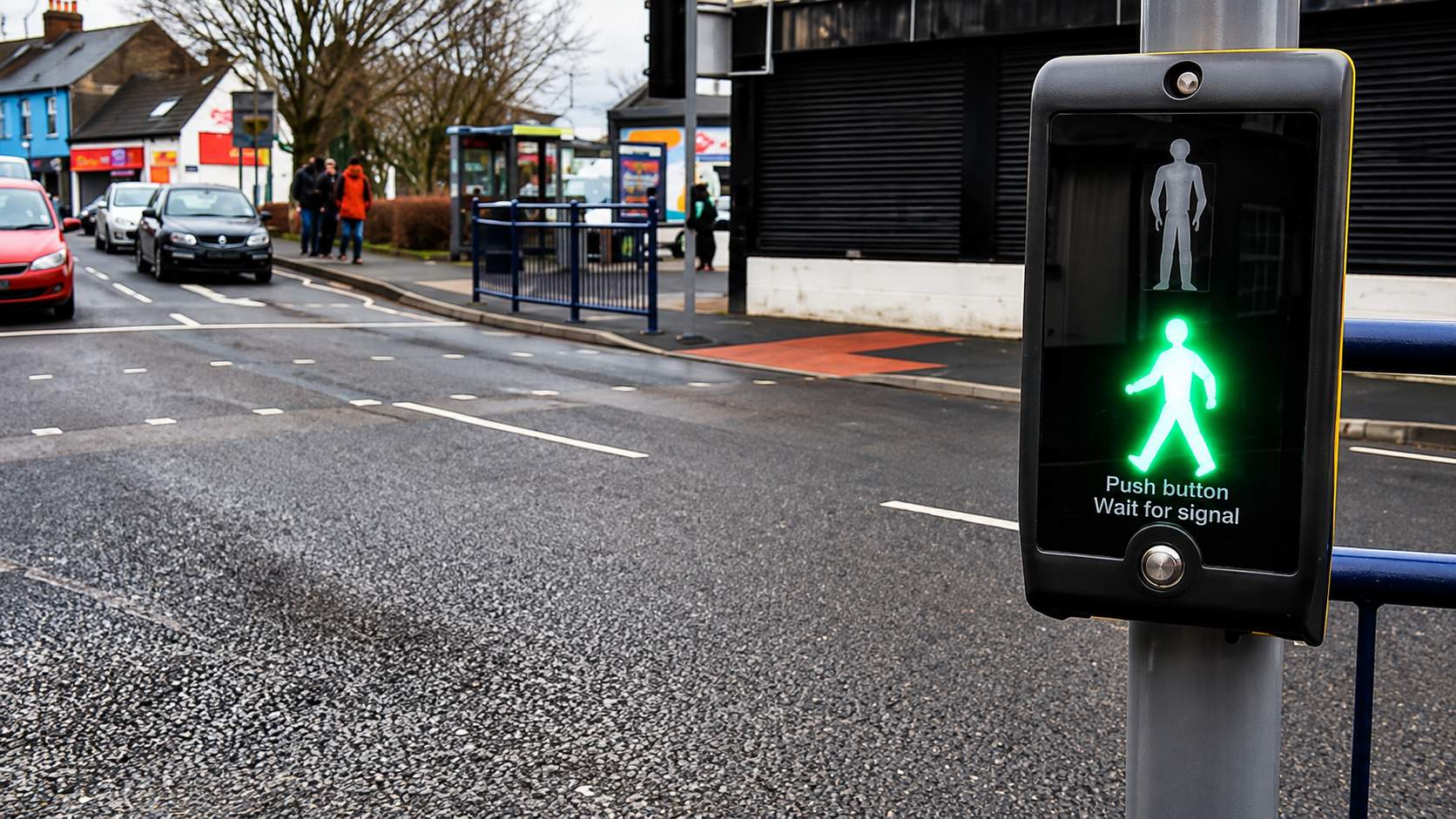
To somebody walking along a Newcastle street, installing a pedestrian crossing might appear relatively straightforward. Add some road markings, traffic lights, a push button and tactile paving, then switch it on.
The reality can be considerably more expensive.
Current guidance published by Cambridgeshire County Council estimates that installing a Puffin or Toucan crossing can cost £125,000 or more, depending on the location. The authority describes signal-controlled crossings as the most expensive options to install and maintain.
Real projects demonstrate how widely prices can vary. A new Puffin crossing forming part of highway works on the A53 Newcastle Road in Staffordshire was included in a £184,141.87 contract in 2025, although that contract also covered associated pavement, kerbing, signs, road markings and other works.
So why can something as familiar as a pedestrian crossing cost six figures?
Why Puffin crossings can cost more than £100,000.
Modern Puffin crossings are considerably more sophisticated than a painted crossing.
The work can involve traffic signals, electrical connections, pedestrian detection sensors, poles, push-button units, tactile paving, dropped kerbs, road markings and changes to street lighting. Contractors may also need to excavate the road and pavement, alter drainage and manage traffic while construction takes place.
Then there are surveys, engineering designs, statutory processes and road safety audits before the crossing is ready to use.
Site conditions can push the bill higher still. Underground electricity, gas, water and communications infrastructure may affect where equipment can be installed.
A £150,000 project announced in Coleraine in January 2025, for example, involved upgrading an existing pedestrian facility to a Puffin crossing.
Are Zebra crossings cheaper.
Generally, yes.
Zebra crossings do not require conventional red, amber and green traffic signals or intelligent pedestrian detection equipment, making them a potentially cheaper solution.
However, there is no single nationwide fixed price for a Zebra crossing. Costs depend heavily on the road and the additional work required.
The contrast can be seen in council guidance. Cambridgeshire says Puffin and Toucan crossings are its most expensive crossing types, while Zebra crossings provide a cheaper alternative. A raised pedestrian crossing is currently estimated there at around £35,000, although that figure excludes additional street lighting, electrical connections and drainage.
That means apparently simple extras can quickly alter the final bill.
What is Newcastle spending on pedestrian safety.
Newcastle provides a good example of why individual crossing costs can be difficult to separate from wider road schemes.
In February 2025, Newcastle City Council began safety improvements along the A186 backed by £3.65 million from the government's Safer Roads Fund. The programme includes new and improved pedestrian crossings at several locations, rather than spending the entire amount on crossings alone.
A new signal-controlled pedestrian crossing was planned outside Hotel du Vin on City Road, with further crossing improvements around Cut Bank. New facilities were also announced for West Road near Gretna Road and St Cuthbert's High School.
Further proposals include crossings at Elstob Place and Welbeck Road, new signalised crossings around Two Ball Lonnen and improvements around Glasshouse Street and Walker Road.
Elsewhere, Newcastle City Council is progressing plans to replace the existing pedestrian refuge near High Gosforth Park and Newcastle Racecourse with a signal-controlled Puffin crossing.
Who pays for a new pedestrian crossing.
The money can come from several places.
Local authority highways budgets are one source, but government road safety and active travel funds can finance larger programmes. Developers can also contribute towards crossings and other transport infrastructure where new developments create additional demand.
Members of the public can request a new pedestrian crossing through their local council, but a request does not guarantee that one will be installed.
Councils typically consider factors including pedestrian numbers, traffic volumes, vehicle speeds and collision records when deciding whether a formal crossing is justified.
Why a crossing can still be money well spent.
A six-figure price tag can sound extraordinary for a short stretch of road, but the finished crossing is only the visible part of the project.
Engineering, electrical infrastructure, accessibility features, construction, traffic management and safety assessments all contribute to the total.
For Newcastle residents, that also explains why getting a requested crossing can take time. A council must determine not only whether a crossing is needed, but which design is appropriate, whether the location can accommodate it and where the funding will come from.
With modern signal-controlled crossings potentially costing £125,000 or more, even a small programme of new crossings can represent a substantial investment.
Share your thoughts.
Is there a Newcastle or North East road where you think a new pedestrian crossing is desperately needed?
Local News
The Six-Figure Cost of Britain's Road Crossings
Advertisement


Comments (0)
You must be logged in to post comments.
Don't have an account? Register here
No comments yet. Be the first to share your thoughts!