
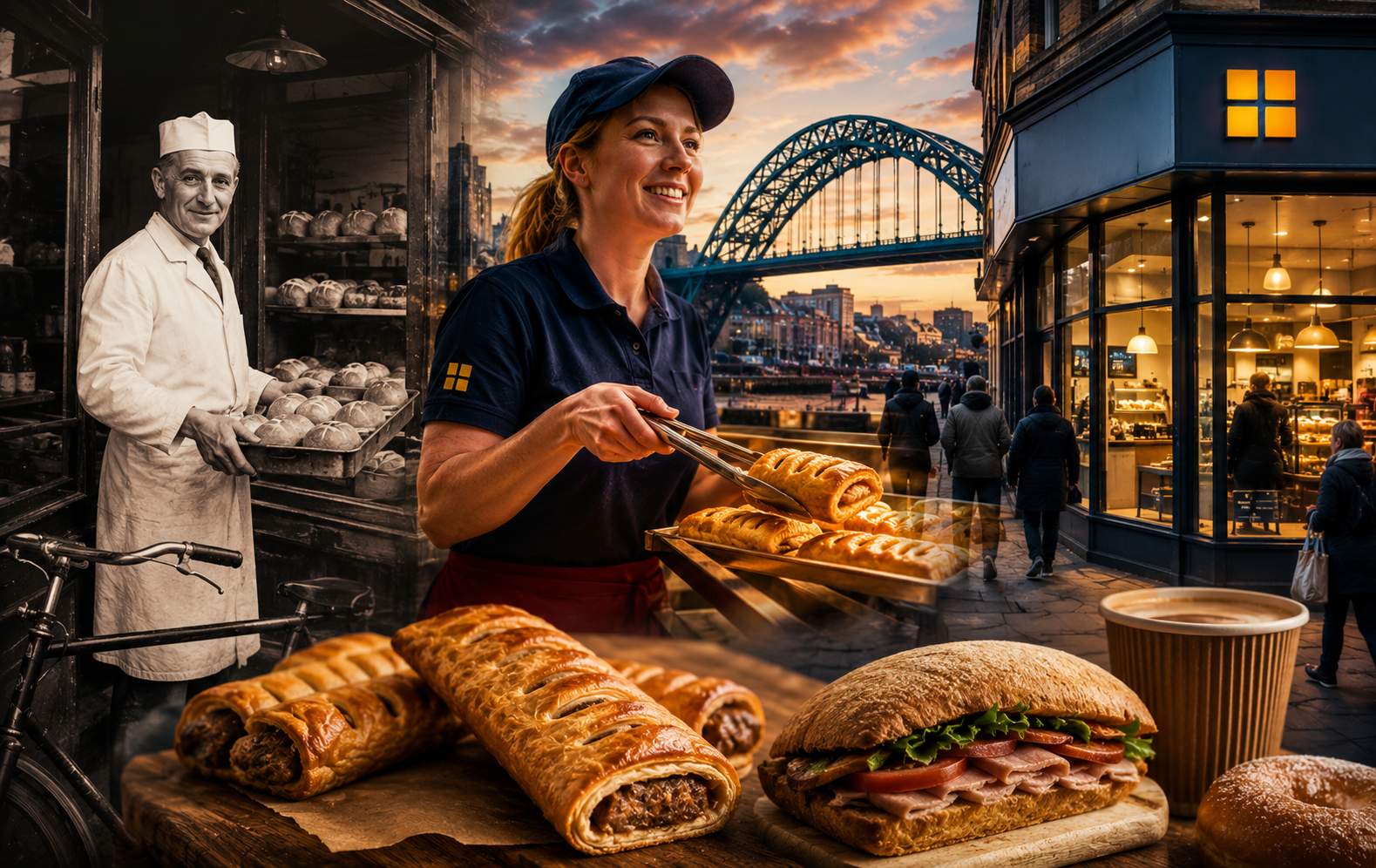
Few businesses have become as closely associated with Britain as Greggs. Known for its sausage rolls, steak bakes and affordable food-to-go, the company has grown from a small Newcastle bakery into one of the country's most recognisable brands.
Today, Greggs operates thousands of stores across the United Kingdom and serves millions of customers every week. Yet its origins were surprisingly humble. Long before the company became a stock market success story, it began with a man on a bicycle delivering eggs and yeast to families across Newcastle.
The story of Greggs is one of hard work, smart decision-making, changing consumer habits and a deep connection to its North East roots.
How Greggs Began.
The Greggs story starts in 1939 when John Gregg launched a small business delivering fresh eggs and yeast to households around Newcastle upon Tyne. Using a bicycle, he travelled door-to-door supplying baking ingredients to local families.
At the time, Britain was entering a period of enormous uncertainty with the outbreak of the Second World War. Despite the challenges, John Gregg continued building relationships with customers across Tyneside.
His reputation for quality products and reliable service helped the business grow steadily. After more than a decade of trading, he took the next major step.
In 1951, Greggs opened its first bakery shop on Gosforth High Street in Newcastle. Remarkably, there is still a Greggs branch trading on the same street today.
The Family Business Years.
When John Gregg passed away in 1964, the business was inherited by his son, Ian Gregg, who took over the company and continued expanding the family operation.
Under Ian's leadership, Greggs moved beyond being simply a local bakery. The company invested in production facilities and began acquiring other regional bakery businesses.
A major milestone arrived in 1968 when Greggs opened a large production facility on Gosforth Industrial Estate. This provided the scale needed to support future expansion.
During the 1970s, Greggs acquired a number of established bakery businesses across Britain, including operations in Scotland, Yorkshire, Kent, East Anglia and Manchester. These acquisitions allowed the company to enter new markets while retaining much of the local customer loyalty those businesses had built.
What had started as a Newcastle bakery was gradually becoming a national brand.
The Expansion Across Britain.
The 1980s and 1990s marked a period of rapid growth.
Greggs became a publicly listed company in 1984, giving it access to additional investment capital and helping fund further expansion.
One of the company's most significant moves came in 1994 when it acquired Bakers Oven, adding hundreds of stores to its portfolio almost overnight.
By the late 1990s, Greggs had established itself as one of Britain's leading bakery chains. The company continued opening new stores throughout the country while maintaining its headquarters in Newcastle.
Unlike many large corporations that relocate to London, Greggs remained proud of its North East origins. Its headquarters continue to be based in Newcastle today.
The Shift That Changed Everything.
Perhaps the most important decision in Greggs' history came during the early 2010s.
Executives realised that traditional bakery sales were becoming increasingly difficult as supermarkets expanded their own in-store bakery offerings.
At the same time, customer behaviour was changing.
More people wanted convenient breakfast options, quick lunches and affordable snacks while travelling, commuting or working.
Greggs responded by transforming itself from a traditional bakery into a food-to-go business. The company expanded its range of sandwiches, coffee, hot food and breakfast products while redesigning stores to better suit modern customers. Around 80 percent of Greggs' business was already coming from food-to-go sales, making the shift a logical move.
The strategy proved hugely successful.
The Sausage Roll That Became a Cultural Icon.
No discussion of Greggs would be complete without mentioning the sausage roll.
While many bakeries sell sausage rolls, Greggs succeeded in turning its version into a cultural phenomenon.
The product became synonymous with affordable British food and helped establish Greggs as a household name.
The launch of the Vegan Sausage Roll in 2019 generated national headlines and attracted widespread attention across social media. The product became one of the company's most successful launches and introduced the brand to new customers.
What was once considered a simple bakery product had become part of modern British culture.
Greggs By The Numbers.
The scale of Greggs today would have been almost impossible to imagine when John Gregg started making deliveries around Newcastle.
As of 2025, Greggs had exceeded £2 billion in annual turnover for the first time in its history.
The company has also grown to more than 2,600 stores across the United Kingdom and employs approximately 33,000 people.
Management has publicly stated that it sees potential for more than 3,000 stores in the future.
Industry analysts have noted that Greggs has become one of the UK's most successful food-to-go operators, holding a significant share of the breakfast and convenience food market.
These figures place Greggs among Britain's most successful retail and food service businesses.
Why Greggs Remains Popular.
Part of Greggs' success comes from consistency.
Customers know what they are getting. The products are familiar, relatively affordable and widely available.
The company has also adapted successfully to changing consumer habits. Drive-through locations, delivery partnerships, loyalty apps and extended opening hours have helped Greggs remain relevant in an increasingly competitive market.
Marketing has played a role too.
Greggs has developed a reputation for being self-aware and humorous, often generating publicity through clever social media campaigns and limited-edition product launches.
Despite becoming a national chain, the business has largely retained its approachable image.
Greggs and Newcastle Today.
Although Greggs now operates nationwide, Newcastle remains central to its story.
The company headquarters are still based in the city where John Gregg first started his deliveries. Thousands of local jobs have been created through manufacturing, logistics, administration and retail operations linked to the business.
For many people across the North East, Greggs represents more than a successful company. It is part of the region's identity.
Visitors to Newcastle often discover that locals speak about Greggs with a mixture of pride, nostalgia and affection. Few businesses have managed to maintain such strong regional connections while expanding nationally.
From Bicycle Deliveries to a National Success Story.
The rise of Greggs demonstrates how a small local business can evolve into a national institution without losing sight of its roots.
From John Gregg's bicycle deliveries in 1939 to a network of more than 2,600 stores, the company has adapted to changing markets while remaining true to its original mission of providing affordable food for everyday customers.
More than 85 years after its founding, Greggs continues to be one of Newcastle's greatest business success stories and one of Britain's most recognisable brands.
Do you remember your first visit to Greggs, and what is your favourite item on the menu today?
Business News
The Untold Story Behind Britain's Most Famous Bakery Chain
Advertisement


Comments (0)
You must be logged in to post comments.
Don't have an account? Register here
No comments yet. Be the first to share your thoughts!