
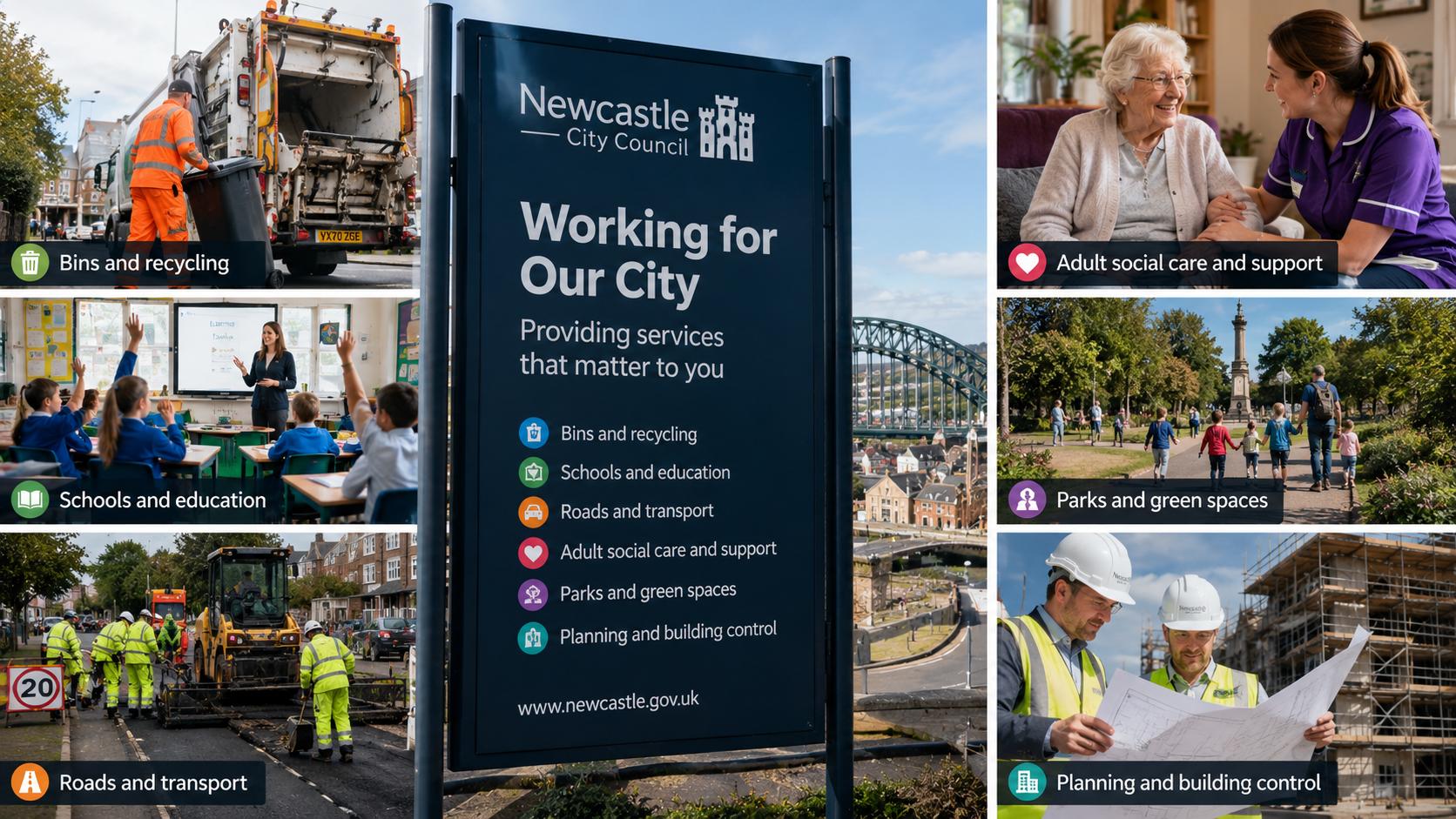
Newcastle City Council is the local authority responsible for delivering a genuinely wide range of essential public services across the city, funded through a combination of council tax, business rates, government grants and various service charges. Understanding exactly what falls under the council's direct responsibility, as opposed to other public bodies, helps residents know precisely who to contact when something specifically needs addressing.
Waste and recycling collection ranks among the council's most visible, day-to-day responsibilities, with Newcastle City Council responsible for household bin collections, recycling schemes, and the operation of local household waste recycling centres across the city. The council also handles street cleaning and the removal of fly-tipped waste from public land, services residents typically only notice when something has gone visibly wrong.
Adult social care represents one of the council's largest and most complex areas of responsibility, covering support for elderly residents, people with disabilities, and other vulnerable adults across Newcastle who require ongoing care and support to live independently and safely. This area of council spending has grown considerably in recent years, reflecting the genuine pressures of an ageing population placing increased demand on local authority care budgets nationally.
Children's services form an equally significant part of the council's remit, encompassing school admissions, education support services, child protection responsibilities, and support for looked-after children across the city. While individual schools are typically run by their own governing bodies or academy trusts rather than directly by the council itself, Newcastle City Council retains genuinely significant statutory responsibilities around overall educational provision and child welfare.
Planning and housing responsibilities give the council direct authority over local planning applications, building regulation enforcement, and various housing services including homelessness support and management of the council's own housing stock. Any resident wanting to object to, or support, a specific local planning application typically does so directly through Newcastle City Council's formal planning department processes.
Roads and transport infrastructure, excluding major trunk roads managed separately by National Highways, generally fall under council responsibility too, including local road maintenance, pothole repairs, street lighting, and Newcastle's public parking provision. Public transport itself, including buses and the Tyne and Wear Metro, is instead coordinated through Nexus, a separate regional transport body operating alongside the city council rather than directly under it.
Libraries, leisure centres, parks and various cultural services also fall under the council's broader remit, alongside crucial public health responsibilities including support for stopping smoking, tackling obesity, and coordinating local responses to public health emergencies, a role that expanded considerably in significance following the responsibilities transferred to local councils under recent public health reforms.
Registration services, covering the official recording of births, deaths and marriages across the city, along with trading standards enforcement and environmental health responsibilities including food hygiene inspections and noise complaint investigations, round out a genuinely broad portfolio of council duties that many residents rarely think about unless they happen to need one of these specific services directly themselves.
Licensing responsibilities also sit with the council, covering everything from pub and restaurant alcohol licences through to taxi licensing and street trading permits, giving Newcastle City Council genuine regulatory oversight over a considerable portion of the city's everyday commercial and hospitality activity, alongside its more visible responsibilities around bins, roads and social care.
Newcastle City Council's overall budget and specific spending priorities are set annually through a formal public process, with elected councillors ultimately voting to approve the council's budget, including that year's council tax rate, following public consultation.
Residents wanting a genuine say in these local spending decisions can engage directly through their local ward councillor or by participating in the council's regular public budget consultation processes. Residents can find a full, detailed breakdown of every specific council service through Newcastle City Council's own official website, which maintains an extensive directory covering each individual department directly.
That directory remains the most reliable single starting point for any resident trying to identify exactly which department handles a specific concern. Understanding this full range of responsibility helps explain exactly why council tax funds so much more than many residents first assume. That genuine breadth is exactly why council tax bills can often feel considerably higher than many residents initially expect them to actually be.
Join the discussion.
Which council service do you personally rely on the most?
Political News
What Does Newcastle City Council Actually Do?
From emptying bins to running schools, Newcastle City Council delivers a genuinely enormous range of everyday services that many residents rarely stop to think about until something goes wrong.
Advertisement


Comments (0)
You must be logged in to post comments.
Don't have an account? Register here
No comments yet. Be the first to share your thoughts!