
The Chartist movement emerged in the late 1830s around a single unifying demand, the People's Charter, which called for universal male suffrage, secret ballots, equal electoral districts and the abolition of property qualifications for MPs. Chartist newspapers originated in Newcastle itself, and week after week the local movement's publications urged working people across Tyneside to rally behind the Charter's six core points of parliamentary reform.
Newcastle quickly developed a reputation as one of the movement's most committed and, to the authorities, most concerning centres of activity. By February 1839, Newcastle had become one of just three areas in the entire country attracting particular attention from the Home Office, driven by genuine suspicion that local Chartists were actively collecting arms in preparation for potential armed insurrection should Parliament reject their demands.
As spring 1839 progressed, large outdoor meetings drew increasingly significant crowds across Tyneside to hear emotionally charged speeches from both local organisers and prominent national Chartist leaders, whose rhetoric grew noticeably more confrontational as the movement's National Petition, ultimately signed by more than 1.25 million people nationwide, moved toward its planned presentation to Parliament that summer.
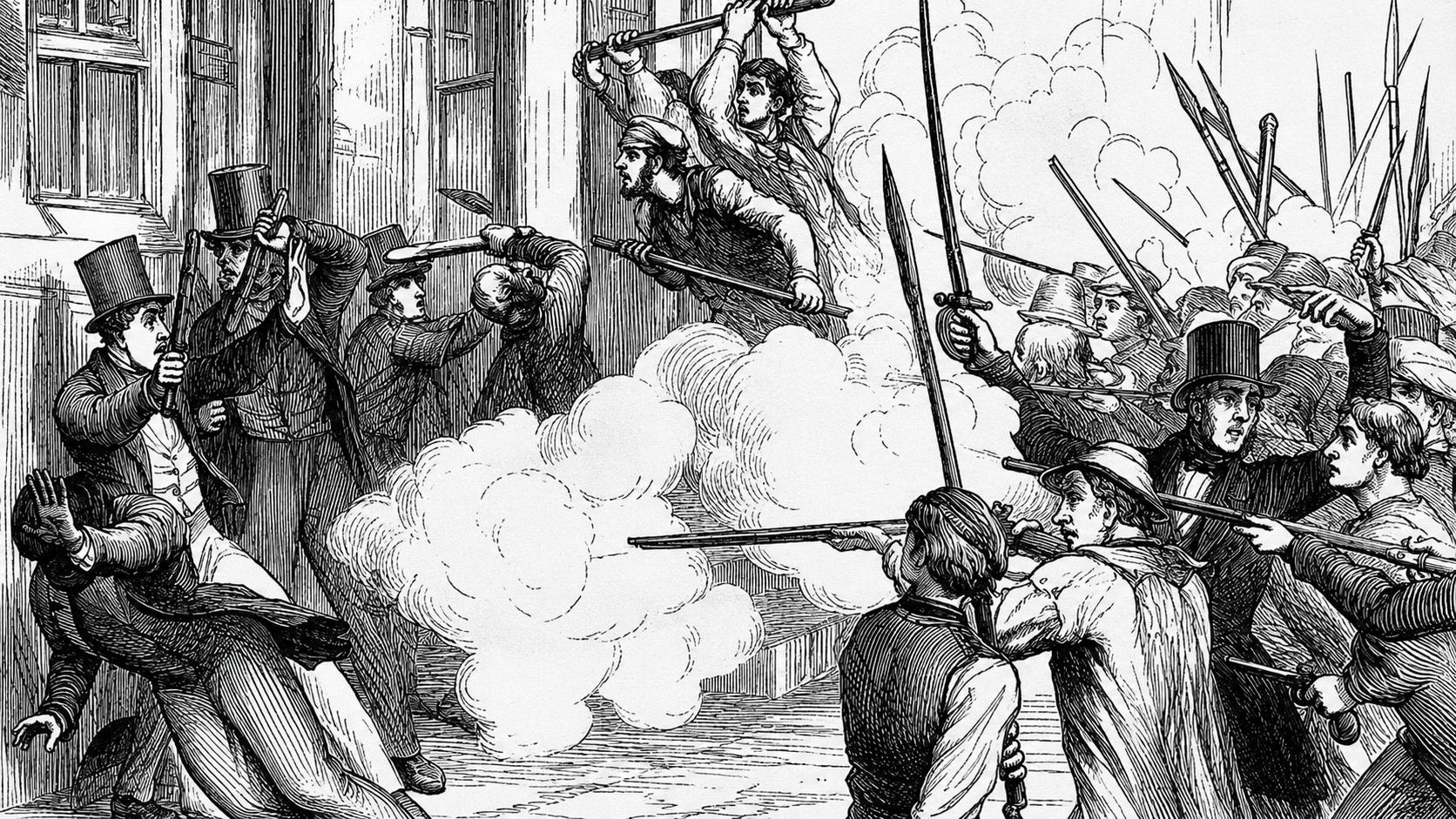
Historical records confirm that in Newcastle specifically, local ironworkers were genuinely manufacturing weapons during this tense period, part of a wider pattern of physical-force preparation reported across several of the movement's most radical strongholds. The national government responded by concentrating troops under the command of Sir Charles Napier at key strategic points across the north of England, including Newcastle, Leeds and Manchester, specifically to deter any attempt at armed uprising.
Parliament's rejection of the National Petition in July 1839, by an overwhelming margin of 235 votes to just 46, provoked genuine anger and unrest across Chartist strongholds nationwide. In South Wales this anger culminated in the Newport Rising that November, where thousands of armed Chartists marched on the town and troops opened fire, killing at least twenty-two people in the bloodiest single confrontation of the entire Chartist period.
Newcastle itself narrowly avoided a similarly violent confrontation. Preparations for a coordinated national uprising had reportedly included Tyneside among several regions expected to rise in support once South Wales delegates gave the signal, with sixty-five delegates said to have gathered in Newcastle specifically to await word from Newport. The rising's swift, bloody defeat in Wales ultimately prevented any comparable armed confrontation from actually breaking out on Tyneside itself.
Following the failed Newport Rising and the government's uncompromising response, Chartism gradually shifted across much of the North East away from talk of physical force and toward what became known as "New Move" Chartism, focusing instead on education, cooperative societies and more gradual, peaceful methods of building working-class political power, a shift reflected in the establishment of reading rooms and mechanics' institutes across Tyneside and Teesside during the early 1840s.
National Chartist leaders touring the country during this period, including figures like Feargus O'Connor, whose newspaper The Northern Star helped spread the movement's message nationwide, were known to come close to openly advocating violence against what they termed the "tyrants" resisting reform, rhetoric that considerably alarmed the authorities and helps explain why Newcastle specifically was placed under such close Home Office observation throughout the spring of 1839.
The military response coordinated by Sir Charles Napier was deliberately calculated rather than purely confrontational, and Napier reportedly invited Chartist leaders to witness demonstrations of artillery firepower specifically to convince them that any attempt at armed uprising would be swiftly and comprehensively crushed, an approach genuinely intended to avoid direct conflict wherever the government could realistically manage to do so.
Although Newcastle never experienced the kind of bloodshed seen at Newport, the sheer scale of arms preparation and Home Office concern focused specifically on the city during 1839 reveals just how close the North East genuinely came to open armed rebellion over democratic reform.
It remains one of the most dramatic, if less widely remembered, chapters in the long North East tradition of popular political agitation for the vote. The suspicion directed at Newcastle specifically by the Home Office in 1839 reflected the city's already well-established reputation, dating back decades, as a genuine centre of radical working-class organisation. That reputation had been building steadily across the region for decades before the events of 1839 finally brought it to a head.
Join the conversation below.
Did you know Newcastle came close to armed rebellion?
Political News
When Newcastle Armed Itself: Inside the 1839 Chartist Uprising
As Parliament rejected the Chartists' demand for democratic reform, Newcastle became one of the few places in Britain where working men genuinely began arming themselves for open rebellion.
Advertisement


Comments (0)
You must be logged in to post comments.
Don't have an account? Register here
No comments yet. Be the first to share your thoughts!