
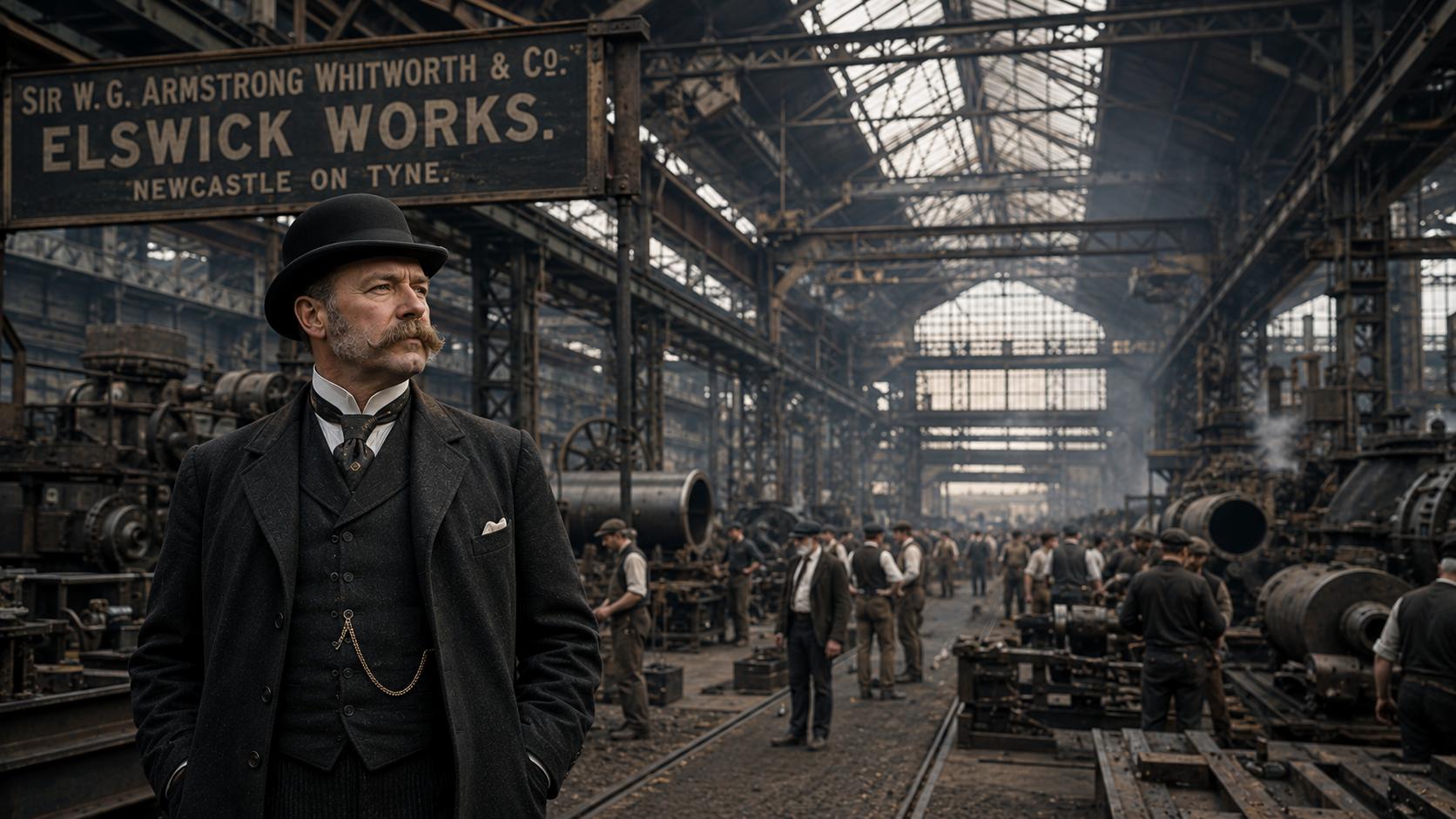
In the nineteenth century, a stretch of riverbank to the west of Newcastle became one of the great industrial powerhouses of the world. The Elswick Works, founded by the engineer and inventor William Armstrong, grew into a colossal enterprise that built cranes, bridges, machinery, ships and armaments, employing tens of thousands of people and carrying the name of Tyneside across the globe. The story of Armstrong's empire is one of extraordinary ambition, technical genius and the transformation of Newcastle into a centre of heavy engineering.
The Genius of William Armstrong.
William George Armstrong was born in Newcastle in 1810 and trained as a solicitor before his fascination with engineering took over his life. While still working in the law, he invented a hydraulic crane that revolutionised the moving of heavy loads on docks and in warehouses, harnessing the power of water pressure to perform work that had previously required enormous effort. Recognising the potential of his invention, Armstrong abandoned his legal career and dedicated himself to engineering, establishing the Elswick Works on the banks of the Tyne in 1847 to manufacture his hydraulic machinery, cranes and bridges.
Hydraulic Power Transforms Industry.
Armstrong's hydraulic technology transformed industry around the world. His cranes, dock machinery, hoists and lifting platforms applied the power of water pressure to tasks of every kind, and his inventions, including the hydraulic accumulator, extended the reach of his machinery even further. Elswick-built equipment was installed across Britain and beyond, and Armstrong's hydraulics later powered famous structures including the mechanism of London's Tower Bridge. The works grew rapidly, expanding from a few hundred workers to many thousands within a short space of time as demand for its products soared.
From Cranes to Cannon.
The Elswick Works soon expanded into a very different field. Armstrong developed a revolutionary breech-loading gun that re-equipped the British Army after the Crimean War, and the manufacture of artillery became a major part of the business. To avoid a conflict of interest while Armstrong served the government, a separate ordnance company was established. The works went on to supply armaments to navies and armies around the world, and the production of guns led naturally to an interest in warships, with Elswick becoming one of the few places on earth capable of building, arming and equipping a warship entirely on a single site.
The Swing Bridge and the River.
A striking symbol of Armstrong's power and ingenuity was the Swing Bridge across the Tyne, opened in the 1870s and operated by his own hydraulic technology. The bridge was built to allow warships and other large vessels to pass upriver to the Elswick yards, and its construction reshaped the river to serve the needs of the great works. The shipyard at Elswick eventually extended for more than a mile along the riverbank, and the sight of warships being fitted out on the Tyne became a powerful emblem of the industrial might that Armstrong had created in the heart of Newcastle.
A Global Enterprise.
Through a series of mergers, Armstrong's business grew into one of the largest heavy engineering and manufacturing companies in the world. It combined with the shipbuilding firm of Charles Mitchell and later with the engineering company of Joseph Whitworth, becoming the famous Armstrong Whitworth concern. At its peak the company built armaments, ships, locomotives, motor vehicles and aircraft, a breathtaking range of products that reflected the scale of its ambition. Tyneside had become a centre of global engineering, and the name of Armstrong was known wherever industry and warships were to be found.
An Employer and a Benefactor.
The Elswick Works was a vast employer, providing work for huge numbers of people and shaping the communities of west Newcastle. Armstrong himself became immensely wealthy and used his fortune generously, giving to the city and the region in many ways and supporting public institutions and education. He was a pioneer of renewable power as well, famously using hydroelectricity at his country house, and his combination of engineering brilliance and public-spirited generosity made him one of the most significant figures in the history of the North East.
A Lasting Mark on the Region.
Although the great works eventually declined along with the wider heavy industries of the region, the mark that Armstrong left on Tyneside is indelible. The Elswick Works helped to make Newcastle a city of engineering and industry, and the legacy of Armstrong's inventions and enterprises can still be traced in the landscape, the institutions and the identity of the region. His story is a reminder that a single individual's genius and drive can transform a place, and that the North East was once home to one of the most powerful engineering empires the world had ever seen.
A Controversial Trade.
The armaments side of Armstrong's empire was, then as now, a subject that invited reflection. The Elswick Works supplied guns and warships to nations around the world, and Armstrong's weapons could be found in the arsenals of many countries.
In one striking and much-noted episode, the works supplied arms to both sides during a major foreign conflict, a fact that drew considerable attention and illustrated the global reach of the company's trade.
The manufacture of weapons made Armstrong and his region wealthy, and it provided employment for vast numbers of people, yet it also tied the fortunes of Tyneside to the business of war in ways that later generations have viewed with mixed feelings. Understanding this dimension of the Elswick story is part of understanding the full history of the works and the age in which they flourished.
The Victorian era was one of intense industrial and imperial competition, and arms manufacture was a major industry in which Britain led the world. Armstrong's enterprise reflected the realities and the moral complexities of that time, and a full account of his achievements must acknowledge this aspect of an extraordinary and far-reaching industrial empire.
Share your thoughts.
Armstrong's Elswick Works made Newcastle a centre of engineering known across the world.
Do you think Armstrong's industrial legacy still impacts Newcastle today?
Business News
Lord Armstrong's Elswick Works: A Tyneside Engineering Empire
How William Armstrong's Elswick Works grew into a global engineering empire building cranes, hydraulics, bridges, warships and armaments on the Tyne.
Advertisement





Comments (0)
You must be logged in to post comments.
Don't have an account? Register here
No comments yet. Be the first to share your thoughts!